
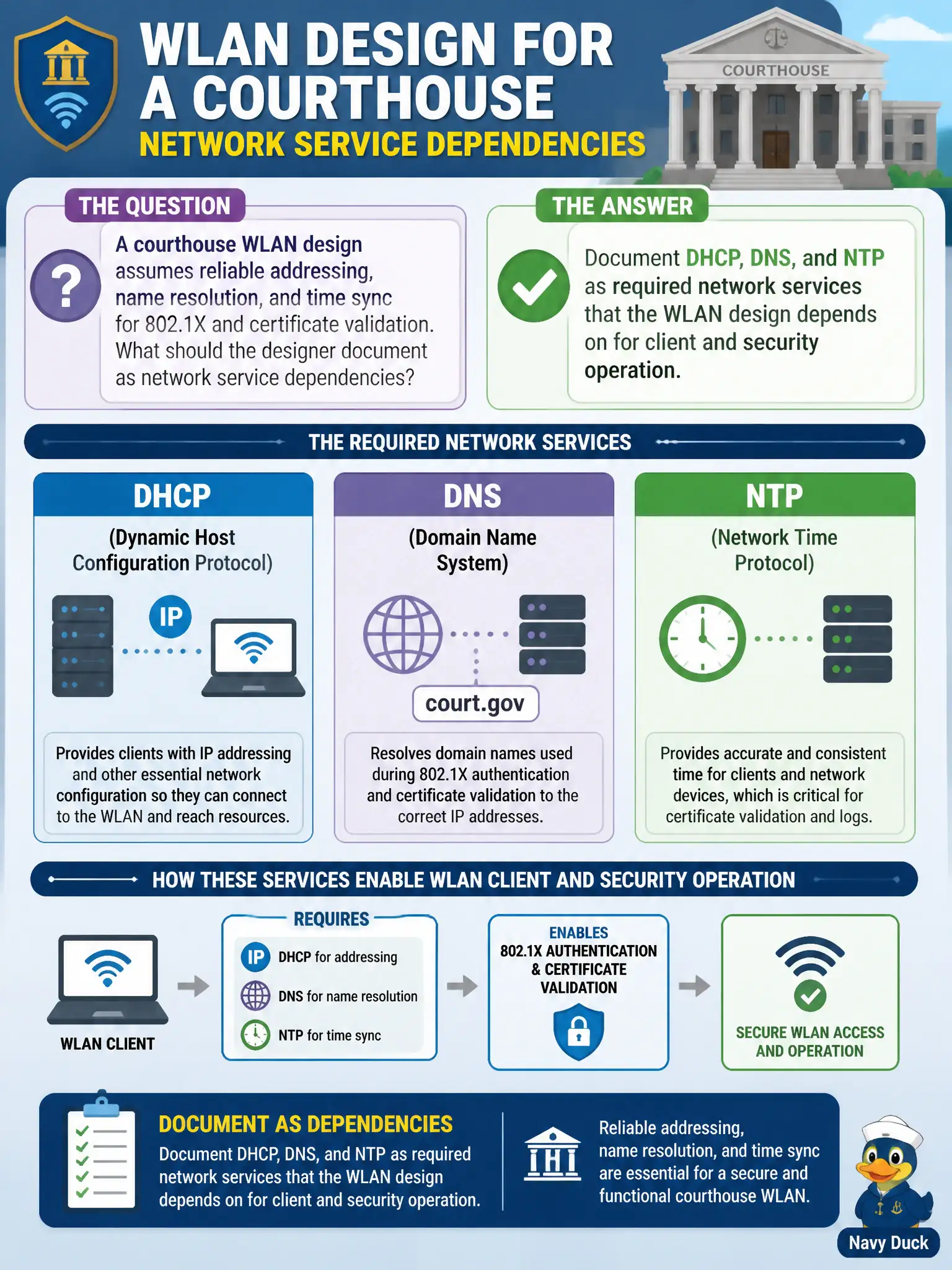
A courthouse WLAN design assumes reliable addressing, name resolution, and time sync for 802.1X and certificate validation. What should the designer document as network service dependencies?
Select an answer to reveal the explanation.
Short Explanation
Pretty RF will not fix a broken DHCP scope or skewed clocks that kill certificates. Write DHCP, DNS, and NTP into the design as first-class dependencies.
Full Explanation
802.1X and certificate validation depend on addressing, name resolution, and accurate time—not RF alone. For a courthouse WLAN that assumes reliable DHCP, DNS, and NTP for client and security operation, the designer should document those as required network service dependencies. Missing NTP alone can break certificate checks; missing DHCP or DNS breaks join and AAA reachability even when RSSI looks excellent.
Documenting only decorative DNS names for SSIDs with no DHCP or NTP planning fails by concept: SSID labels are not service dependency design. Assuming clients will use link-local addressing forever so DHCP is optional fails by concept: enterprise services and AAA paths need proper addressing. Replacing DHCP, DNS, and NTP requirements with a note that RF alone guarantees join success fails by concept: strong RF cannot substitute for broken infrastructure services.
Exam caveat: CWNE designs explicitly call out DHCP, DNS, and NTP dependencies for enterprise security joins in civic buildings.
Operational check: Verify DHCP scopes, DNS resolution to AAA and certificate-status endpoints, and NTP stratum for APs and clients in the courthouse; include those checks in acceptance and runbooks.