
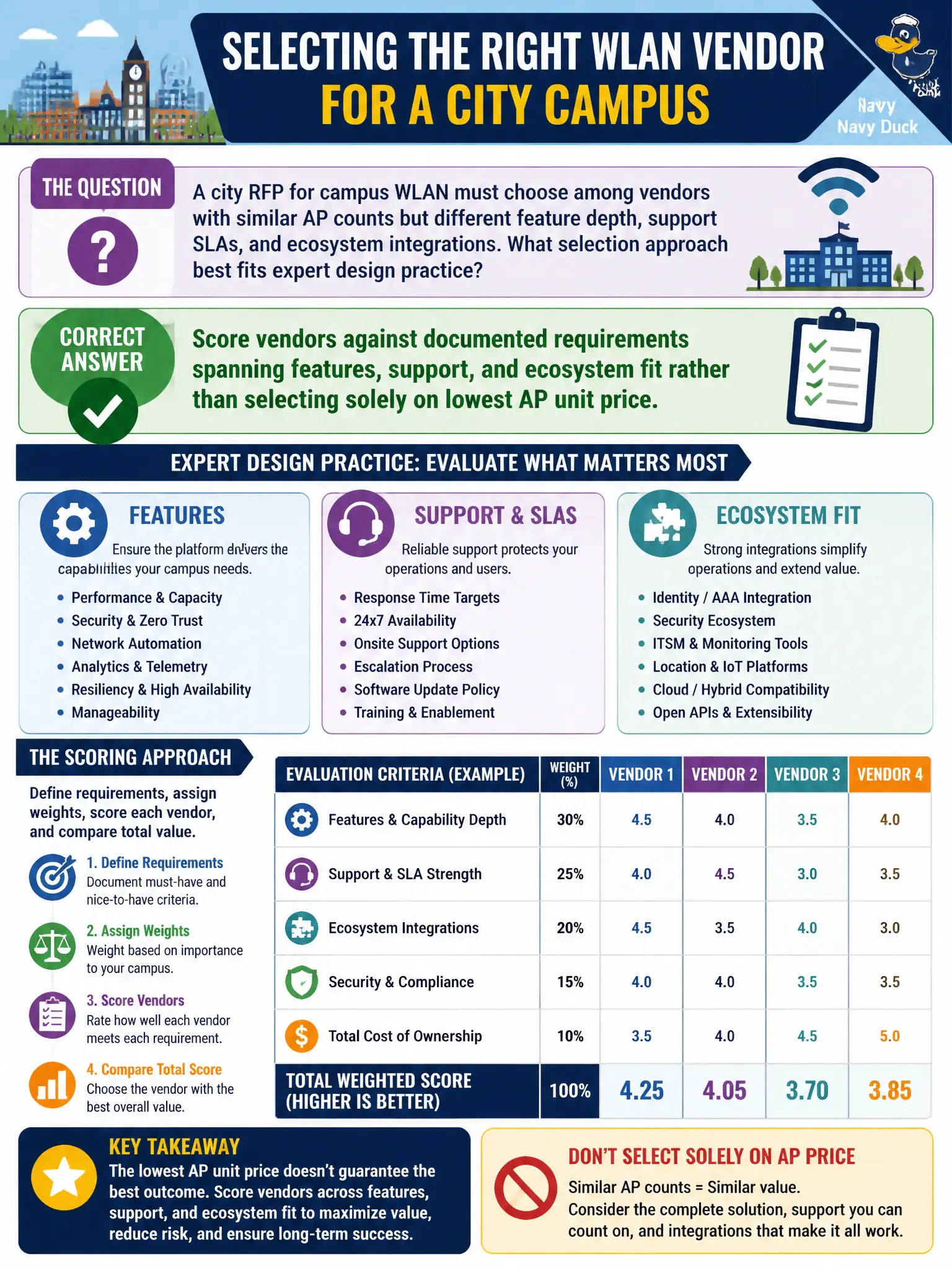
A city RFP for campus WLAN must choose among vendors with similar AP counts but different feature depth, support SLAs, and ecosystem integrations. What selection approach best fits expert design practice?
Select an answer to reveal the explanation.
Short Explanation
Cheapest AP price is a trap if support and ecosystem collapse on day two. Score the RFP against real requirements—features, support, fit—then buy.
Full Explanation
Expert vendor selection scores against documented requirements spanning features, support SLAs, and ecosystem integrations—not sticker price alone. When a city RFP for campus WLAN sees similar AP counts but different feature depth, support, and integrations, scoring vendors on those documented requirements best fits expert design practice. Lowest AP unit price can win a race to an unsupportable or poorly integrated civic network.
Awarding only on the cheapest AP sticker price and ignoring support and integrations fails by concept: lifecycle operations and ecosystem fit dominate total value. Picking the vendor whose marketing brochure has the most colorful heatmaps fails by concept: marketing art is not scored technical evidence. Deferring all selection criteria until after APs are purchased and installed fails by concept: selection must precede buy to avoid lock-in without requirements fit.
Exam caveat: CWNE procurement judgment uses weighted requirements matrices, not price-only or brochure aesthetics.
Operational check: Publish a scored RFP matrix covering features, support SLA, and ecosystem integrations, evaluate proposals against it, and record the award rationale before issuing purchase orders.