
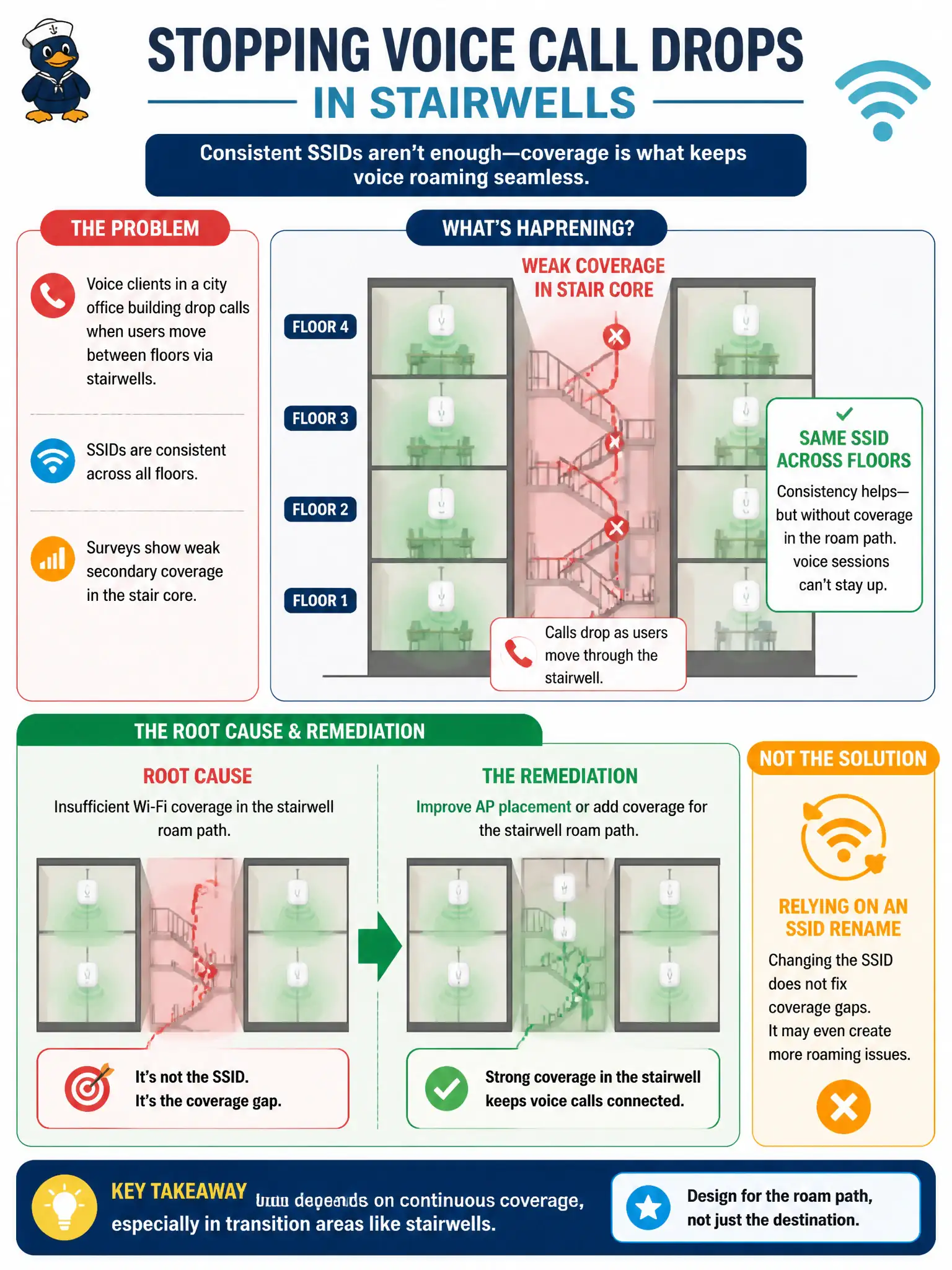
Voice clients in a city office building drop calls when users move between floors via stairwells, even though SSIDs are consistent. Surveys show weak secondary coverage in the stair core. What remediation addresses the root cause?
Select an answer to reveal the explanation.
Short Explanation
Roam gaps are RF geography problems. Renaming the SSID will not put signal in the stairwell. Place or add APs so voice can hand off where people actually walk.
Full Explanation
Voice drops in stairwells with consistent SSIDs but weak secondary coverage are RF roam-path failures. Remediation should improve AP placement or add coverage for the stairwell roam path instead of relying on an SSID rename. Softphones need overlapping RSSI and SNR along the vertical path so timely roam can succeed between floors in a city office building. Renaming SSIDs cannot invent that secondary coverage.
Renaming the SSID on each floor so clients forget previous APs fails by concept: renaming breaks seamless identity and does not create stairwell RF. Disabling all security so reassociation is faster fails by concept: removing security does not fix missing secondary coverage and violates municipal policy. Forcing all voice clients onto 2.4 GHz only for stairwell travel fails by concept: dumping voice onto congested 2.4 GHz is not a substitute for a designed roam path.
Exam caveat: CWNE voice roam issues are usually coverage geometry on the path, not SSID cosmetics.
Operational check: Survey the stair core for secondary AP coverage at voice SNR targets, add or relocate APs to create overlap between floors, and retest softphone roam while walking the stairs with active calls.