
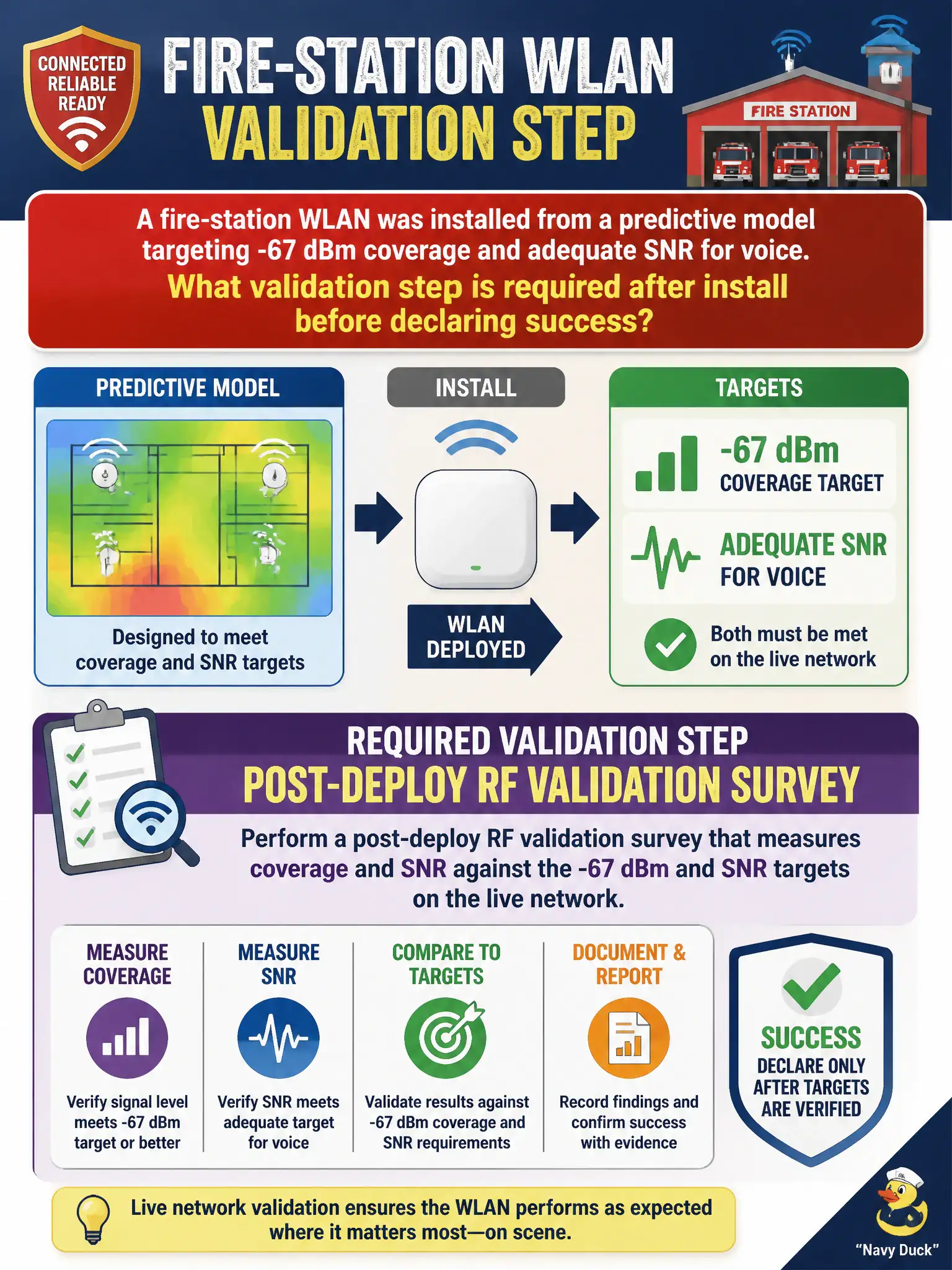
A fire-station WLAN was installed from a predictive model targeting -67 dBm coverage and adequate SNR for voice. What validation step is required after install before declaring success?
Select an answer to reveal the explanation.
Short Explanation
Pretty predictive greens are not a receipt. After the fire-station APs are up, walk it with real measurements against -67 dBm and SNR. That is when you know voice coverage is real.
Full Explanation
Predictive targets are hypotheses until measured on the live network. After a fire-station WLAN is installed from a model targeting −67 dBm coverage and adequate SNR for voice, success requires a post-deploy RF validation survey that measures coverage and SNR against those targets on the live network. Predictive green is not acceptance, and as-built aiming or attenuation often differs from the model enough to break voice in apparatus bays and dorms.
Accepting predictive heatmaps as final proof without on-site measurements fails by concept: models diverge from as-built attenuation and aiming. Only pinging the default gateway from one kitchen desktop fails by concept: a single ping does not validate station-wide coverage or voice SNR. Increasing all AP power settings until the predictive tool shows green again fails by concept: cranking power without measurement can worsen CCI and still skips validation.
Exam caveat: CWNE acceptance separates predictive design from post-deploy RF validation against numeric targets.
Operational check: Walk the fire station with a calibrated survey client, map RSSI and SNR against −67 dBm and voice SNR goals, open tickets for nulls, and sign RF acceptance only after remediation.