
After APs are mounted in a museum gallery that forbids visible antennas and requires exact downtilt, what installation QA should the city WLAN team perform before acceptance?
Select an answer to reveal the explanation.
Short Explanation
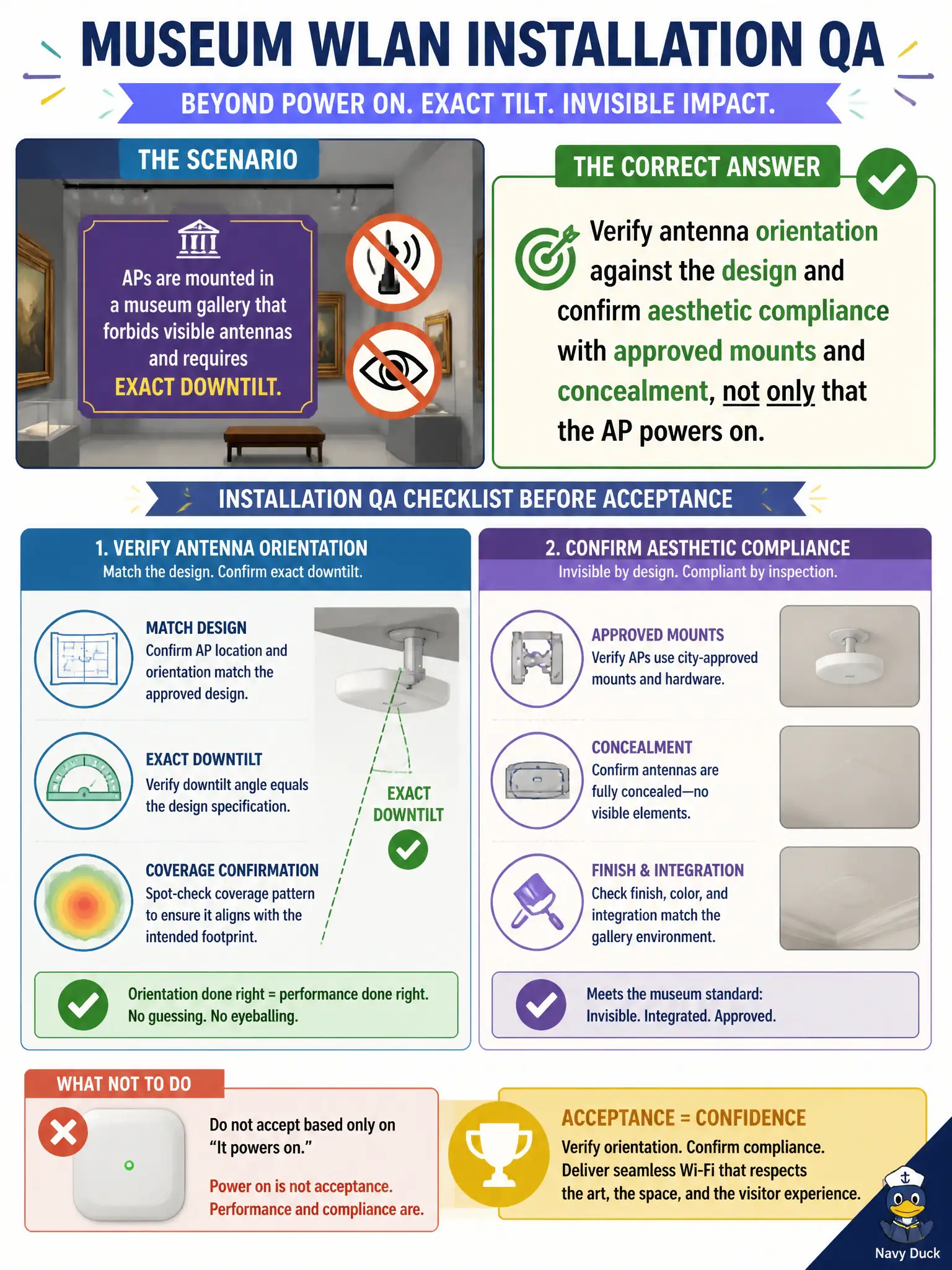
Power LEDs do not equal a good install. In a museum, wrong downtilt or a visible cable run can fail both RF and aesthetics. Check orientation and concealment against the design before you sign.
Full Explanation
Museum installs that forbid visible antennas and require exact downtilt need physical QA beyond a powered LED. Before acceptance, the city WLAN team should verify antenna orientation against the design and confirm aesthetic compliance with approved mounts and concealment, not only that the AP powers on. Wrong aim or visible cabling fails both RF performance and facilities requirements even when the Ethernet link light is green. Civic galleries often fail acceptance on aesthetics as quickly as on RSSI.
Accepting any powered AP regardless of aim or visible cabling fails by concept: power-on does not equal design-compliant RF or aesthetics. Skipping physical QA in favor of a pre-install predictive heatmap fails by concept: predictive prints do not prove as-built orientation. Measuring only WAN latency from the museum office switch fails by concept: WAN latency does not validate antenna aim or concealment at the gallery mounts.
Exam caveat: Installation QA for constrained civic spaces includes orientation and aesthetics as acceptance criteria alongside basic reachability.
Operational check: Use an acceptance checklist for gallery AP downtilt and azimuth versus design, photograph concealment compliance, remediate deviations, then proceed to RF validation surveys.