
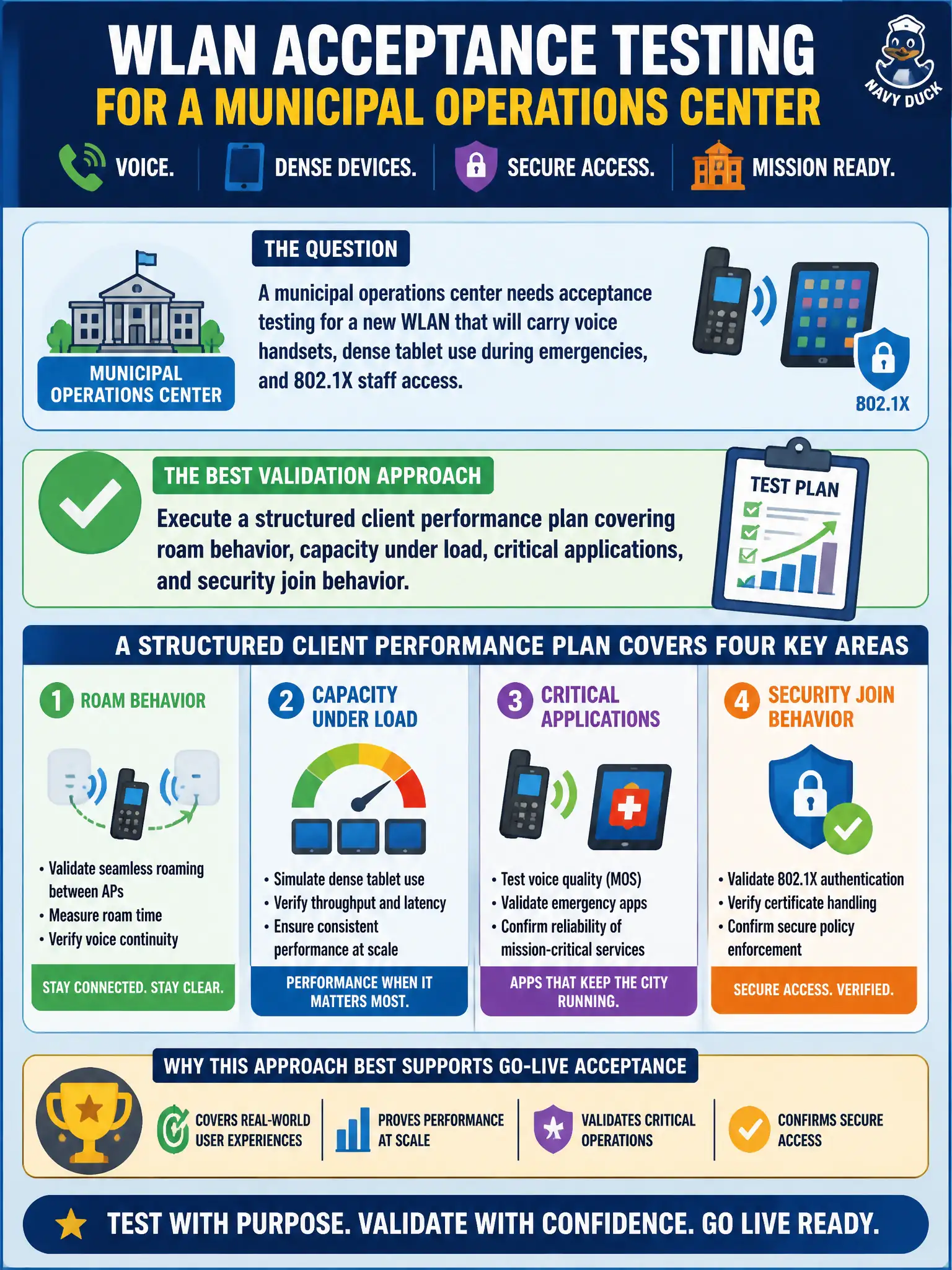
A municipal operations center needs acceptance testing for a new WLAN that will carry voice handsets, dense tablet use during emergencies, and 802.1X staff access. Which validation approach best supports go-live acceptance?
Select an answer to reveal the explanation.
Short Explanation
“It browsed once” is not acceptance for an ops center. You need roam, capacity, real apps, and security joins on the checklist—or incident day becomes your test lab.
Full Explanation
Complex municipal operations-center WLANs need structured acceptance testing across roam, capacity, applications, and security—not a single website check. For a new WLAN carrying voice handsets, dense emergency tablets, and 802.1X staff access, the best go-live approach is a structured client performance plan covering roam behavior, capacity under load, critical applications, and security join behavior. That plan produces evidence stakeholders can accept before declaring the network ready for emergencies.
Confirming that one laptop can open a public website then signing off fails by concept: one browse test ignores voice, roam, density, and 802.1X. Testing only DHCP and ignoring roaming or application behavior fails by concept: address assignment is necessary but far from sufficient for emergency operations. Relying exclusively on AP association counts in the GUI fails by concept: association count is not performance, roam quality, or security validation.
Exam caveat: CWNE validation planning matches test depth to application mix and risk of the municipal use case.
Operational check: Execute a written test plan with roam timing, multi-client load, voice and tablet application checks, and 802.1X failure injection; record pass/fail before authorizing operations-center go-live.