
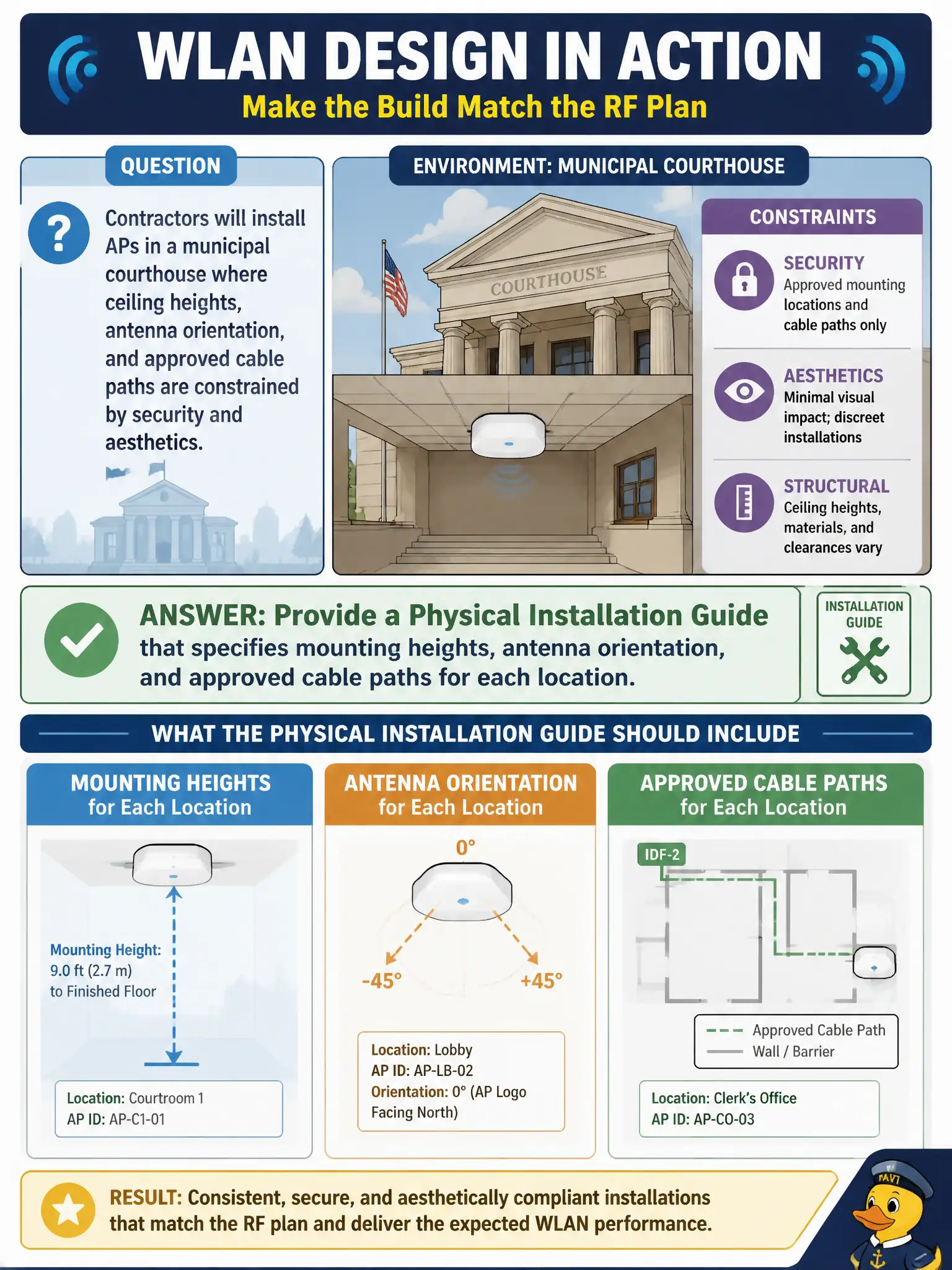
Contractors will install APs in a municipal courthouse where ceiling heights, antenna orientation, and approved cable paths are constrained by security and aesthetics. What documentation should the WLAN designer provide so the build matches the RF plan?
Select an answer to reveal the explanation.
Short Explanation
RF drawings without build instructions invite creative installers. Heights, aim, and cable paths have to be written down so the courthouse gets the design you modeled—not whatever fit the ladder that day.
Full Explanation
Constrained courthouse installs need written physical instructions so contractors do not invent mounts that break RF or security rules. The WLAN designer should provide a physical installation guide that specifies mounting heights, antenna orientation, and approved cable paths for each location so the build matches the RF plan under aesthetic and security constraints. Channel plans alone leave too much improvisation on the ladder.
Providing only a channel plan PDF with no physical placement or cabling instructions fails by concept: channels do not tell installers where and how to mount. A verbal briefing to the lowest bidder with no written build criteria fails by concept: verbal-only guidance is not auditable and drifts across crews. A guest Wi-Fi FAQ for the public that omits contractor details fails by concept: public FAQs are not installation work packages.
Exam caveat: CWNE deployment documentation includes physical install guides when mounting is constrained by security and aesthetics.
Operational check: Issue per-location mounting height, antenna aim, and cable-path sheets for the courthouse, walk a pilot location with the contractor, and require photo evidence against the guide before acceptance.