
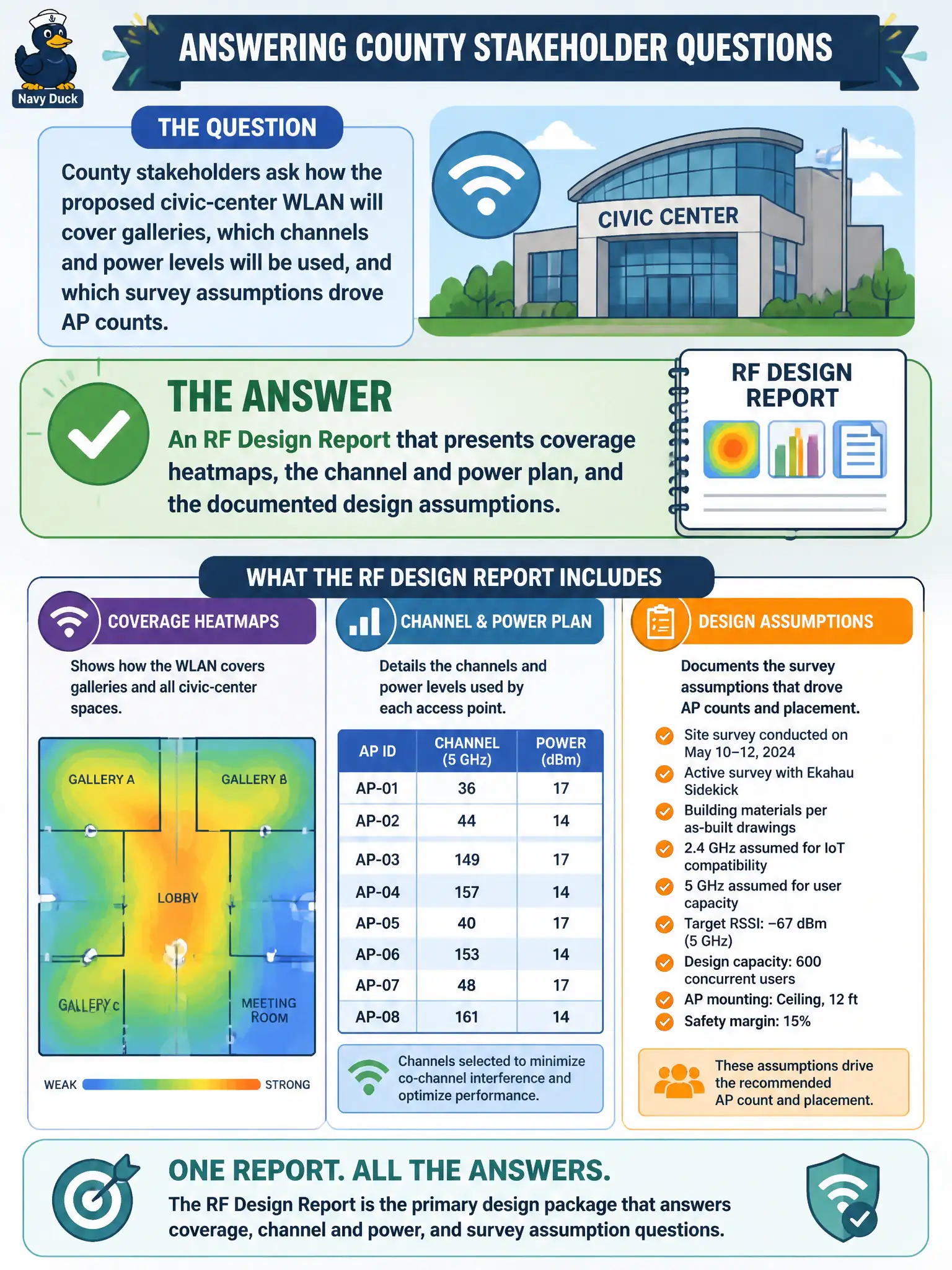
County stakeholders ask how the proposed civic-center WLAN will cover galleries, which channels and power levels will be used, and which survey assumptions drove AP counts. Which deliverable should answer those questions as the primary design package?
Select an answer to reveal the explanation.
Short Explanation
Stakeholders do not want a price list dressed up as engineering. They need heatmaps, channels, power, and the assumptions behind the AP count. That package is the RF Design Report.
Full Explanation
Stakeholders asking about gallery coverage, channels and power, and survey assumptions need an RF Design Report—not a price quote. For the civic-center WLAN, the primary design package that answers those questions is an RF Design Report presenting coverage heatmaps, the channel and power plan, and documented design assumptions. That package is how county stakeholders validate intent before build and how installers know what "done" means for RF.
A single SSID naming spreadsheet with no RF maps or channel plan fails by concept: naming does not explain coverage or interference design. A vendor quote listing AP prices without coverage or interference analysis fails by concept: cost alone is not an RF design package. An installer packing list of cable lengths and patch ports fails by concept: cabling logistics are necessary but do not answer coverage, channel, or assumption questions.
Exam caveat: CWNE communication and deliverable items identify the RF Design Report as the stakeholder-facing design artifact.
Operational check: Assemble civic-center heatmaps, channel/power tables, and assumption notes into one RF Design Report, review it with stakeholders, and baseline that document for installation QA.