
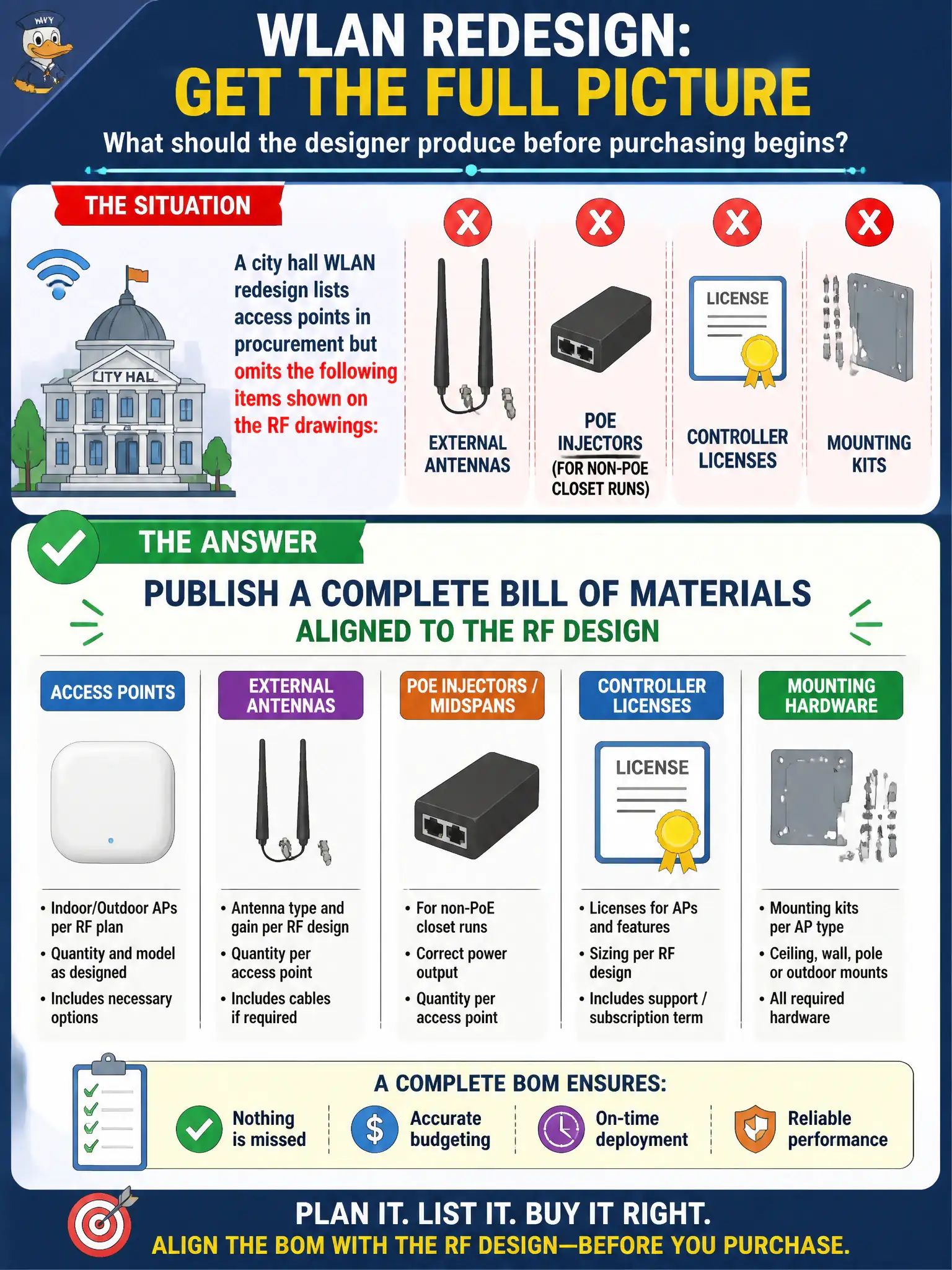
A city hall WLAN redesign lists access points in procurement but omits external antennas, PoE injectors for non-PoE closet runs, controller licenses, and mounting kits shown on the RF drawings. What should the designer produce before purchasing begins?
Select an answer to reveal the explanation.
Short Explanation
APs alone do not make a WLAN. If antennas, power, licenses, and mounts are not on the list, the city will stall in a half-built closet. The BoM has to match the RF design, not just the shiny AP part number.
Full Explanation
Procurement must buy everything the RF drawings assume—not only AP chassis SKUs. When a city hall redesign lists APs but omits external antennas, PoE injectors for non-PoE closet runs, controller licenses, and mounting kits shown on the drawings, the designer should publish a complete bill of materials aligned to the RF design that includes APs, antennas, injectors or midspans, licenses, and mounting hardware before purchasing begins. Incomplete BoMs create install stops, aiming compromises, and change orders mid-project.
Ordering only AP SKUs and assuming facilities will improvise mounts and power fails by concept: improvisation breaks RF aiming and power design. Shipping a marketing brochure of accessories without quantities tied to the RF design fails by concept: brochures are not quantity-controlled BoMs. Deferring accessory lists until installers report gaps on the first floor fails by concept: discovery-by-shortage delays the municipal cutover.
Exam caveat: CWNE deliverables include a design-aligned BoM covering RF-critical accessories and licenses.
Operational check: Walk the city hall RF drawings line by line into a BoM covering AP, antenna, mount, injector or midspan, and license; peer-review quantities against IDF PoE reality; and release purchasing only after that package is complete.