
Two fire stations need a wireless bridge for shared CAD traffic in addition to indoor WLAN. What extra design work is required?
Select an answer to reveal the explanation.
Short Explanation
A rooftop bridge isn’t the same homework as hallway coverage—you need link budget, Fresnel clearance, and antennas aimed at the other station. Indoor heat maps don’t certify a street-crossing hop. Powerline across the road isn’t a fire-grade backhaul plan.
Full Explanation
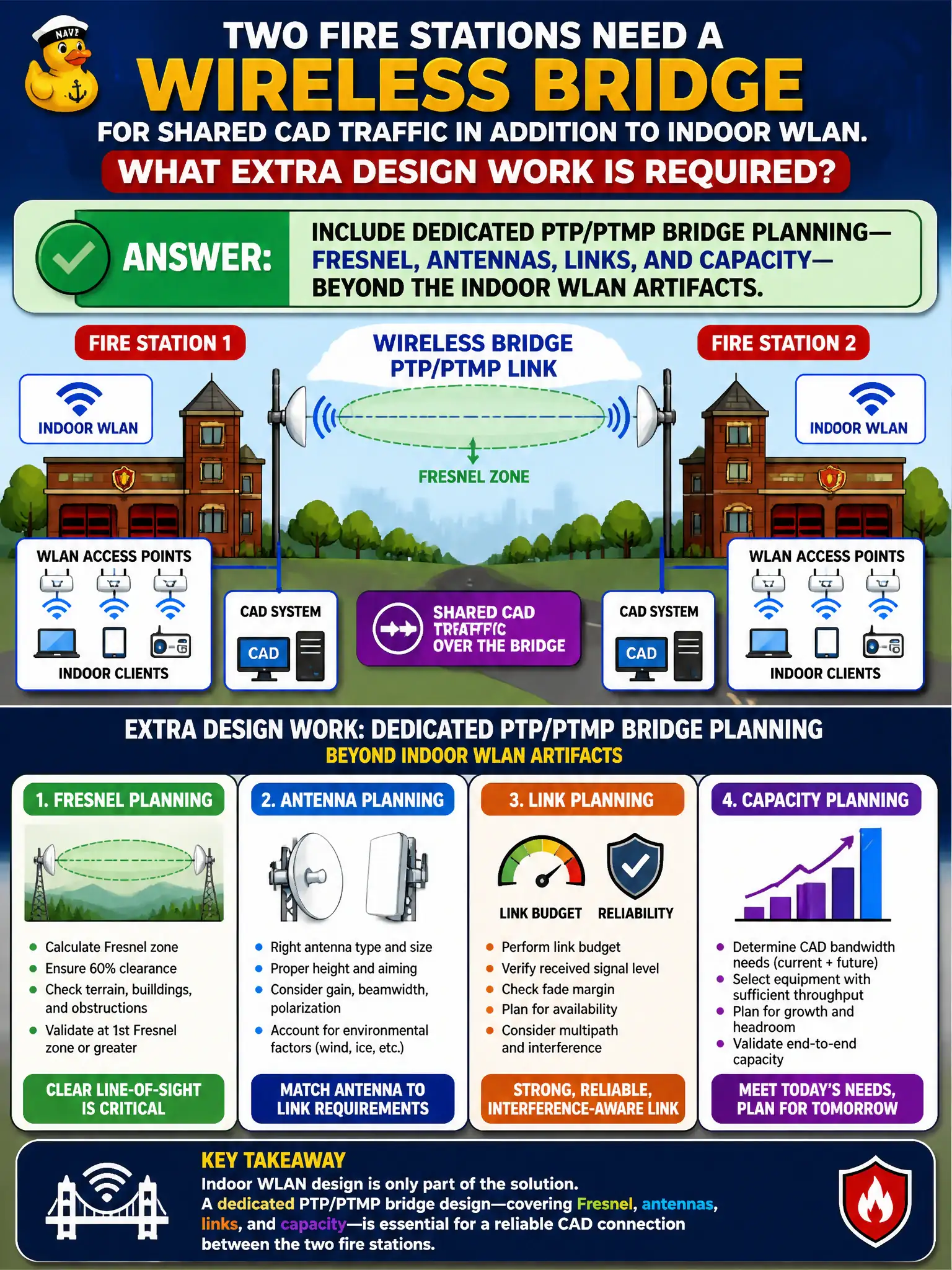
Indoor WLAN artifacts do not replace outdoor bridge engineering. When two fire stations need a wireless bridge for shared CAD traffic in addition to indoor WLAN, the designer must include dedicated PTP/PTMP bridge planning—Fresnel clearance, antennas, link budget, and capacity—beyond indoor heatmaps. CAD backhaul SLA depends on that engineered bridge path, not on omni indoor cells aimed at offices. Treating the bridge as an afterthought leaves emergency data on an unvalidated hop.
Reusing the indoor omni AP heat map as the sole bridge path analysis fails by concept: indoor coverage maps do not model outdoor Fresnel zones or directional link budgets. Assuming any indoor mesh automatically meets fire-station backhaul SLA fails by concept: mesh hop characteristics differ from engineered PTP capacity and availability targets. Replacing bridging with consumer powerline adapters across the public street fails by concept: powerline does not span separate buildings across a street as municipal CAD backhaul.
Exam caveat: Specialty municipal backhaul is a distinct design workstream from indoor RF plans.
Operational check: Survey the fire-station path for Fresnel obstacles, select antennas and channels for the CAD capacity target, calculate fade margin, and document the bridge design separately from indoor AP drawings.