
Wi-Fi 6E APs with USB accessories will hang on older municipal access switches. What infrastructure check belongs in the design?
Select an answer to reveal the explanation.
Short Explanation
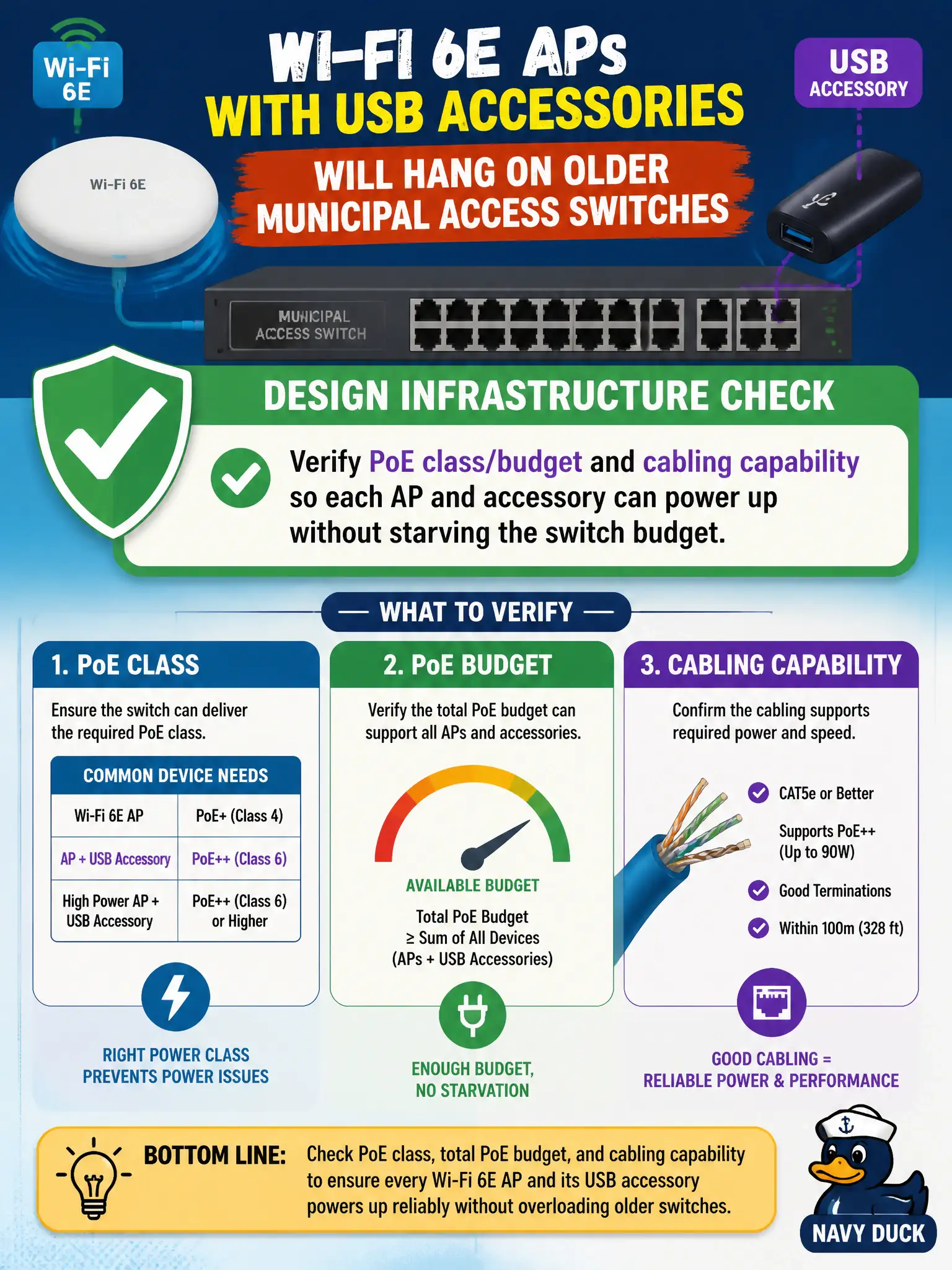
Modern APs are hungry, and USB add-ons make them hungrier—count watts on those older switches before install day. A pretty heat map doesn’t feed PoE. Hoping Fast Ethernet magically becomes UPOE is how APs brown out.
Full Explanation
Wi-Fi 6E APs plus USB accessories raise PoE class and budget needs that older municipal access switches may not meet. The design must verify PoE class/budget and cabling capability so each AP and accessory can power up without starving the switch budget—including cable category and length limits for the intended power class. Green predictive heatmaps do not deliver watts to the radio. Underpowered ports produce flaky boots and disabled USB accessories that look like RF faults.
Assuming all Fast Ethernet PoE ports deliver UPOE automatically fails by concept: port class and switch budget are explicit capabilities, not automatic upgrades. Powering APs from client USB-C chargers instead of the switch fails by concept: that is not a standards-based AP power architecture for production municipal WLAN. Ignoring PoE math if the predictive heatmap looks green fails by concept: RF prediction does not validate powered infrastructure.
Exam caveat: CWNE infrastructure readiness includes PoE budget math for modern APs and accessories before procurement.
Operational check: Sum AP and accessory PoE draw per IDF, compare to switch budget and port class, upgrade switches or cabling where short, and boot a pilot 6E AP with accessories under load before mass rollout.