
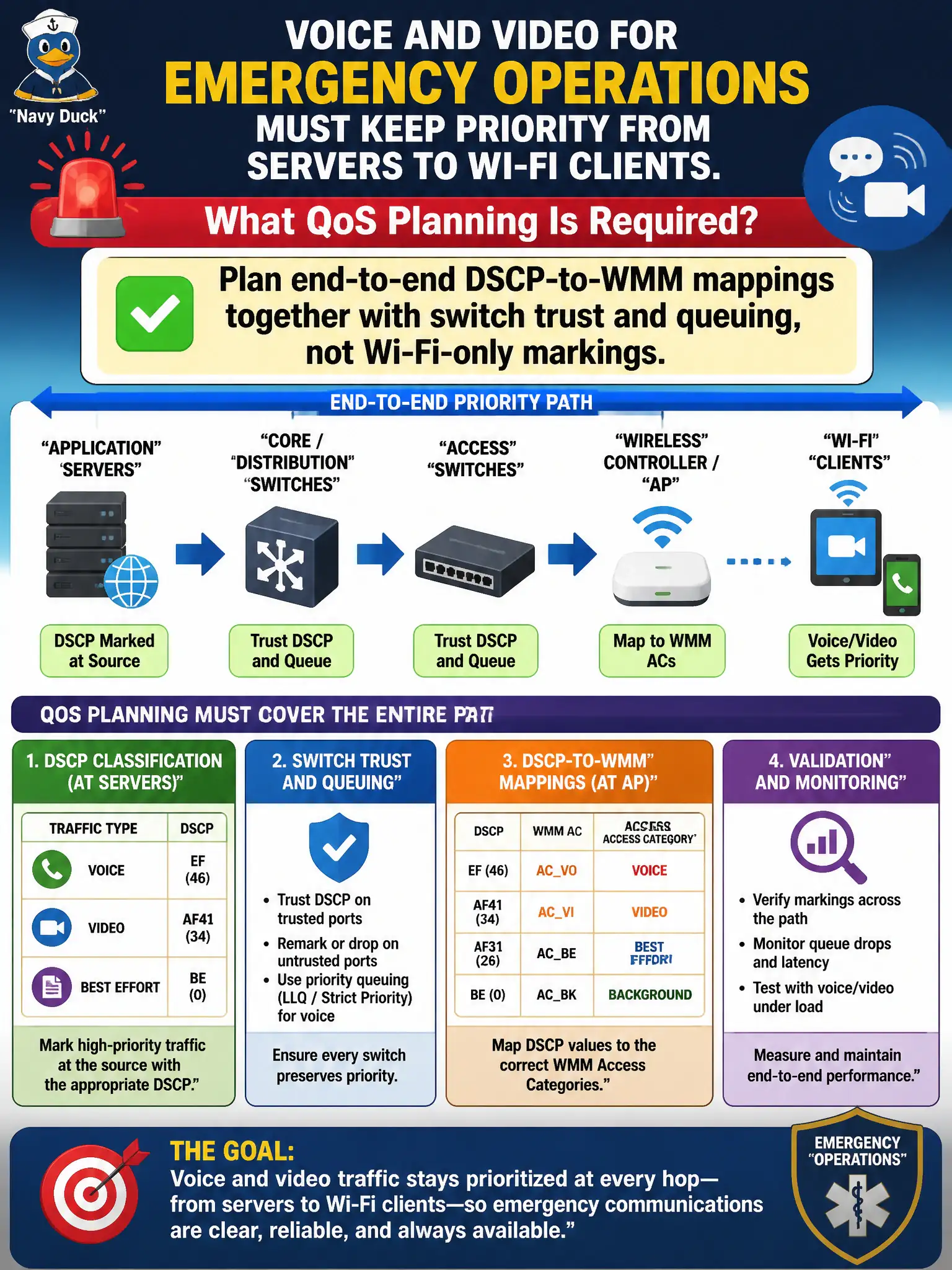
Voice and video for emergency operations must keep priority from servers to Wi-Fi clients. What QoS planning is required?
Select an answer to reveal the explanation.
Short Explanation
QoS is a relay race—if the switch drops the baton, fancy WMM on the AP won’t save the call. Map DSCP to WMM end to end and make the wired gear trust those marks. Putting backups in the voice queue just lets the dump truck into the HOV lane.
Full Explanation
Emergency voice and video need priority preserved from application servers through campus switches to Wi-Fi clients. QoS planning must include end-to-end DSCP-to-WMM mappings together with switch trust and queuing, not Wi-Fi-only markings that get remarked or ignored upstream. Without wired trust and consistent classification, WMM voice/video queues see best-effort arrivals and emergency media loses priority before the AP ever schedules airtime. Municipal emergency operations centers fail this when only the WLAN profile is tagged.
Marking frames only on the wireless side and ignoring switch DSCP trust fails by concept: upstream unmarked or untrusted hops flatten priority before air. Using WMM voice queues for all traffic including bulk backups fails by concept: stuffing everything into voice destroys differentiation and starves true voice. Disabling Differentiated Services so every hop treats packets equally fails by concept: that erases the end-to-end priority emergency operations require.
Exam caveat: CWNE QoS items are end-to-end; Wi-Fi WMM alone is insufficient when switches remark or ignore DSCP.
Operational check: Trace DSCP from the emergency media servers through switch trust policies to AP WMM access categories, generate a test voice/video flow, and confirm queue counters and latency under competing bulk load.