
What pre-design activity should a municipal WLAN team run to discover incumbents before finalizing a channel plan?
Select an answer to reveal the explanation.
Short Explanation
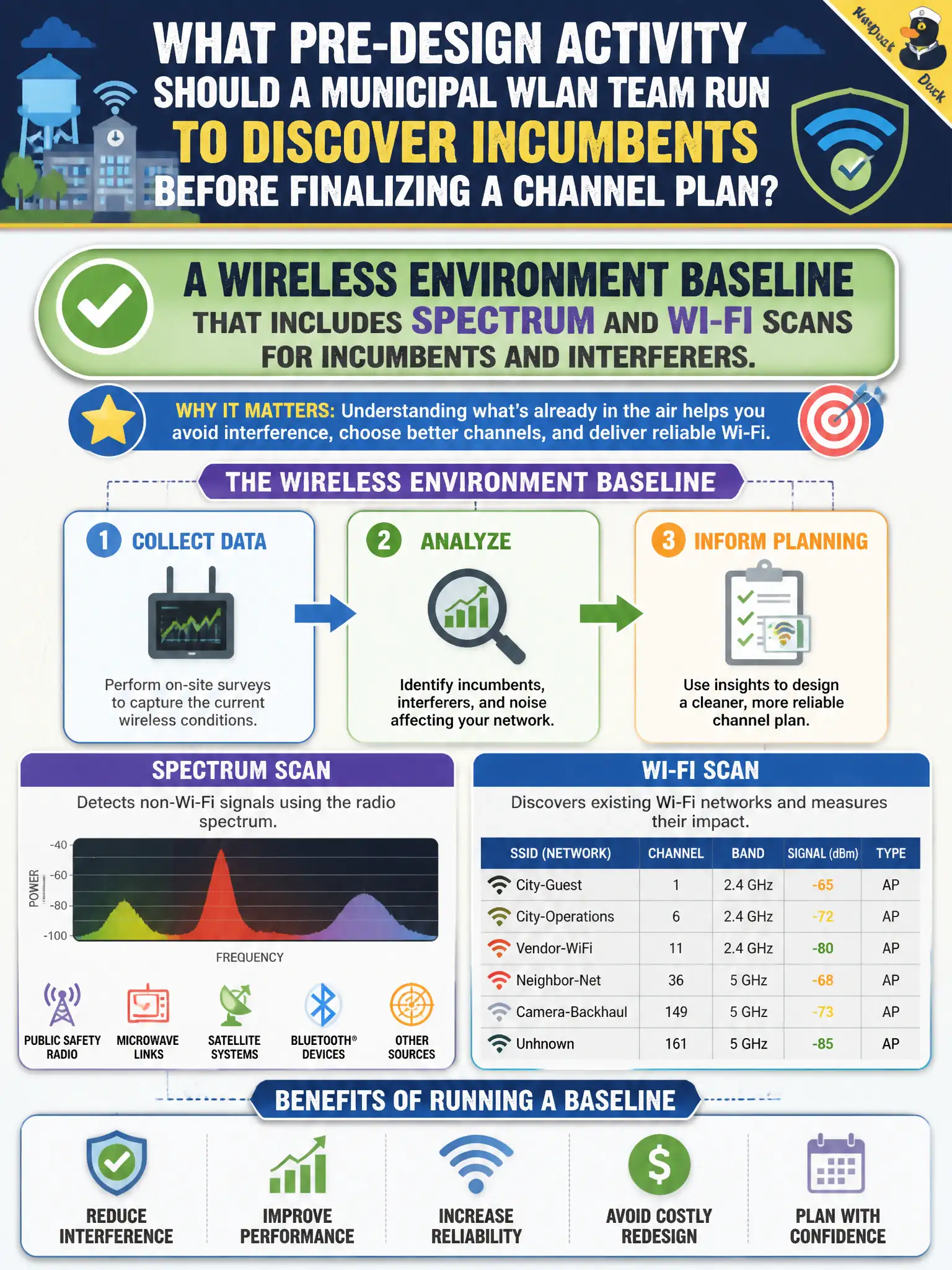
Before you paint channels on a map, walk the RF neighborhood—spectrum and Wi-Fi scans show who already lives there. Traceroutes and furniture brochures don’t reveal microwave ovens or rogue APs. Shutting off a neighbor without data is politics, not design.
Full Explanation
Channel plans must respect what already occupies the air. A municipal WLAN team should run a wireless environment baseline that includes spectrum and Wi-Fi scans for incumbents and interferers before finalizing channels—neighboring SSIDs, non-Wi-Fi energy, and duty cycles that constrain reuse. That baseline turns channel selection into an evidence-based plan instead of a template copied from another building. Wired traceroute and furniture catalogs do not reveal RF incumbents.
Only a wired traceroute from the core to the Internet edge fails by concept: Layer-3 path checks do not inventory RF occupants on the target floors. Only reviewing furniture catalogs for metal shelving brands fails by concept: shelving may hint at attenuation but does not replace spectrum/Wi-Fi scans for co-channel and non-Wi-Fi interferers. Disabling neighboring agency APs without measurement or coordination fails by concept: unilateral shutdowns are operationally and politically improper versus measured coexistence planning.
Exam caveat: Baseline RF/Wi-Fi survey is a prerequisite to municipal channel planning; guesswork invites CCI and interference surprises at cutover.
Operational check: Perform on-site spectrum and 802.11 scans at representative building locations, document strong incumbents and interferers with duty cycle notes, and feed those constraints into the channel plan before AP go-live.