
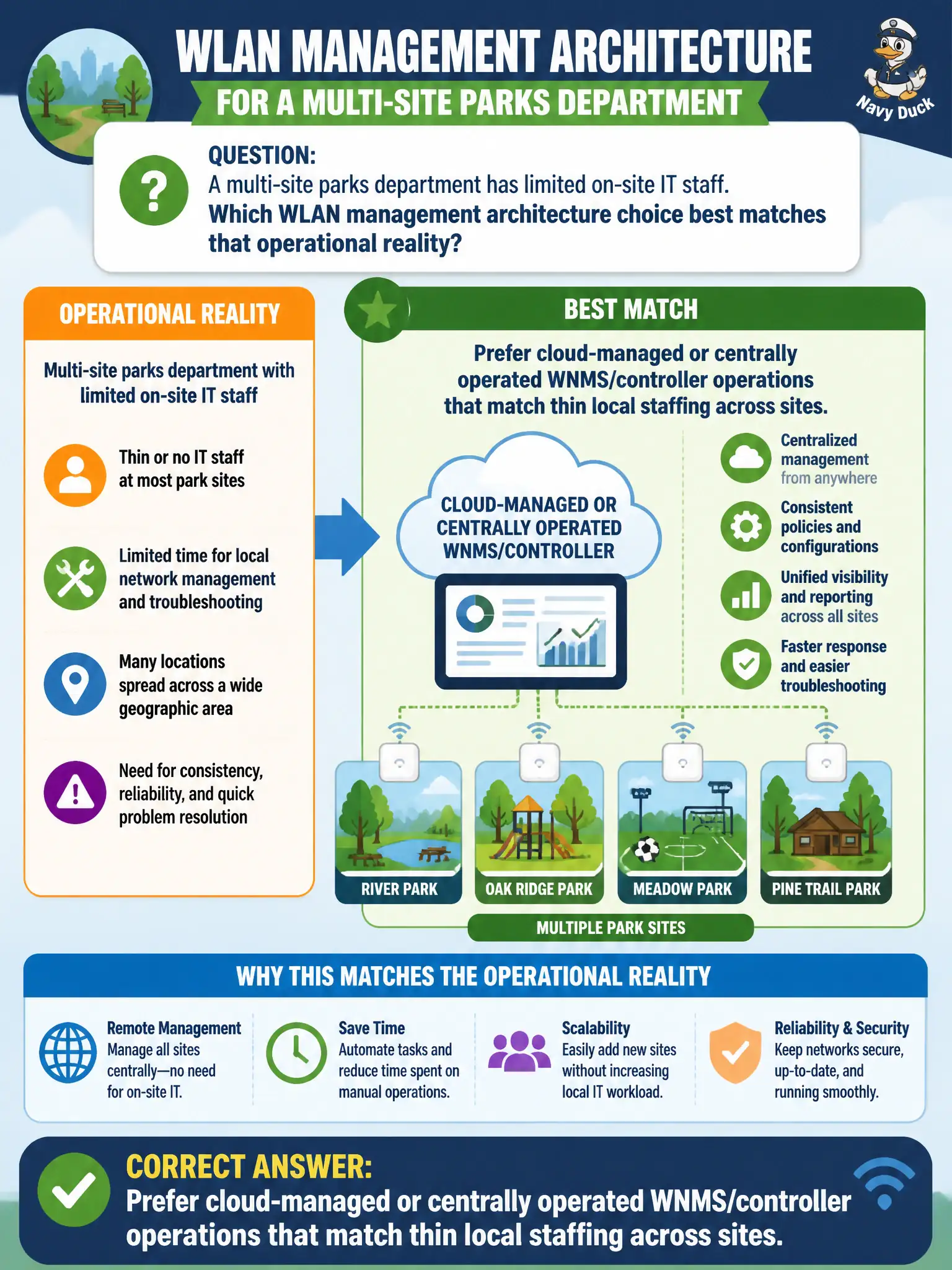
A multi-site parks department has limited on-site IT staff. Which WLAN management architecture choice best matches that operational reality?
Select an answer to reveal the explanation.
Short Explanation
Tiny park crews can’t babysit a controller closet in every shed. Cloud or centralized management lets a small team see and fix many sites without living on the road. A pile of unmanaged autonomous APs is how firmware and SSIDs drift apart.
Full Explanation
Management architecture should match staffing reality across distributed sites. For a multi-site parks department with limited on-site IT staff, preferring cloud-managed or centrally operated WNMS/controller operations that match thin local staffing is the architecture choice that enables consistent policy, monitoring, and upgrades without requiring expert admins in every pavilion. Central visibility reduces truck rolls and configuration drift across seasonal venues. Local-only heavy controller footprints fight the staffing model.
Requiring a full controller cluster in every small park shed with local-only admins fails by concept: that multiplies hardware and skills the department does not have. Forbidding centralized visibility so each pavilion uses a unique unmanaged autonomous AP fails by concept: unmanaged drift blocks citywide operations and security consistency. Mandating air-gapped CLI-only APs with no remote monitoring fails by concept: that maximizes truck rolls when local staff are already thin.
Exam caveat: CWNE architecture items weigh operational model and staffing equal to RF; central/cloud operations fit multi-site municipal parks.
Operational check: Map parks sites to a central/cloud management tenant, confirm remote monitoring and config backup, define who applies firmware policy, and retire one-off unmanaged APs that lack NOC visibility.