
A county hospital wing adds RTLS asset tracking on the WLAN. How do location accuracy needs change the design versus data-only coverage?
Select an answer to reveal the explanation.
Short Explanation
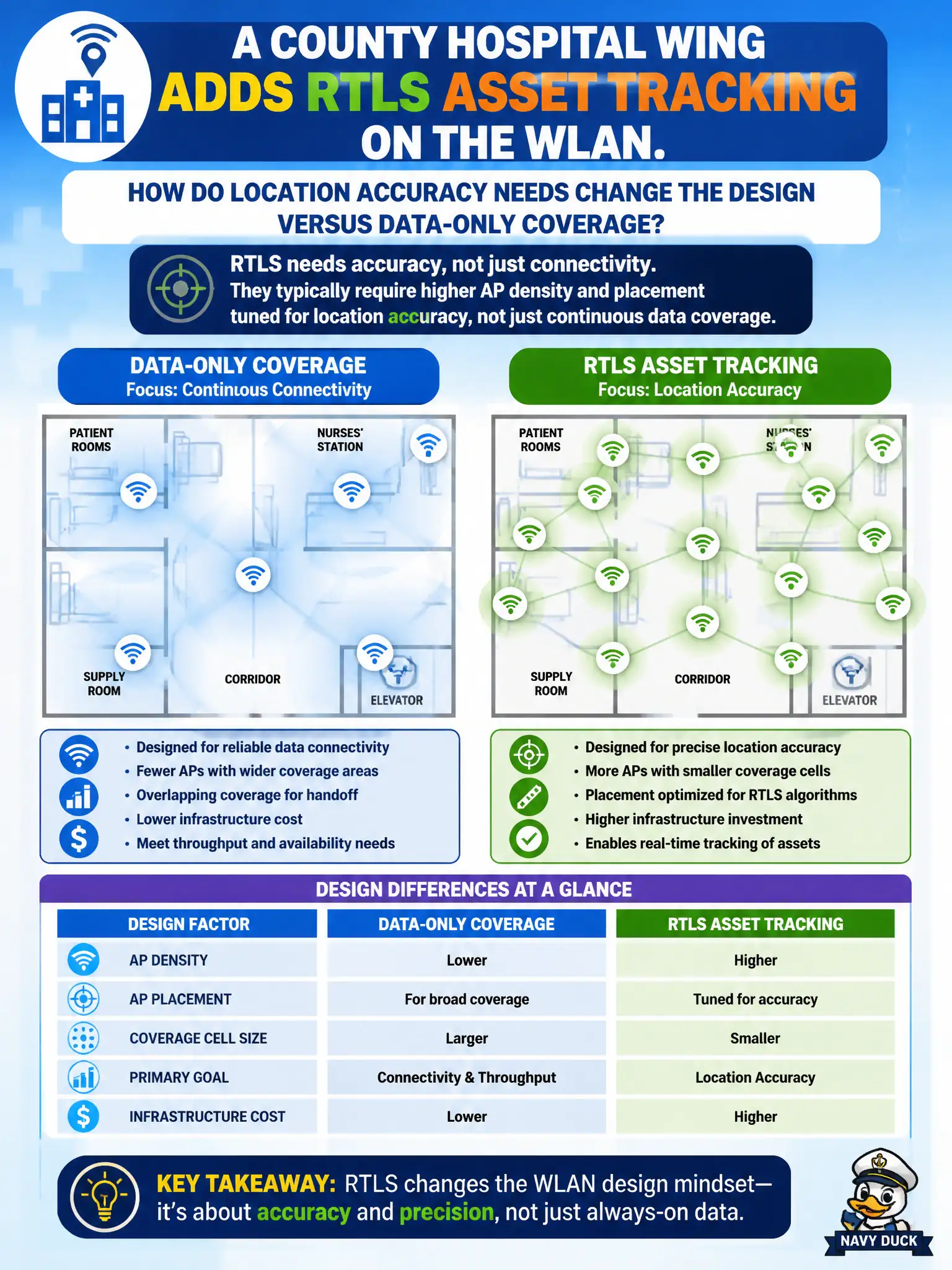
Asset tags that need to be found aren’t satisfied by 'some bars on a phone.' RTLS usually wants denser, thoughtfully placed APs so location math works, not a thin data blanket. Thinning the grid or assuming −75 dBm is enough skips the accuracy requirement.
Full Explanation
RTLS accuracy generally needs denser, placement-tuned APs compared with data-only coverage. When a county hospital wing adds RTLS asset tracking on the WLAN, location accuracy needs typically require higher AP density and placement tuned for location accuracy, not just continuous data coverage. Data designs optimized for −67 dBm aisles may still triangulate poorly if AP geometry is sparse or collinear.
Removing half the APs because tags only need occasional beacons fails by concept: fewer APs worsen geometry and accuracy. Turning off 802.11 entirely for Bluetooth-only without RF planning fails by concept: abandoning WLAN RTLS requirements and skipping RF planning does not meet a WLAN RTLS design goal. Assuming any −75 dBm data design automatically meets location needs fails by concept: weaker data thresholds and data-centric placement do not guarantee RTLS accuracy.
Exam caveat: CWNE specialty applications (RTLS, voice) change density and placement rules beyond generic data coverage.
Operational check: Obtain RTLS vendor accuracy and AP-density guidance for the hospital wing, revise predictive AP count/geometry accordingly, and validate tag error against known points—not only data RSSI maps.