
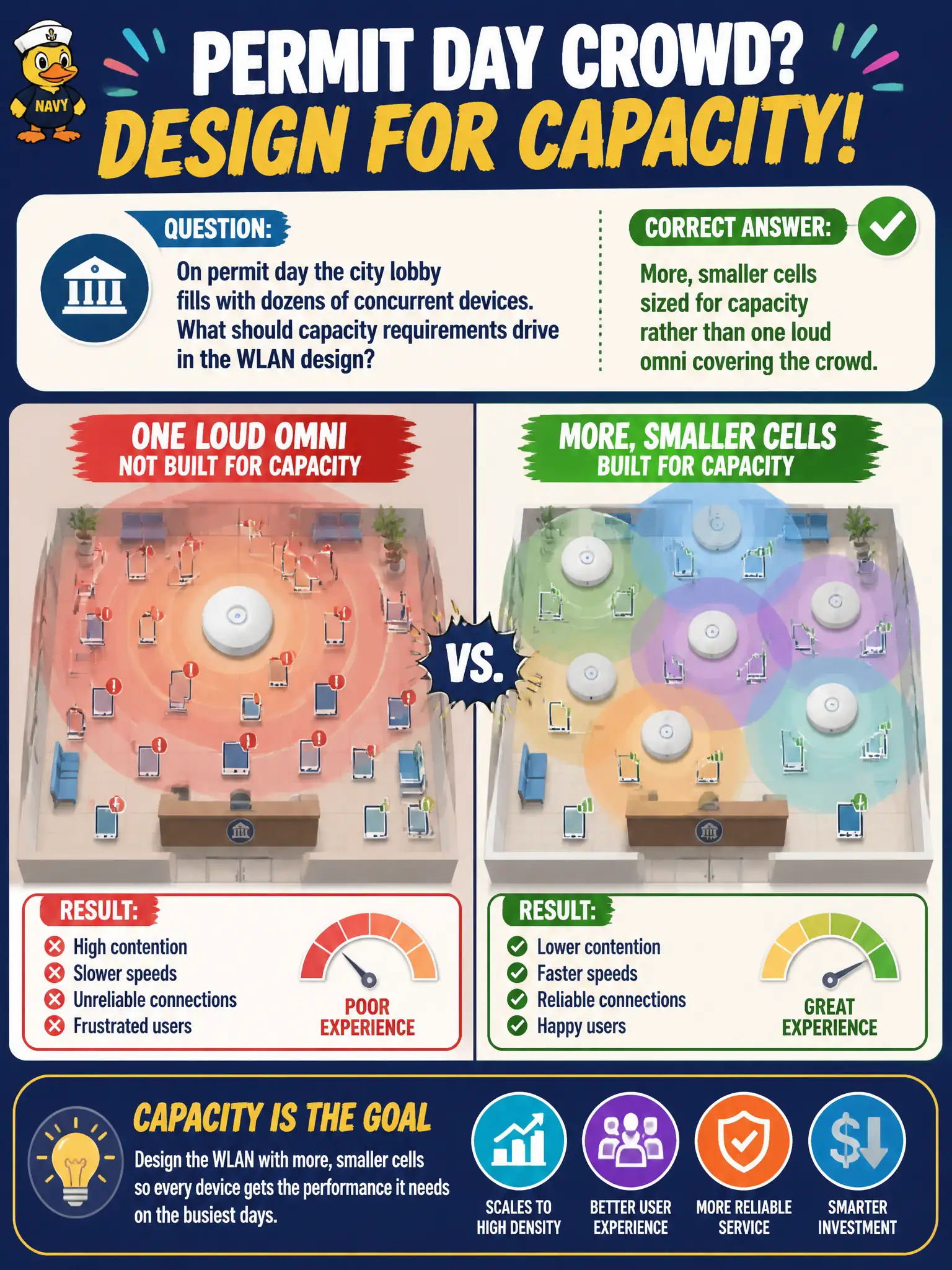
On permit day the city lobby fills with dozens of concurrent devices. What should capacity requirements drive in the WLAN design?
Select an answer to reveal the explanation.
Short Explanation
A packed permit lobby needs more cells, not one bullhorn AP yelling over everyone. Capacity math says shrink cells and add APs so airtime is shared sanely. One loud omni or collapsing to 2.4 GHz just makes the contention louder.
Full Explanation
Permit-day density is a capacity problem solved with more, smaller cells—not one loud omni. When the city lobby fills with dozens of concurrent devices, capacity requirements should drive a design of more, smaller cells sized for airtime and client count rather than one high-power omni covering the crowd. Smaller cells reuse spectrum, reduce per-BSS contention, and keep airtime available for association and data.
Centering a single high-power omni to maximize one cell's range fails by concept: range without capacity collapses under dozens of concurrent devices. Using fewer APs with wider channels only while ignoring airtime contention fails by concept: wider channels increase bleed and do not create infinite airtime for a crowded lobby. Disabling all 5 GHz radios so devices share one large 2.4 GHz cell fails by concept: that concentrates contention on the most constrained band.
Exam caveat: High-density municipal lobbies are classic capacity-versus-coverage traps; CWNE answers favor cell sizing for concurrent devices.
Operational check: Estimate peak concurrent devices and airtime on permit day, design lobby AP count and channel width for that load, and validate with a crowded active survey rather than empty-building RSSI heatmaps alone.