
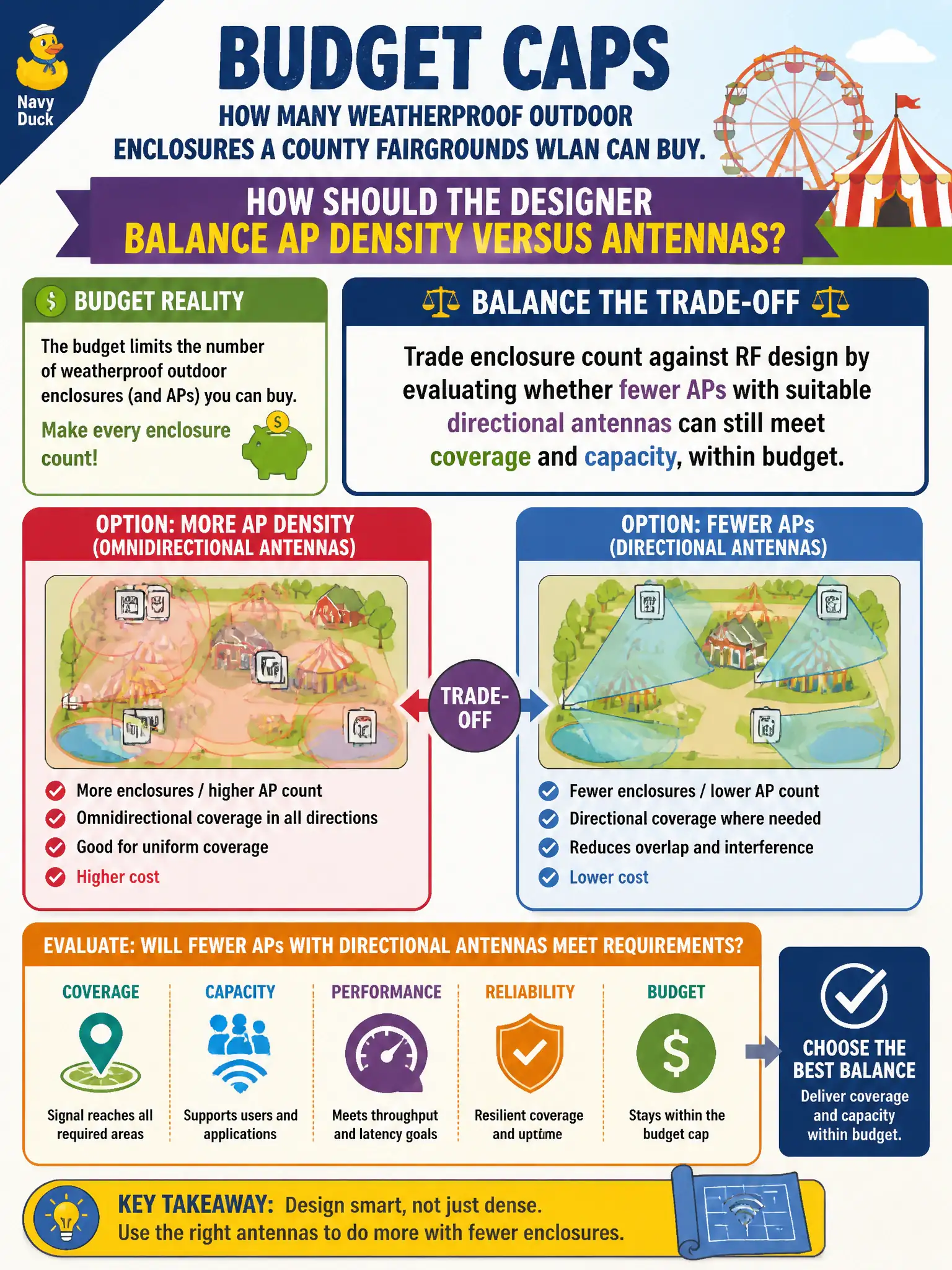
Budget caps how many weatherproof outdoor enclosures a county fairgrounds WLAN can buy. How should the designer balance AP density versus antennas?
Select an answer to reveal the explanation.
Short Explanation
Money limits how many outdoor boxes you can hang, so you trade density for smarter antenna patterns—like covering a fairground with a few well-aimed floodlights instead of a hundred night-lights. One max-power omni in the middle is the classic interference generator. Budget is a design input, not a reason to gut security or abandon RF planning.
Full Explanation
Budget-limited outdoor designs trade AP/enclosure count against antenna pattern and cell shaping. For a county fairgrounds WLAN capped on weatherproof outdoor enclosures, the designer should balance density versus antennas by evaluating whether fewer APs with suitable directional antennas can still meet coverage and capacity within budget. Directionality can stretch useful coverage and control bleed when every enclosure is expensive.
Buying unlimited enclosures by cutting all security features from indoor SSIDs fails by concept: security is not a fungible pool to fund outdoor hardware, and the trade does not solve fairgrounds RF planning. Placing one omni AP at the center at maximum power and skipping antenna planning fails by concept: a single hot omni rarely meets fairgrounds capacity and creates CCI and edge starvation. Canceling outdoor coverage for cellular tethering only fails by concept: that abandons the WLAN requirement rather than designing within the enclosure budget.
Exam caveat: CWNE outdoor BoM questions reward RF trade studies (AP count versus antenna pattern) under explicit cost caps.
Operational check: Model fairgrounds coverage with reduced AP count plus directional antennas, compare capacity and edge RSSI to the all-omni denser option, and select the mix that meets SLA inside the enclosure budget.