
City council aesthetics rules ban visible hallway APs in a renovated civic center. What must the designer document in the requirements?
Select an answer to reveal the explanation.
Short Explanation
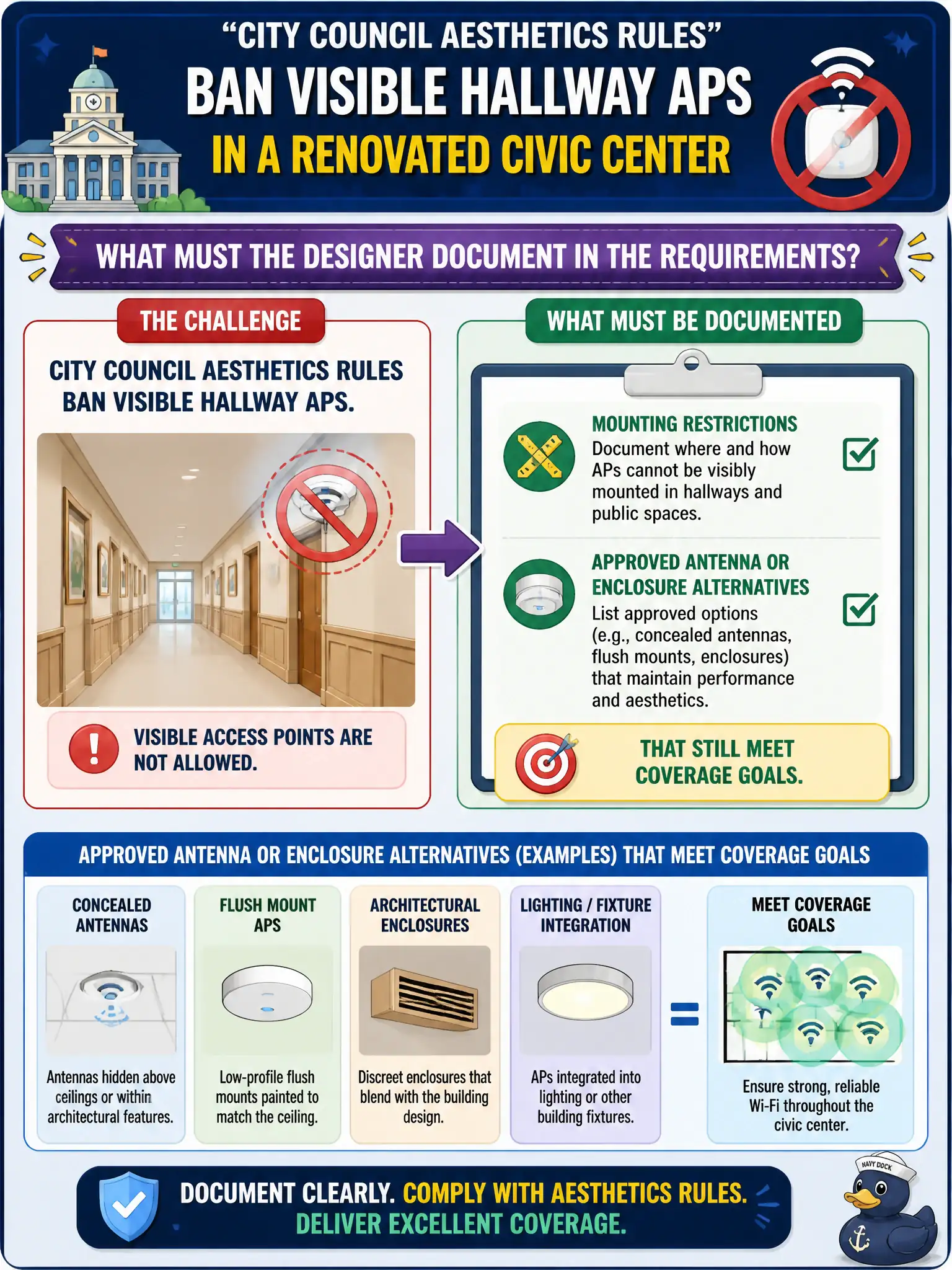
Council said no hallway mushrooms on the ceiling—so write that constraint down and pick stealth mounts or alternate antennas that still cover the space. Ignoring aesthetics or forcing corridor yagis just picks a fight with facilities. Document the restriction and the approved workarounds together.
Full Explanation
Aesthetic constraints are real municipal requirements that change mounting and antenna choices without erasing coverage goals. When city council aesthetics rules ban visible hallway APs in a renovated civic center, the designer must document mounting restrictions and approved antenna or enclosure alternatives that still meet coverage goals—recessed mounts, aesthetic enclosures, or alternate antenna types authorized by facilities policy.
Claiming aesthetic rules may be ignored if predictive software shows any coverage gap fails by concept: policy constraints remain binding; the design must solve coverage within them. Mandating only high-gain yagis in public corridors regardless of policy fails by concept: that can violate aesthetics and create harmful elongated cells. Removing all antenna options so only default omni dipoles are allowed fails by concept: approved alternatives are often how aesthetic bans are met while preserving RF performance.
Exam caveat: CWNE requirements gathering treats facilities and aesthetic rules as design inputs equal to RSSI targets, not as optional afterthoughts.
Operational check: Record the civic-center mounting ban in the design brief, list facilities-approved enclosures/antennas, and validate that the chosen mounting still meets hallway coverage and capacity before procurement.