
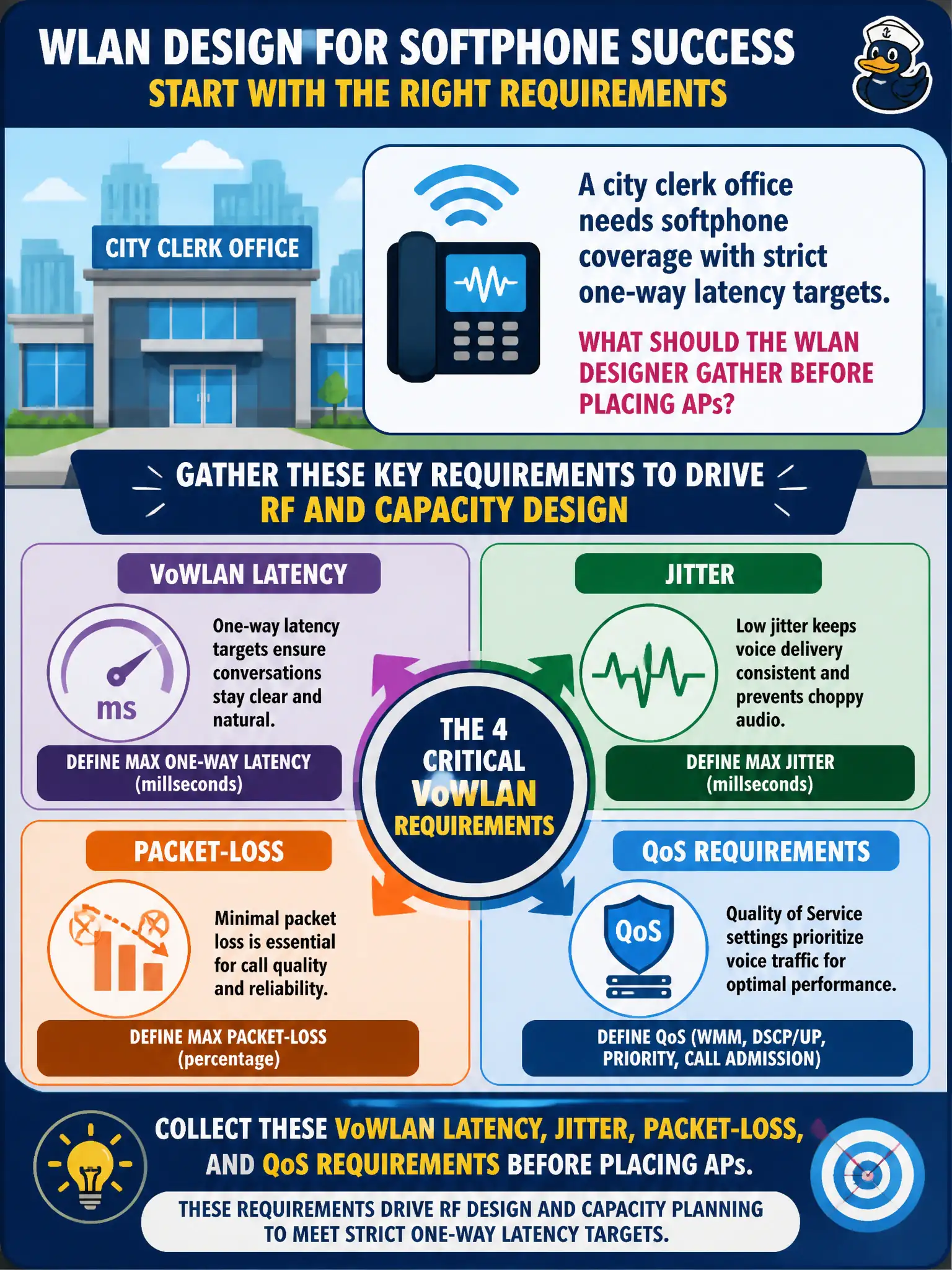
A city clerk office needs softphone coverage with strict one-way latency targets. What should the WLAN designer gather before placing APs?
Select an answer to reveal the explanation.
Short Explanation
Softphones are picky roommates—they need low latency and clean QoS, not prettier AP lids. Collect the voice delay and loss budgets first so cell size and markings actually serve the clerks. Turning WMM off is like ripping out the HOV lane right before rush hour.
Full Explanation
Softphone VoWLAN succeeds only when the RF and capacity design absorb explicit voice quality targets. Before placing APs in a city clerk office that needs softphone coverage with strict one-way latency targets, the WLAN designer should gather VoWLAN latency, jitter, packet-loss, and QoS requirements that will drive cell size, band strategy, WMM/QoS markings, and capacity. Aesthetic preferences and unrelated outdoor fade margins do not define whether one-way delay stays inside policy.
Gathering only the preferred AP vendor color scheme for ceiling tiles fails by concept: cosmetics do not encode latency, jitter, loss, or QoS needs. Collecting only outdoor bridge fade margins unrelated to clerk softphones fails by concept: PTP outdoor margins are a different design problem from indoor VoWLAN. Planning to disable WMM so softphones share best-effort airtime equally fails by concept: disabling WMM removes the QoS differentiation voice depends on and worsens contention under load.
Exam caveat: CWNE voice designs start from measurable SLA inputs (latency/jitter/loss/QoS), not from AP placement intuition alone.
Operational check: Document one-way latency, jitter, and loss budgets plus DSCP/WMM mappings for the clerk softphones, then set predictive RSSI/SNR and airtime assumptions to those numbers before locking AP count and channels.