
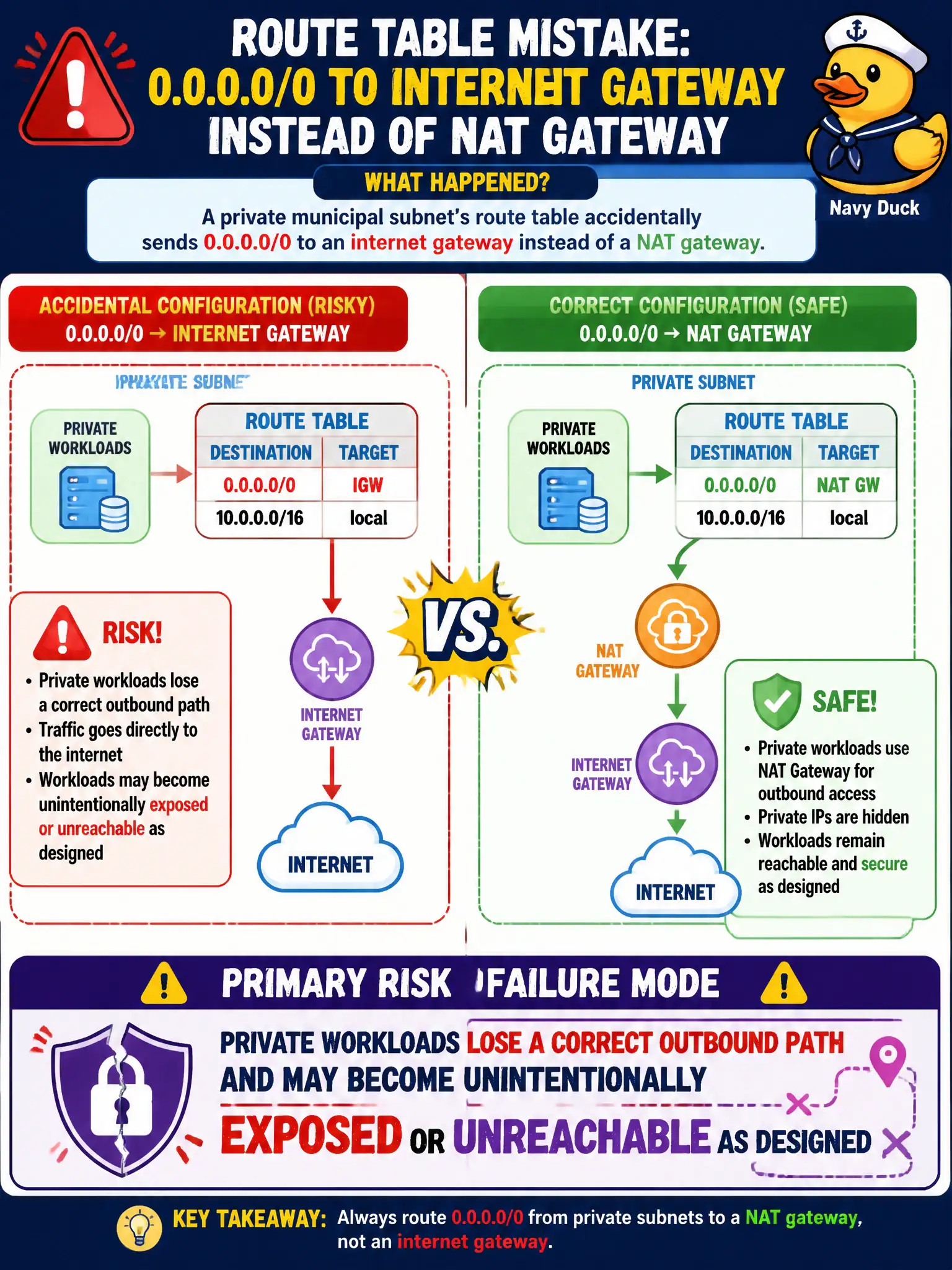
A private municipal subnet's route table accidentally sends 0.0.0.0/0 to an internet gateway instead of a NAT gateway. What is the primary risk or failure mode?
Select an answer to reveal the explanation.
Short Explanation
Pointing private default traffic at an IGW is like mailing through the front door when you meant the back alley—traffic either won't work as planned or you risk exposure. Private subnets should default to NAT, not the internet gateway.
Full Explanation
A private municipal subnet's route table accidentally sending 0.0.0.0/0 to an Internet gateway instead of a NAT gateway creates a primary risk that private workloads lose a correct outbound path and may become unintentionally exposed or unreachable as designed. Private instances typically lack public IPs usable with an IGW default route, so egress breaks and design intent collapses. Object versioning is not automatically disabled on all buckets by a route mistake. IAM roles can still assume federated identities independently of this route. Block volumes do not remount as read-only across availability zones because of an IGW mis-route. Exam caveat: private subnet egress should target NAT (or equivalent); IGW default routes belong to public subnets with appropriate public addressing. Operational check: correct 0.0.0.0/0 to the NAT gateway, confirm private instances reach needed endpoints without public IPs, verify no unintended public exposure, and add route-table lint checks to civic IaC pipelines. In municipal cloud operations, record the chosen control and the rejected alternatives in the change or incident ticket so future on-call staff understand which failure modes were avoided for city services. Re-validate after the next maintenance window that the same decision still holds under current provider limits, identity bindings, and application versions used by the civic platform team.