
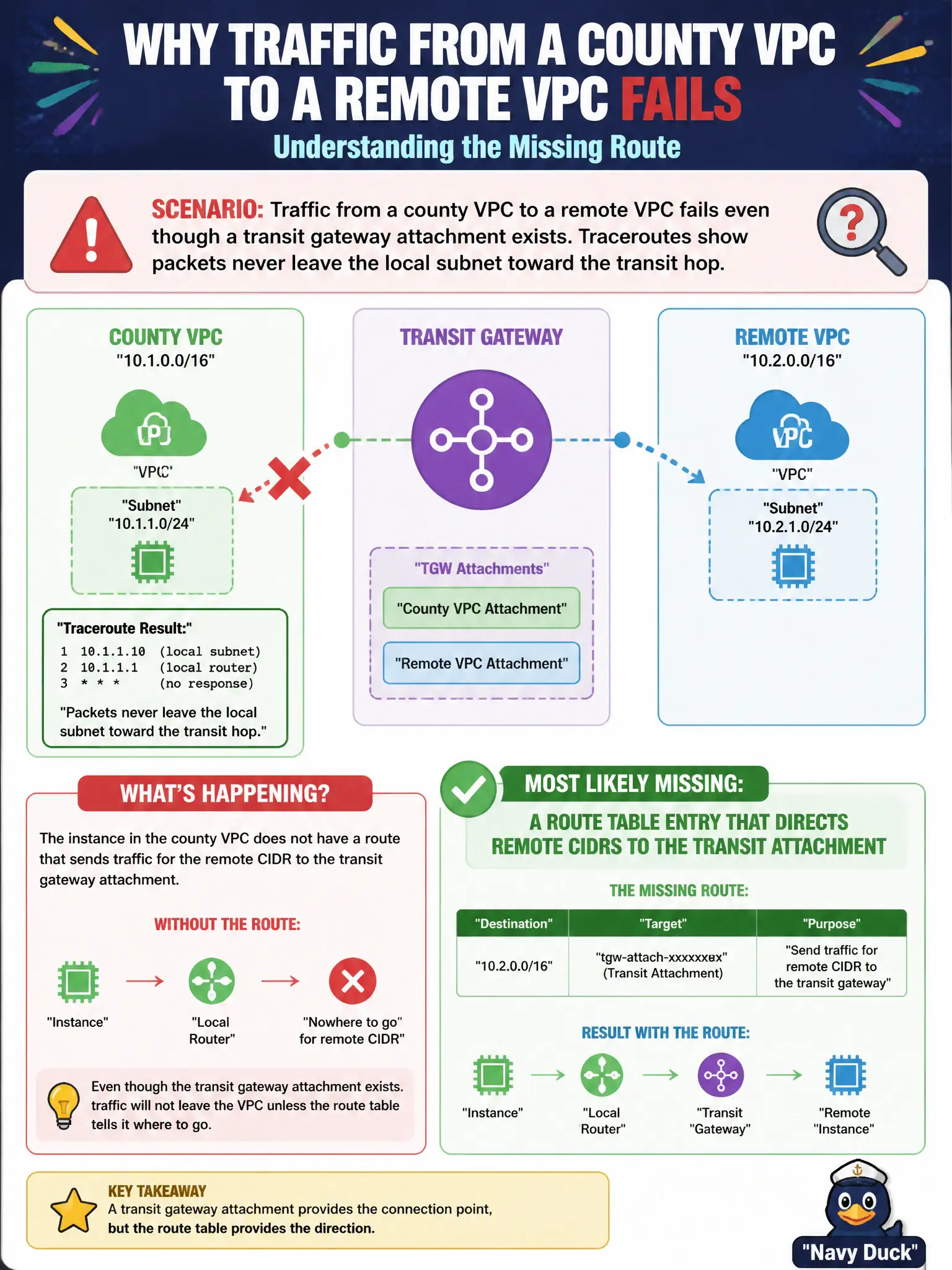
Traffic from a county VPC to a remote VPC fails even though a transit gateway attachment exists. Traceroutes show packets never leave the local subnet toward the transit hop. What is most likely missing?
Select an answer to reveal the explanation.
Short Explanation
The transit bridge can be standing there, but if the local route table never points at it, traffic stays on the driveway. Add a route for the remote CIDR that targets the transit attachment.
Full Explanation
Traffic from a county VPC to a remote VPC failing even though a transit gateway attachment exists, with traceroutes showing packets never leave the local subnet toward the transit hop, most likely means a route table entry that directs remote CIDRs to the transit attachment is missing. Attachments without routes do not forward civic traffic. A larger instance type for the transit gateway is usually irrelevant to missing subnet routes. Public DNS hostnames on every remote instance do not create the transit path. Disabling encryption in transit for troubleshooting does not fix absent routes and weakens security. Exam caveat: check both spoke route tables and transit association/propagation settings—multiple layers must align for municipal transit designs. Operational check: inspect the subnet route table for remote CIDRs via the transit attachment, add or propagate the routes, re-run traceroute, verify return path routes, and document the transit routing standard for county networks. In municipal cloud operations, record the chosen control and the rejected alternatives in the change or incident ticket so future on-call staff understand which failure modes were avoided for city services. Re-validate after the next maintenance window that the same decision still holds under current provider limits, identity bindings, and application versions used by the civic platform team.