
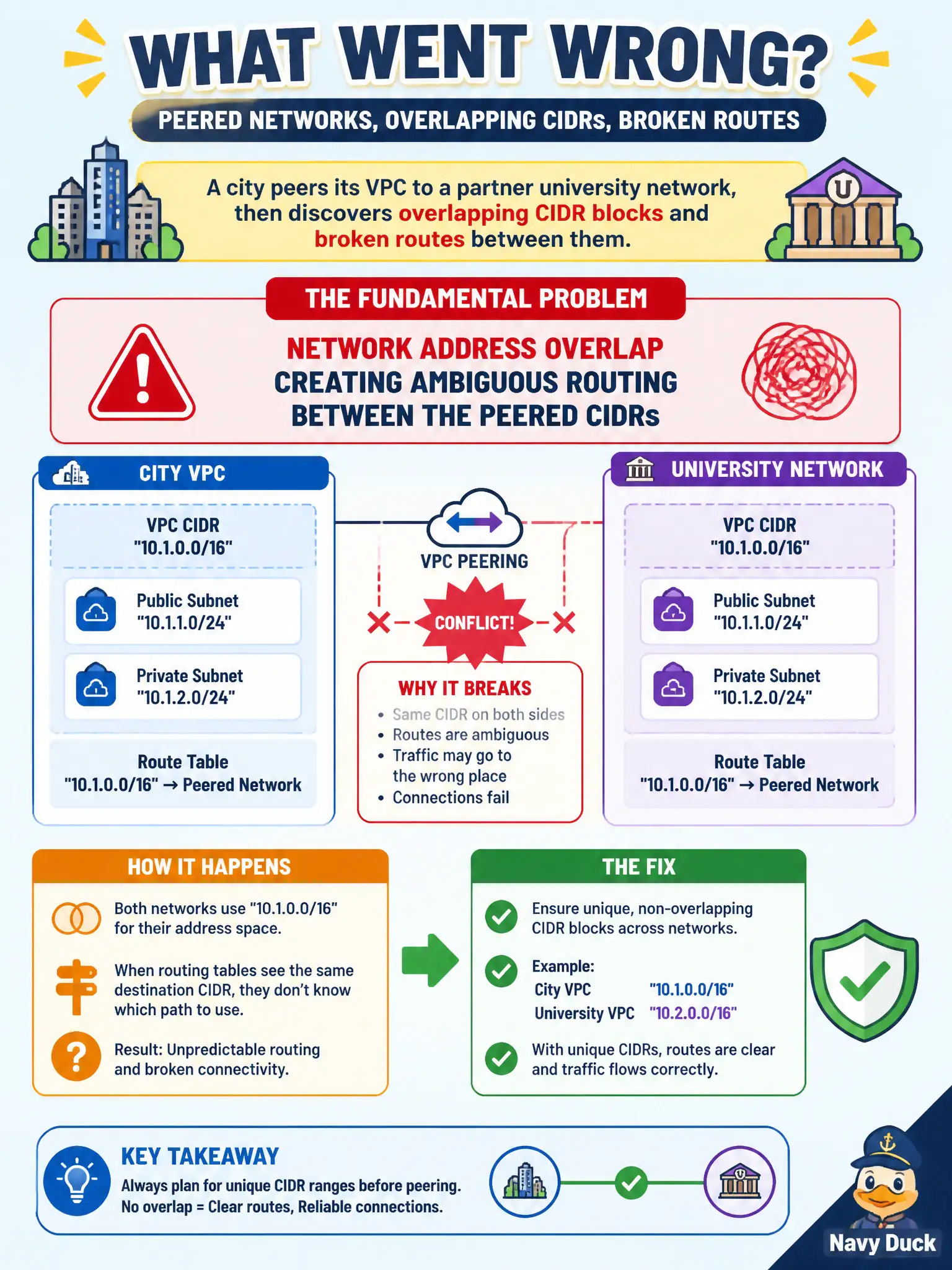
A city peers its VPC to a partner university network, then discovers overlapping CIDR blocks and broken routes between them. What is the fundamental problem?
Select an answer to reveal the explanation.
Short Explanation
Two networks claiming the same street numbers can't peer cleanly—routers don't know which house is which. Overlapping CIDRs need redesign, NAT, or non-overlapping ranges before peering works.
Full Explanation
When a city peers its VPC to a partner university network and then discovers overlapping CIDR blocks and broken routes between them, the fundamental problem is network address overlap creating ambiguous routing between the peered CIDRs. Overlapping spaces prevent deterministic routes for municipal hybrid connectivity. The partner's S3-compatible bucket lacking versioning is a data-protection gap unrelated to peering route ambiguity. Both sides disabling flow logs for cost savings hurts visibility but is not the root cause of broken overlap routing. The university using IPv6 while the city uses only IPv4 can complicate design but is not the stated overlapping CIDR problem. Exam caveat: prevent overlap with IPAM and documented civic address plans before peering; NAT or re-CIDR are remediation options when overlap already exists. Operational check: compare CIDR inventories on both sides, identify overlaps, suspend or redesign the peering, implement non-overlapping ranges or translation, retest routes, and update the municipal IPAM records. In municipal cloud operations, record the chosen control and the rejected alternatives in the change or incident ticket so future on-call staff understand which failure modes were avoided for city services. Re-validate after the next maintenance window that the same decision still holds under current provider limits, identity bindings, and application versions used by the civic platform team.