
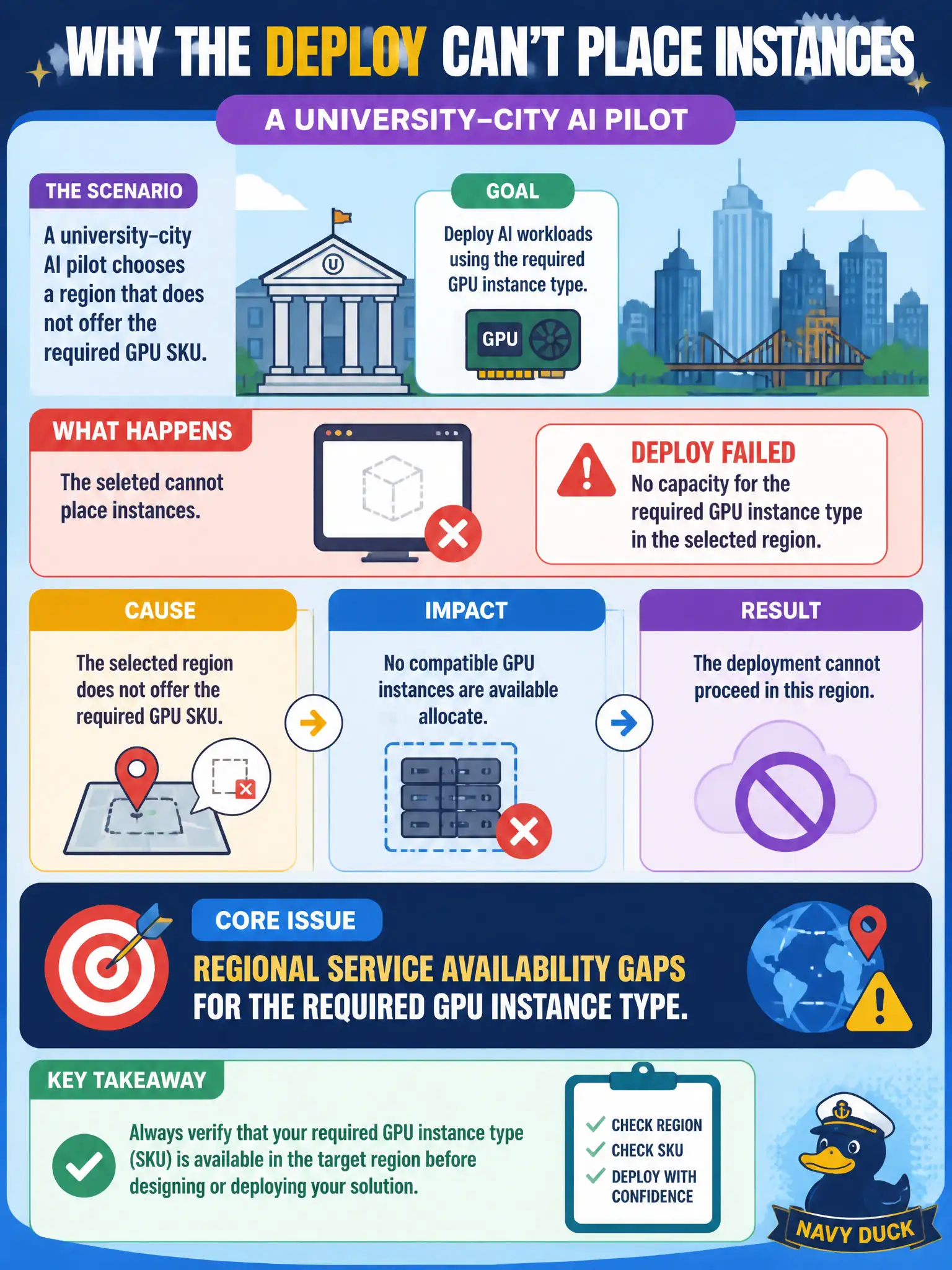
A university–city AI pilot chooses a region that does not offer the required GPU SKU, so the deploy cannot place instances. What is the core issue?
Select an answer to reveal the explanation.
Short Explanation
Not every region stocks every GPU flavor—availability is regional. Pick a region that sells the SKU or change the instance family. Assuming the catalog is identical everywhere is a common trap.
Full Explanation
A university–city AI pilot choosing a region that does not offer the required GPU SKU so the deploy cannot place instances faces regional service availability gaps for the required GPU instance type. Not every SKU exists in every region; civic pilots must verify regional feature matrices before committing architecture. Local disk encryption settings on an unrelated file share do not block GPU SKU placement. Correct confirmation that every region sells every SKU identically is false. A completed capacity reservation already covering the missing SKU in that region contradicts the inability to place instances. Exam caveat: availability differs from temporary capacity sold-out conditions—one is regional catalog absence, the other is transient stock; remediation paths differ. Operational check: consult the provider's regional SKU list, pick a region that offers the GPU type and meets data-residency rules, update IaC region parameters, validate a small pilot launch, and document approved regions for municipal AI workloads. In municipal cloud operations, record the chosen control and the rejected alternatives in the change or incident ticket so future on-call staff understand which failure modes were avoided for city services. Re-validate after the next maintenance window that the same decision still holds under current provider limits, identity bindings, and application versions used by the civic platform team.