
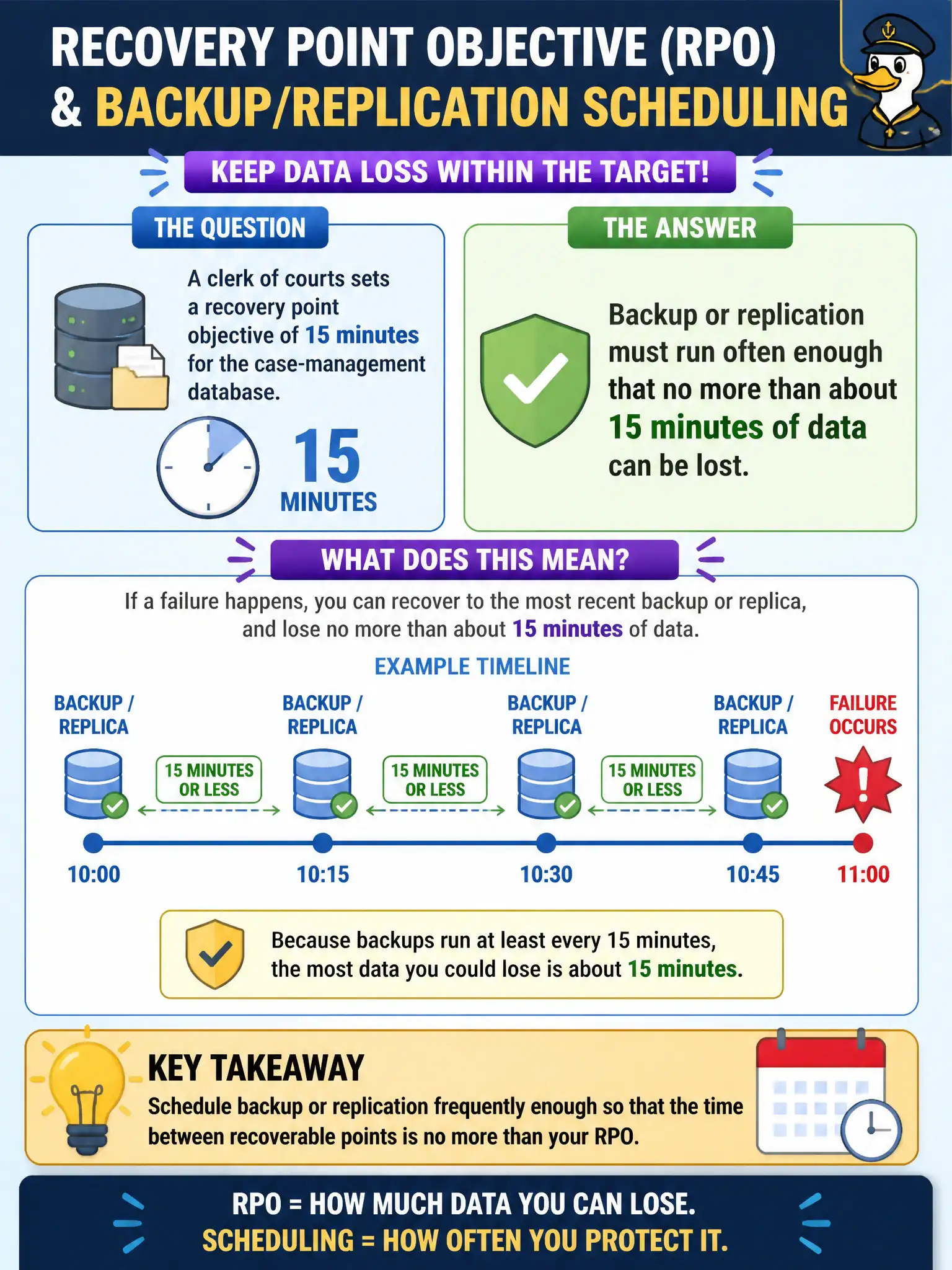
A clerk of courts sets a recovery point objective of 15 minutes for the case-management database. What must backup or replication scheduling primarily satisfy?
Select an answer to reveal the explanation.
Short Explanation
RPO is about how much recent work you can afford to lose—like how far back the camera rewind goes—not how fast the firetruck arrives. A 15-minute RPO means copies must land at least that often.
Full Explanation
Recovery Point Objective defines the maximum acceptable data loss measured in time. A clerk of courts RPO of 15 minutes for case-management data means backup or replication must run often enough that, in a failure, roughly no more than fifteen minutes of committed work can be missing. Meeting that civic obligation protects court schedules, filings, and public trust in record integrity far more than optimizing only restore speed.
Backup jobs that run once nightly cannot meet a 15-minute RPO even if restore drills finish quickly—RTO and RPO are different axes. RPO does not primarily govern how fast staff arrive on-site; that concern relates more to response and RTO. A weekly full backup alone cannot meet a sub-hour RPO because intervening days of changes would be lost.
Exam caveat: RPO is about data-loss tolerance (frequency/currency of copies); RTO is about downtime tolerance (how long recovery may take). A fast restore of a stale backup can meet RTO while still failing RPO.
Operational check: measure actual replication or backup interval and lag for the case-management database, confirm the worst-case loss window is ≤15 minutes, alert when lag exceeds the RPO, and record evidence in the court’s continuity documentation. Include a restore or failover drill that proves both the RPO currency and the operational steps staff will follow during an incident.