
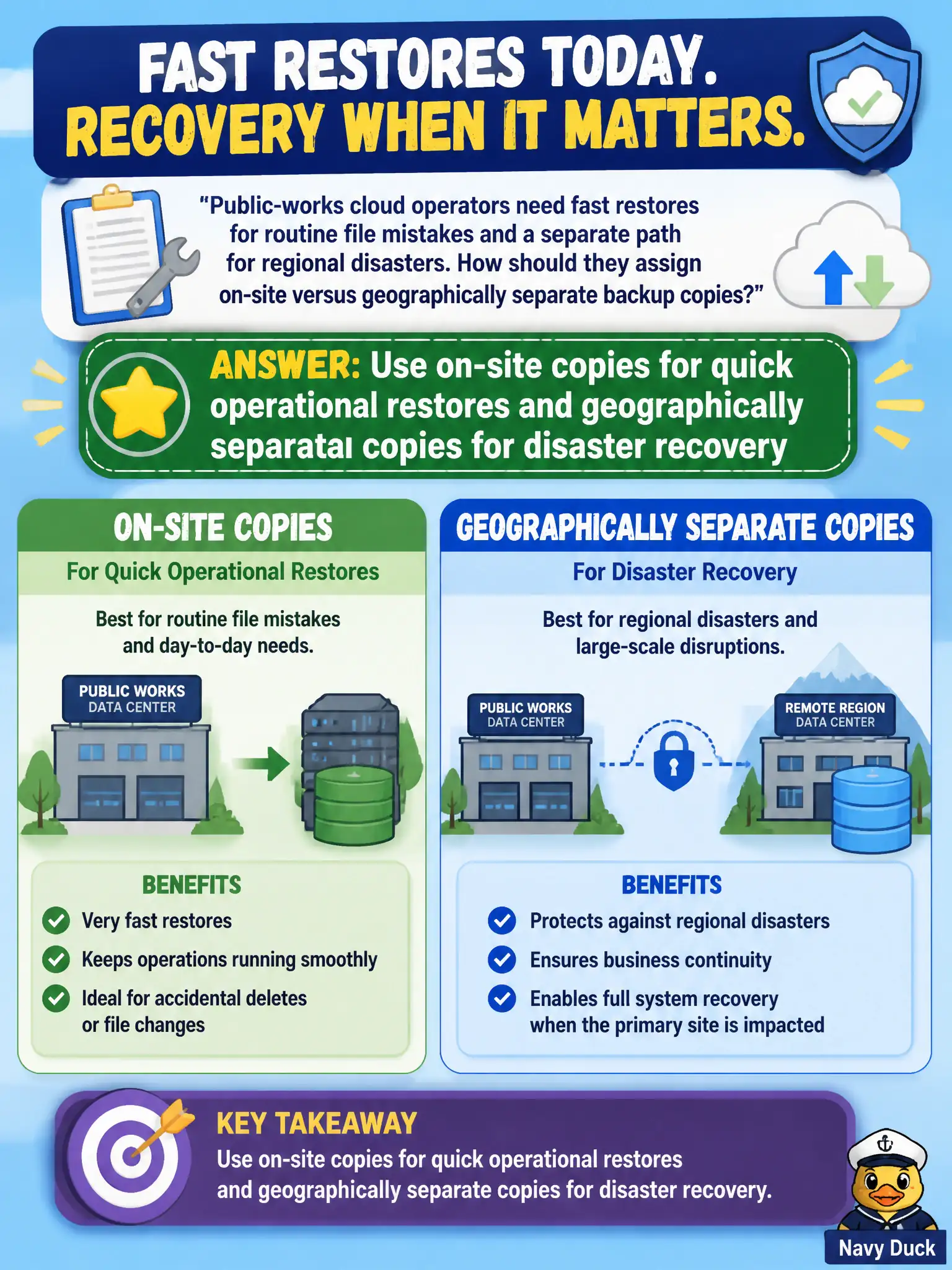
Public-works cloud operators need fast restores for routine file mistakes and a separate path for regional disasters. How should they assign on-site versus geographically separate backup copies?
Select an answer to reveal the explanation.
Short Explanation
The spare tire in the trunk gets you moving after a flat; the one at the depot across town covers a bigger wreck. On-site copies speed everyday restores; far-away copies cover site loss.
Full Explanation
On-site or same-region operational copies typically minimize restore latency for routine recovery—accidental deletes, bad patches, or single-file mistakes—while geographically separate copies protect public-works systems when a region or site is unavailable. Assigning roles that way lets operators restore quickly for day-to-day incidents without giving up a disaster-recovery path that survives local facility loss. Both copy types serve citizens; they optimize different failure modes.
Using only off-site tape for every accidental delete forces long RTO on common operational mistakes and frustrates service desks. Keeping both copies in the same availability zone simplifies networking but collapses geographic separation. Disabling on-site backups once any off-site replica exists removes the fast operational restore tier and can turn every small restore into a cross-region exercise.
Exam caveat: "on-site" vs "off-site" is about failure domains and RTO/RPO tradeoffs, not about abandoning one tier. Exams often pair this with RTO (how fast) versus RPO (how much data loss).
Operational check: map restore scenarios—file undelete versus regional outage—to the intended copy, time a restore from the on-site set and from the geo-separated set, and document which runbook path public-works on-call should use. Verify replication lag on the geo copy meets the stated RPO for critical GIS or work-order data.