
A stateful legacy permitting app cannot safely run multiple writers. Which short-term scaling choice is safest?
Select an answer to reveal the explanation.
Short Explanation
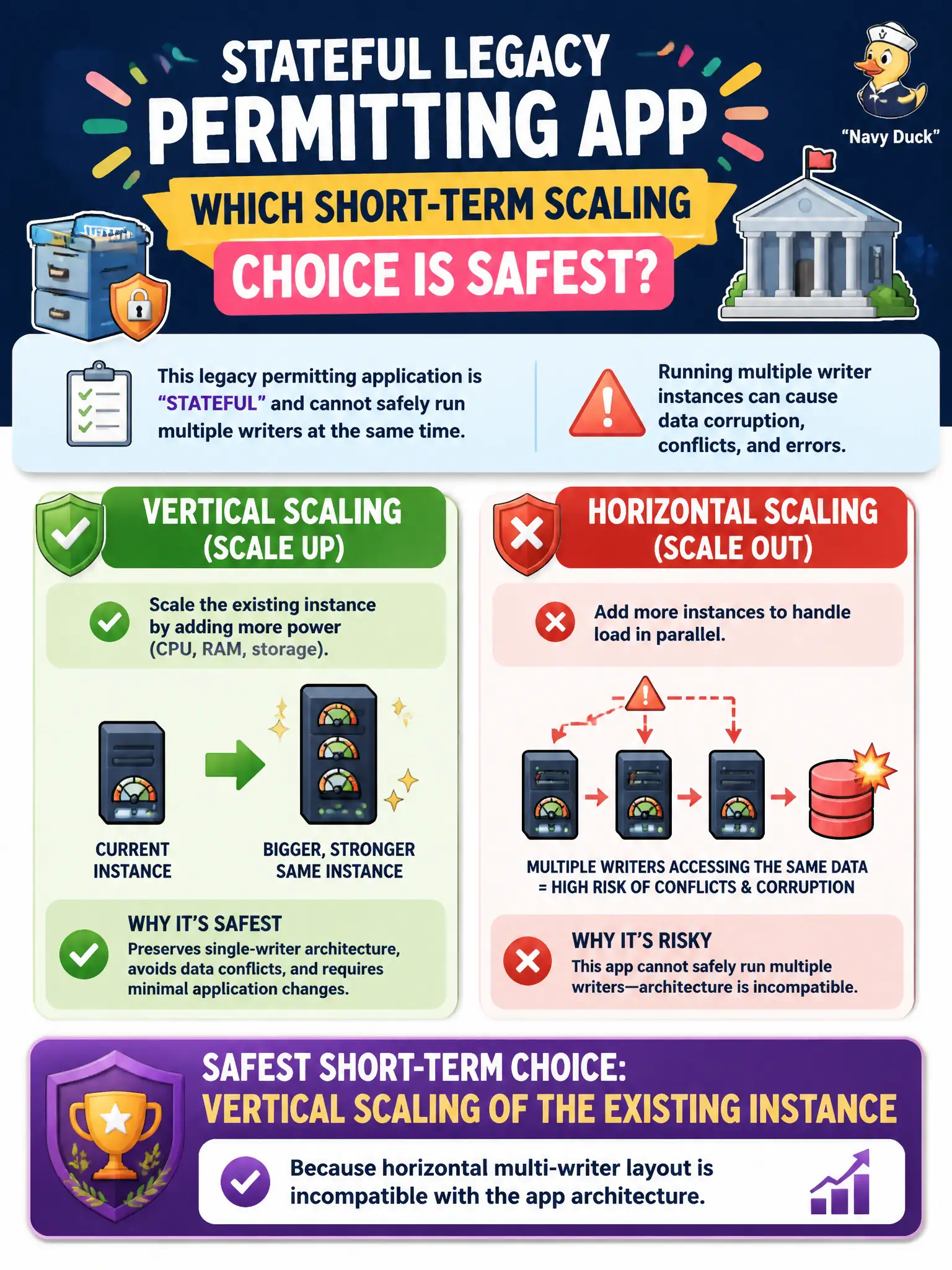
If the old permitting app freaks out with two writers, don’t force a crowd—give the one box more muscle for now. Vertical scaling is the safer short-term move when horizontal multi-writer just isn’t compatible. Rebuild for scale-out later; don’t corrupt permits tonight.
Full Explanation
Vertical scaling of the existing instance is the safest short-term choice when a stateful legacy permitting app cannot safely run multiple writers; horizontal multi-writer layout is incompatible with that architecture. Adding many writer instances immediately without session or data coordination risks conflicting writes and corruption. Sharding writes across random VMs with no shared state strategy fails consistency for permits. Removing the database and storing permits only in browser local storage destroys durability and central records. Exam caveat: architecture constraints dictate scaling mode—stateful single-writer legacy often forces vertical short-term. Operational check: scale up during a maintenance window, validate permits CRUD, plan a longer-term redesign, and document why horizontal writers were rejected. In municipal platform operations, record the chosen control and the rejected alternatives in the change record so future on-call engineers understand the failure modes avoided for citizen services. Re-check the decision after the next provider feature change or compliance update to ensure the same answer still holds for the city's estate. Confirm monitoring, access reviews, and backup coverage still align with the selected approach before closing the civic hypercare period.