
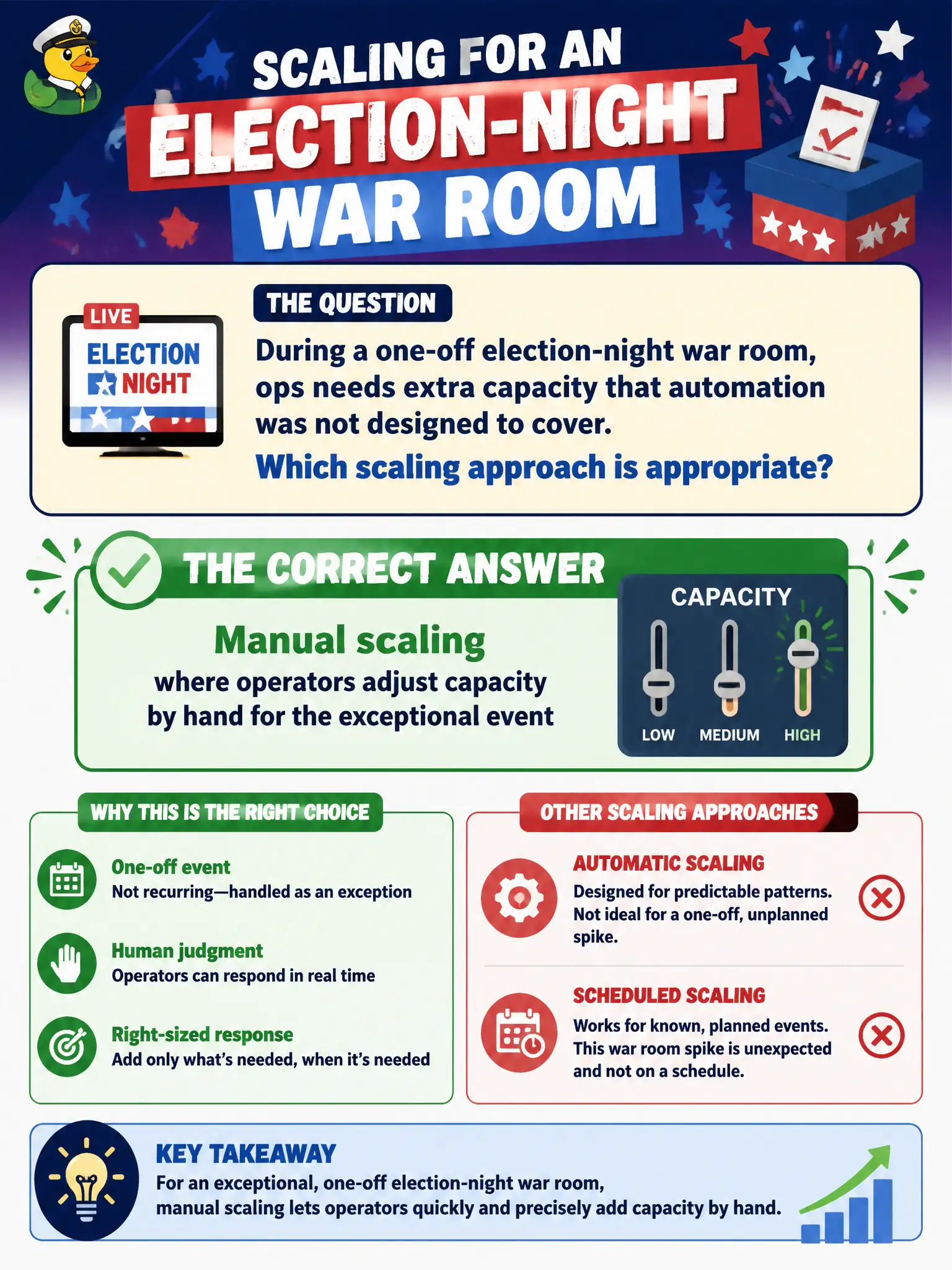
During a one-off election-night war room, ops needs extra capacity that automation was not designed to cover. Which scaling approach is appropriate?
Select an answer to reveal the explanation.
Short Explanation
Election night is the pop-up concert your autoscaler never rehearsed. Sometimes humans in the war room crank capacity by hand because the playbook doesn’t fit a one-off. Manual scaling isn’t laziness—it’s the right tool when automation wasn’t built for that night.
Full Explanation
Manual scaling where operators adjust capacity by hand is appropriate during a one-off election-night war room when automation was not designed to cover that exceptional municipal traffic pattern. Depending solely on yesterday’s scheduled scale-in while traffic spikes unpredictably risks under-capacity. Disabling monitoring so nobody notices capacity shortfalls hides failure instead of fixing it. Refusing any capacity change until the next quarterly architecture review fails the live event need. Exam caveat: manual scaling remains valid for exceptional events outside automation’s design envelope. Operational check: pre-authorize war-room capacity changes, keep an audit log of manual scales, watch error rates, and feed lessons into future scheduled/triggered policies. In municipal platform operations, record the chosen control and the rejected alternatives in the change record so future on-call engineers understand the failure modes avoided for citizen services. Re-check the decision after the next provider feature change or compliance update to ensure the same answer still holds for the city's estate. Confirm monitoring, access reviews, and backup coverage still align with the selected approach before closing the civic hypercare period.