
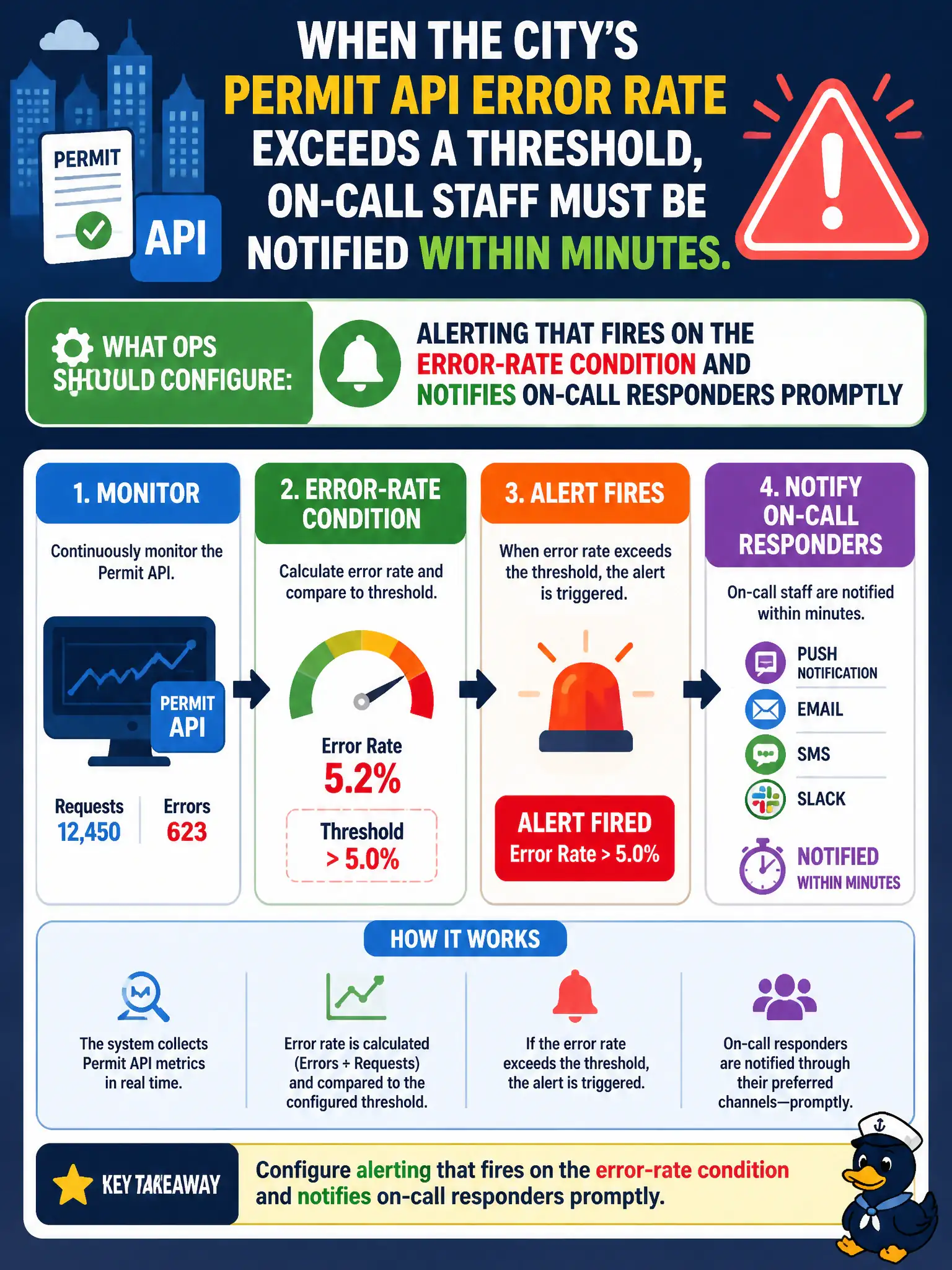
When the city’s permit API error rate exceeds a threshold, on-call staff must be notified within minutes. What should ops configure?
Select an answer to reveal the explanation.
Short Explanation
Thresholds without a pager are like a smoke detector with the battery pulled—something’s wrong, but nobody hears it. Alerting watches the error-rate metric and buzzes on-call within minutes. Waiting for a monthly summary is how citizen-facing APIs burn quietly.
Full Explanation
Alerting that fires on the error-rate condition and notifies on-call responders promptly is required when the city’s permit API must page within minutes of threshold breach. A monthly retrospective email summarizing prior-cycle errors fails near-real-time response. Silent dashboard widgets with no notification channels attached fail the notify-within-minutes need. Manual SSH polling of each host every eight hours by the help desk fails timeliness and coverage. Exam caveat: alerting = condition evaluation + notification; dashboards alone are not alerting. Operational check: wire error-rate alerts to on-call rotations, test pages, tune thresholds against baselines, and document ack/escalate for permit outages. In municipal platform operations, record the chosen control and the rejected alternatives in the change record so future on-call engineers understand the failure modes avoided for citizen services. Re-check the decision after the next provider feature change or compliance update to ensure the same answer still holds for the city's estate. Confirm monitoring, access reviews, and backup coverage still align with the selected approach before closing the civic hypercare period. Document residual risk for auditors.