
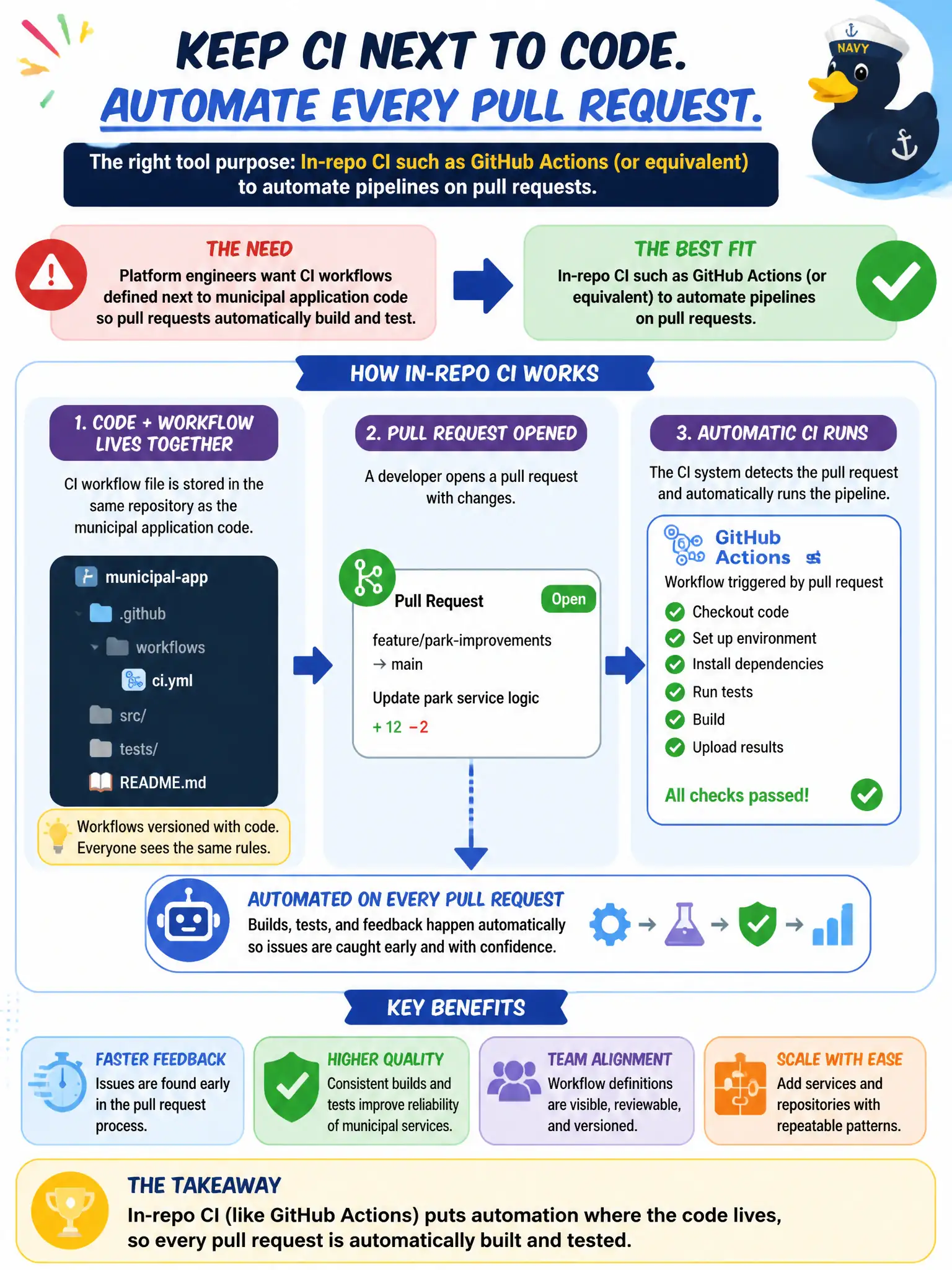
Platform engineers want CI workflows defined next to municipal application code so pull requests automatically build and test. Which tool purpose fits best?
Select an answer to reveal the explanation.
Short Explanation
Put the pipeline next to the code and let every pull request light up builds and tests—that is GitHub Actions-style CI. Archives and fax gateways do not watch your repo. Automating checks on PRs is how civic teams catch breaks before merge.
Full Explanation
Platform engineers who want CI workflows defined next to municipal application code so pull requests automatically build and test should use in-repo CI such as GitHub Actions (or equivalent) to automate pipelines on pull requests. Keeping workflow definitions with code versions the pipeline alongside the app for civic teams. A cold-storage archive tier used only for seven-year retention of PDFs is records retention, not PR automation. A physical badge printer with no connection to source repositories cannot build application changes. A standalone fax gateway that receives paper forms from citizens is not a CI system. Exam caveat: in-repo CI still needs secrets management, runner isolation, and required status checks—YAML alone does not secure municipal pipelines. Operational check: add a workflow file to the repo, open a test pull request, confirm build and test run, make the check required for merge, store secrets in the platform vault, and document the civic CI entrypoint in the README. In municipal cloud operations, record the chosen control and the rejected alternatives in the change or incident ticket so future on-call staff understand which failure modes were avoided for city services. Re-validate after the next maintenance window that the same decision still holds under current provider limits, identity bindings, and application versions used by the civic platform team.