
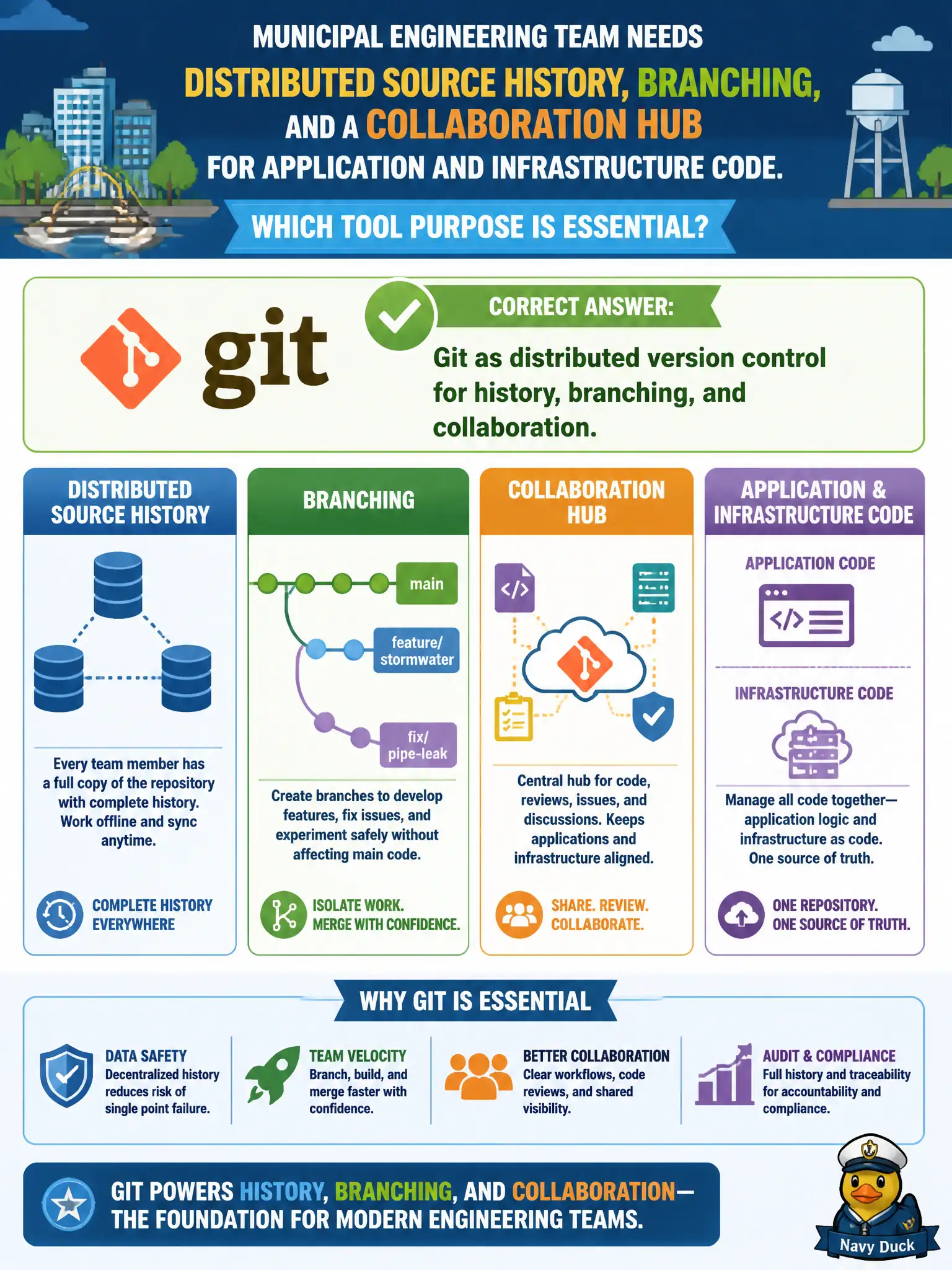
A municipal engineering team needs distributed source history, branching, and a collaboration hub for application and infrastructure code. Which tool purpose is essential?
Select an answer to reveal the explanation.
Short Explanation
Code history, branches, and team collaboration live in Git—the distributed source-control hub almost every DevOps shop leans on. Packet captures and KVM switches solve different problems. Treat Git as the system of record for how the city changes code over time.
Full Explanation
A municipal engineering team that needs distributed source history, branching, and a collaboration hub for application and infrastructure code requires Git as distributed version control for history, branching, and collaboration. Git underpins pull requests, code review, and CI for city DevOps. A packet capture appliance that only records network frames is for network forensics, not source history. A hardware KVM switch for console access to racked servers provides out-of-band console, not branching. A thermal printer driver used only for permit stickers is unrelated to code collaboration. Exam caveat: Git is the VCS; hosting products add issues, PRs, and permissions—understand both layers on Cloud+ tooling questions. Operational check: initialize or clone the municipal repo, create a branch, commit, push, open a pull request, verify history shows author and timestamp, and enforce protected-branch rules on main. In municipal cloud operations, record the chosen control and the rejected alternatives in the change or incident ticket so future on-call staff understand which failure modes were avoided for city services. Re-validate after the next maintenance window that the same decision still holds under current provider limits, identity bindings, and application versions used by the civic platform team.