
County SRE wants centralized log ingest, search, and dashboards so ops can troubleshoot multi-cloud municipal services from one place. Which stack purpose fits?
Select an answer to reveal the explanation.
Short Explanation
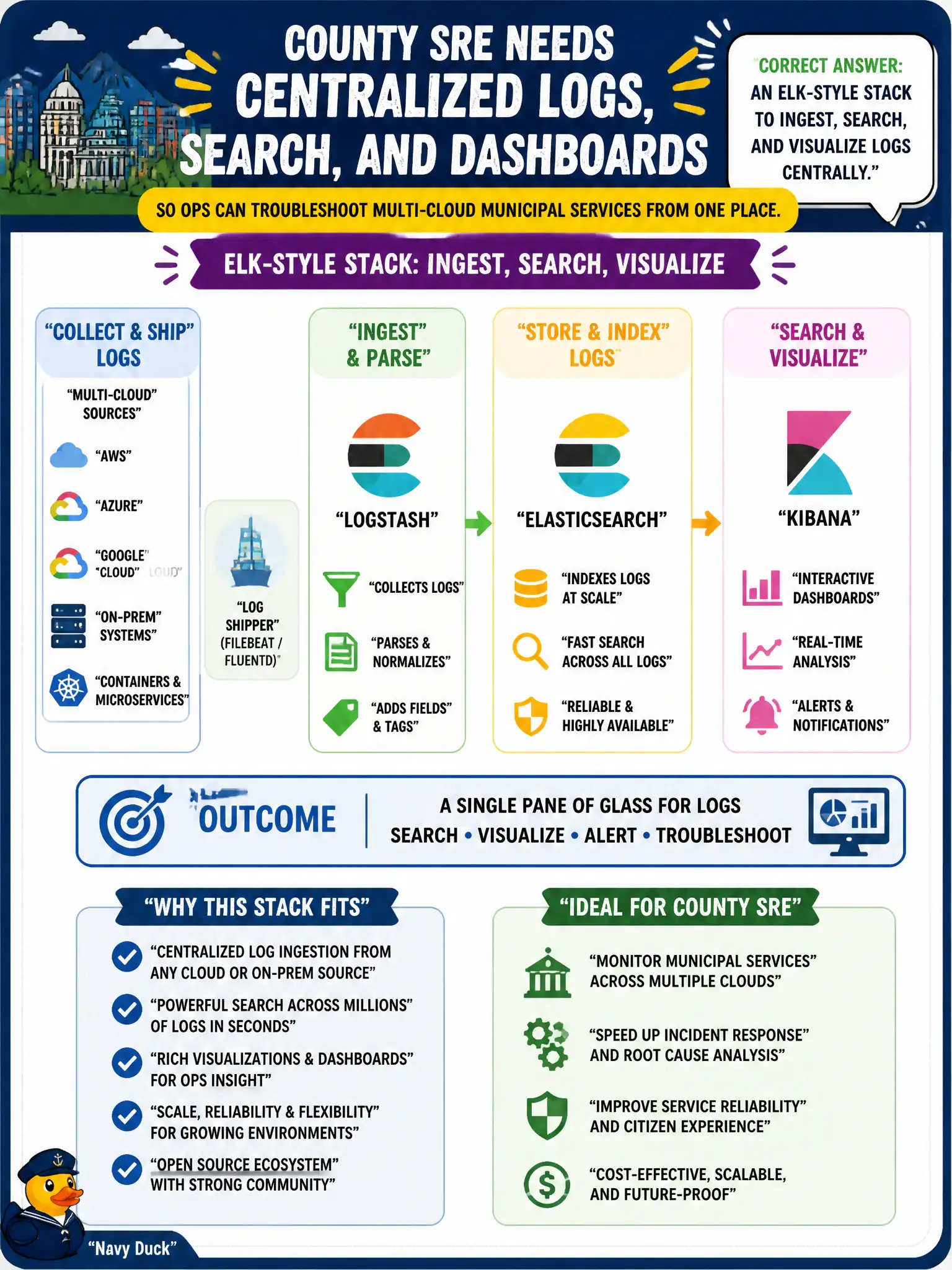
When every service dumps logs into one searchable place with dashboards, you are in ELK-style territory—ingest, search, visualize. Load balancers and DHCP are important, but they are not your central log brain. Ops troubleshooting loves that single pane for text search.
Full Explanation
County SRE that wants centralized log ingest, search, and dashboards so ops can troubleshoot multi-cloud municipal services from one place should choose an ELK-style stack to ingest, search, and visualize logs centrally. Central search shortens incident time when civic services span accounts and providers. A load balancer that only distributes HTTP traffic with no log index is traffic management, not log analytics. A GPU reservation system that schedules training jobs without log search does not meet the troubleshooting requirement. A DHCP server that only hands out addresses on the civic VLAN addresses IP assignment, not log aggregation. Exam caveat: central logging needs retention, access control, and PII handling appropriate to municipal data—not only pretty dashboards. Operational check: ship a sample service's logs to the ELK-style pipeline, confirm searchable fields arrive, build an ops dashboard, test an alert from a log pattern, and document index retention for the county SRE runbook. In municipal cloud operations, record the chosen control and the rejected alternatives in the change or incident ticket so future on-call staff understand which failure modes were avoided for city services. Re-validate after the next maintenance window that the same decision still holds under current provider limits, identity bindings, and application versions used by the civic platform team.