
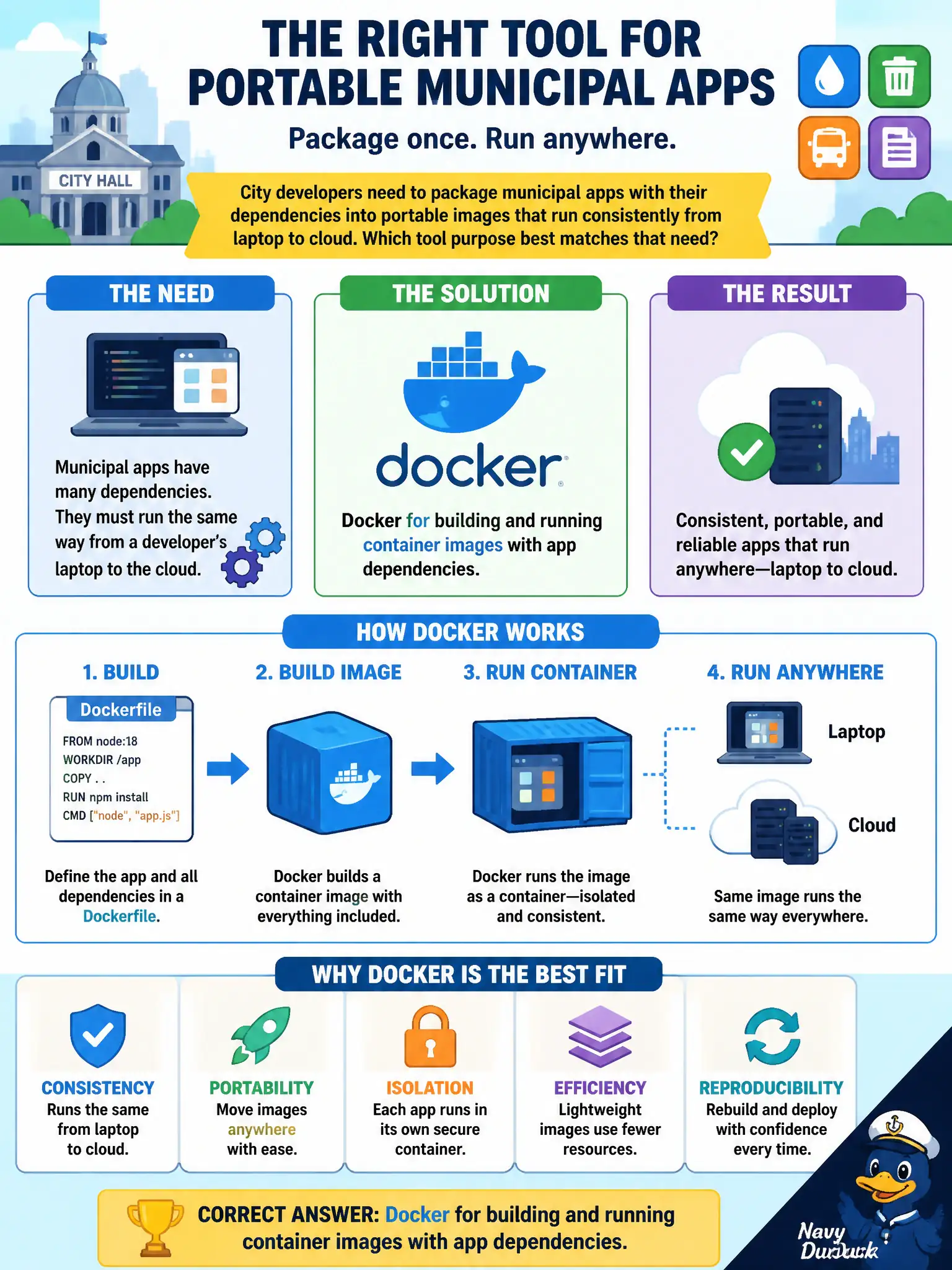
City developers need to package municipal apps with their dependencies into portable images that run consistently from laptop to cloud. Which tool purpose best matches that need?
Select an answer to reveal the explanation.
Short Explanation
Shipping the app plus its libraries in one portable image is classic Docker territory. Same image on a laptop or in the cloud means fewer "works on my machine" surprises. Metrics DBs and paper runbooks do not package runtime dependencies that way.
Full Explanation
City developers who need to package municipal apps with their dependencies into portable images that run consistently from laptop to cloud should use Docker for building and running container images with app dependencies. Containers improve consistency across civic environments when images are built once and promoted. A time-series metrics database used only for alert thresholds does not package applications. A physical barcode scanner inventory system for city warehouses is operational logistics, not app packaging. A spreadsheet macro that prints paper runbooks for each release does not produce portable runtime images. Exam caveat: containers do not remove the need for orchestration, registries, scanning, and least-privilege runtime configuration in municipal production. Operational check: write a Dockerfile for a sample civic app, build and run locally, push to the municipal registry, deploy the same digest to a cloud test cluster, and scan the image before any production promotion. In municipal cloud operations, record the chosen control and the rejected alternatives in the change or incident ticket so future on-call staff understand which failure modes were avoided for city services. Re-validate after the next maintenance window that the same decision still holds under current provider limits, identity bindings, and application versions used by the civic platform team.