
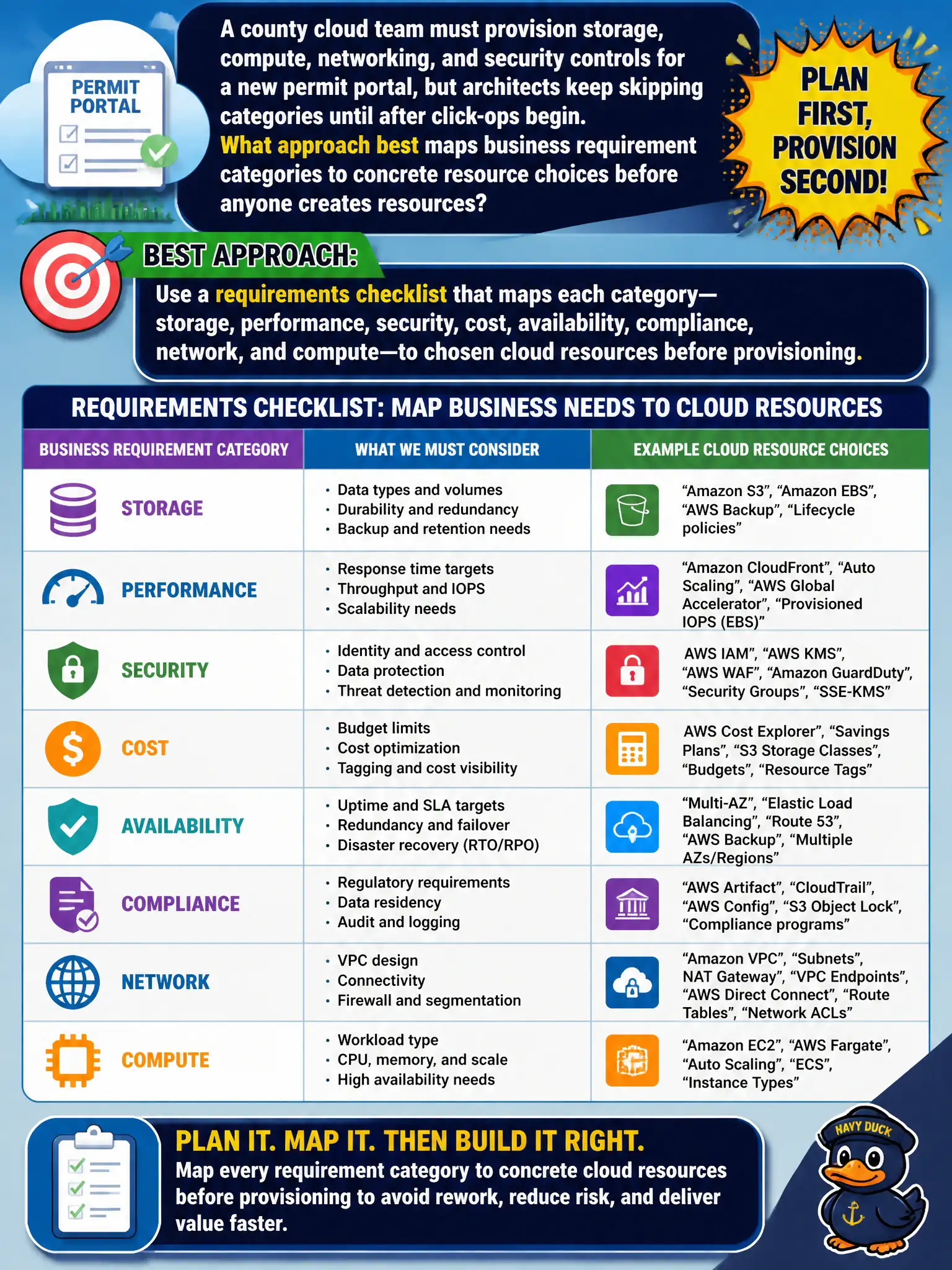
A county cloud team must provision storage, compute, networking, and security controls for a new permit portal, but architects keep skipping categories until after click-ops begin. What approach best maps business requirement categories to concrete resource choices before anyone creates resources?
Select an answer to reveal the explanation.
Short Explanation
Picture a grocery list before you hit the aisle—you decide milk and eggs up front instead of wandering and hoping. A requirements checklist does that for cloud: storage, security, cost, availability, and the rest get mapped to real resource choices before anyone clicks Create. Skipping it is how surprise bills and missing controls show up on launch day.
Full Explanation
A requirements checklist that maps storage, performance, security, cost, availability, compliance, network, and compute categories to concrete cloud resources before provisioning prevents architects from skipping categories until after click-ops begin on a county permit portal. Provisioning first from a favorite VM size then inventing documentation after go-live fails requirements-driven design. Relying only on a verbal hallway agreement and skipping written mapping fails auditability and completeness. Disabling cost and compliance categories so the portal can launch with fewer decisions fails municipal control obligations. Exam caveat: systematic requirement-to-resource mapping is a provisioning discipline; exams may list the category set explicitly. Operational check: complete the checklist in design review, attach SKU choices and guardrails, and block pipeline applies that lack category coverage for the civic portal. In municipal platform operations, record the chosen control and the rejected alternatives in the change record so future on-call engineers understand the failure modes avoided for citizen services. Re-check the decision after the next provider feature change or compliance update to ensure the same answer still holds for the city's estate.