
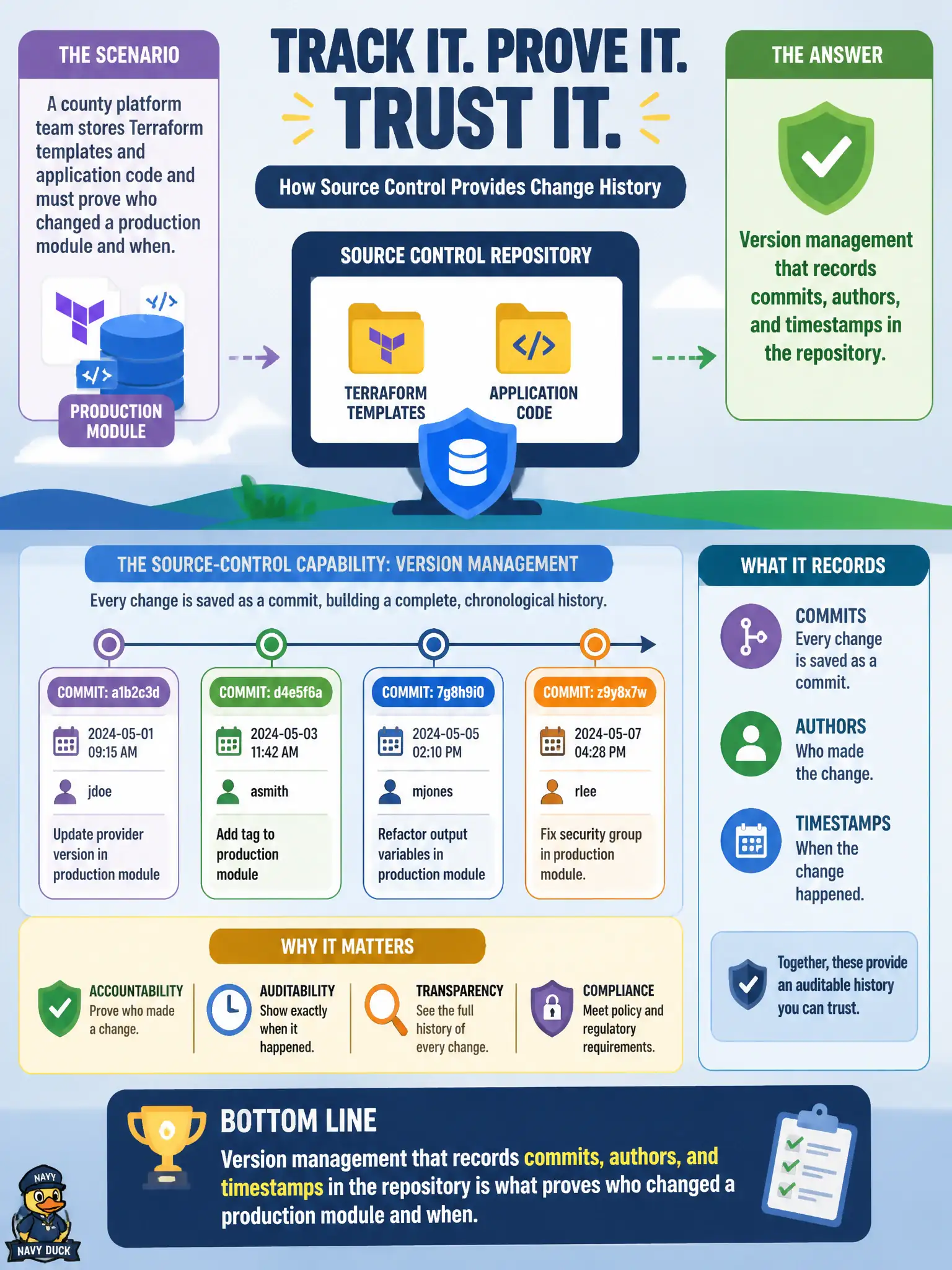
A county platform team stores Terraform templates and application code and must prove who changed a production module and when. Which source-control capability primarily provides that history?
Select an answer to reveal the explanation.
Short Explanation
Source control is the city’s black box recorder for code and IaC. Commits stamp who touched what and when, so ‘who changed that module?’ is a git log, not a scavenger hunt through chat. Skip the live-only server edits—history lives in the repo.
Full Explanation
When a county platform team stores Terraform templates and application code and must prove who changed a production module and when, the capability that primarily provides that history is version management that records commits, authors, and timestamps in the repository. Source control is the municipal black-box recorder for infrastructure-as-code and application changes, enabling blame, rollback, and audit sampling against exact revisions. Ad hoc chat screenshots saved in a shared drive folder are incomplete, editable, and not bound to a specific file tree state. Monthly email summaries without linking to specific revisions cannot answer precise "who changed this line" questions during an incident. Live-only edits on production servers with no repository copy destroy reproducibility and leave no trustworthy author timeline for auditors. Exam caveat: commit history is necessary but not sufficient on its own—protected branches, required peer review, and retention settings strengthen the civic audit story beyond raw commits. Operational check: open git log and blame for the production module across the change window, match author and timestamp to the change ticket, ensure production applies reference reviewed commits only, store the commit SHA in the municipal release record, and confirm remote retention meets audit policy for city infrastructure code.