
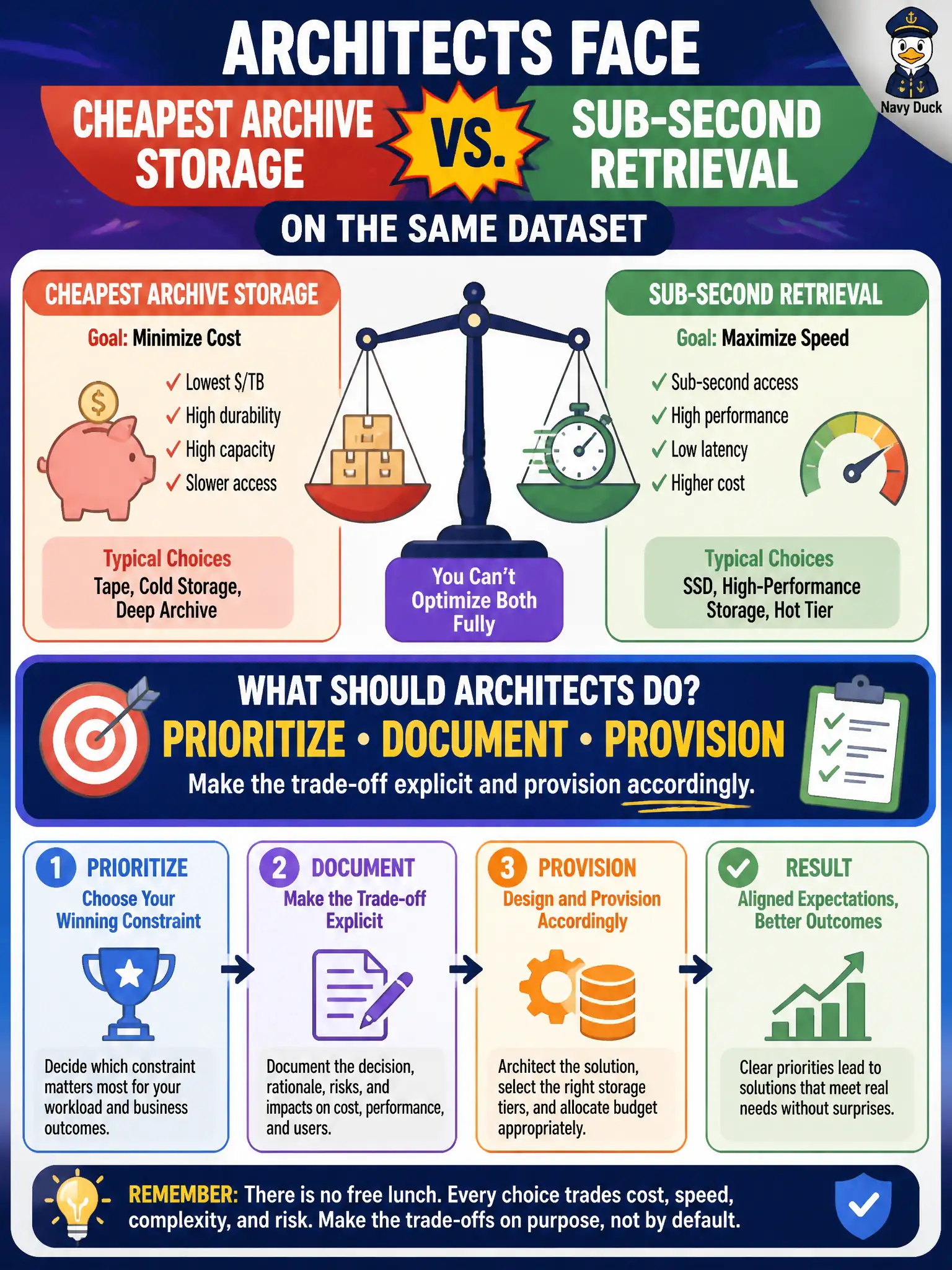
Architects face cheapest archive storage versus a mandate for sub-second retrieval on the same dataset. What should they do?
Select an answer to reveal the explanation.
Short Explanation
You cannot have the bargain basement vault and the express elevator at the same time without picking a winner. Call the trade-off out loud, write it down, then provision to that priority.
Full Explanation
When cheapest archive storage conflicts with a mandate for sub-second retrieval on the same dataset, architects must prioritize explicitly which constraint wins, document the trade-off, and provision accordingly rather than pretending one tier satisfies both extremes. Ignoring the conflict and provisioning both extremes on one unmanaged disk fails to resolve the requirement clash. Deleting the retrieval requirement from the SLA without stakeholder agreement fails governance and civic accountability. Assuming cold archive tiers always deliver sub-second reads fails technically and sets false expectations. Exam caveat: competing non-functional requirements require an explicit priority decision and documented trade-off—not silent assumption. Operational check: convene records and application owners, pick the governing SLA, select tiering or dual-copy designs if needed, and publish the decision in the architecture record for auditors. In municipal platform operations, record the chosen control and the rejected alternatives in the change record so future on-call engineers understand the failure modes avoided for citizen services. Re-check the decision after the next provider feature change or compliance update to ensure the same answer still holds for the city's estate.