
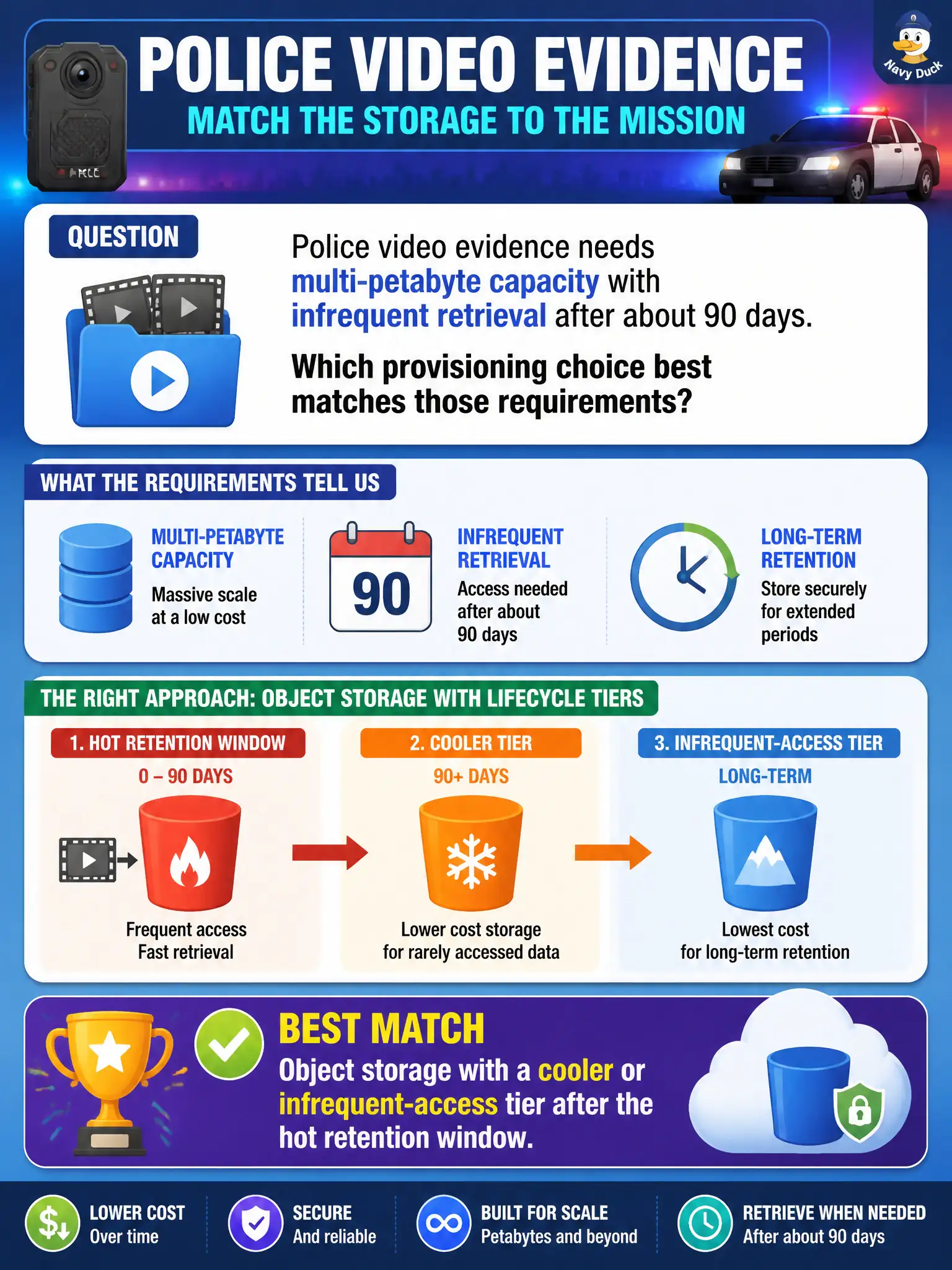
Police video evidence needs multi-petabyte capacity with infrequent retrieval after about 90 days. Which provisioning choice best matches those requirements?
Select an answer to reveal the explanation.
Short Explanation
Huge piles of video that mostly sit quiet after three months want a big object bucket, not a lonely NVMe stick. Slide them into a cheaper, cooler tier once the hot window ends. That matches capacity and access without a USB courier route.
Full Explanation
Object storage with a cooler or infrequent-access tier after the hot retention window matches multi-petabyte police video evidence that is rarely retrieved after about 90 days. Lifecycle policies move objects to cheaper tiers while preserving durability and auditability for civic evidence. Local NVMe scratch on a single GPU workstation only fails capacity, durability, and shared access needs. In-memory cache clusters as the sole long-term archive fail persistence and cost realities. Consumer USB drives shipped between precincts each night fail chain-of-custody and scale. Exam caveat: map retention temperature to storage tier—hot versus infrequent or archive—rather than defaulting to block disks for everything. Operational check: set lifecycle transitions at day 90, verify retrieval SLAs still meet legal timelines, enable encryption and object lock if evidence policy requires, and test restore of a sample case file quarterly. In municipal platform operations, record the chosen control and the rejected alternatives in the change record so future on-call engineers understand the failure modes avoided for citizen services. Re-check the decision after the next provider feature change or compliance update to ensure the same answer still holds for the city's estate.