
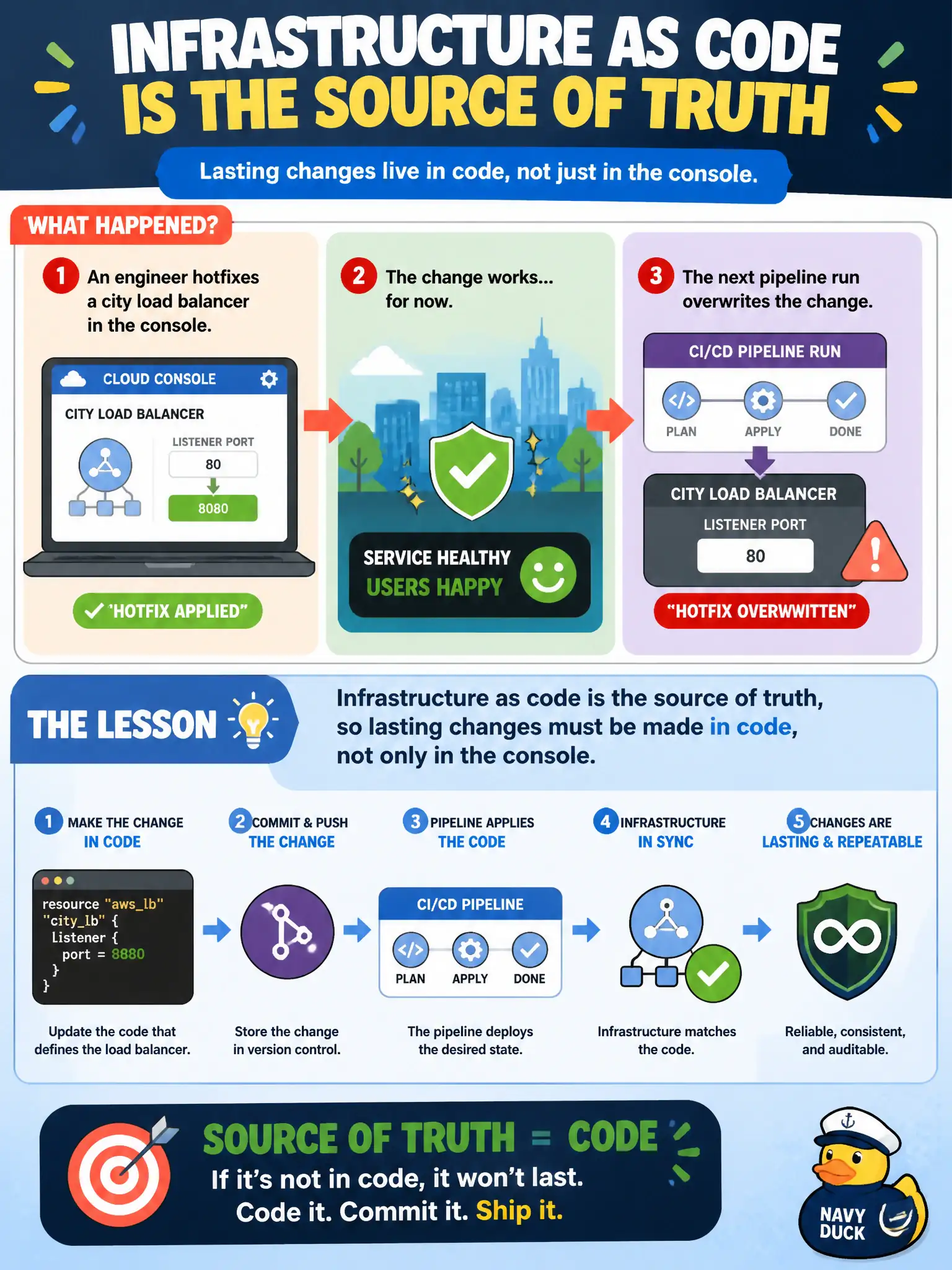
An engineer hotfixes a city load balancer in the console, then the next pipeline run overwrites the change. What lesson should the team reinforce?
Select an answer to reveal the explanation.
Short Explanation
Fixing live gear by hand is like taping a note on a printer that the nightly rebuild ignores—the tape falls off when automation reapplies the real blueprint. Put lasting fixes in the code.
Full Explanation
Infrastructure as code is the source of truth, so lasting changes must be made in code rather than only in the console. When an engineer hotfixes a city load balancer interactively and the next pipeline run overwrites it, the lesson is that out-of-band edits are ephemeral unless codified. Console edits permanently override all future pipeline applies fails the usual reapply model. Pipelines must be deleted after every successful hotfix fails and destroys governance. Load balancers cannot be managed by templates once created fails; they remain IaC-manageable. Exam caveat: expect code wins on reconcile behavior unless the platform is explicitly unmanaged; Cloud+ stresses source-of-truth discipline. Operational check: after emergency console changes, either revert live state or immediately PR the equivalent template change, then let the pipeline converge; add drift alerts on civic load balancers. In municipal platform operations, record the chosen control and the rejected alternatives in the change record so future on-call engineers understand the failure modes avoided for citizen services. Re-check the decision after the next provider feature change or compliance update to ensure the same answer still holds for the city's estate.