
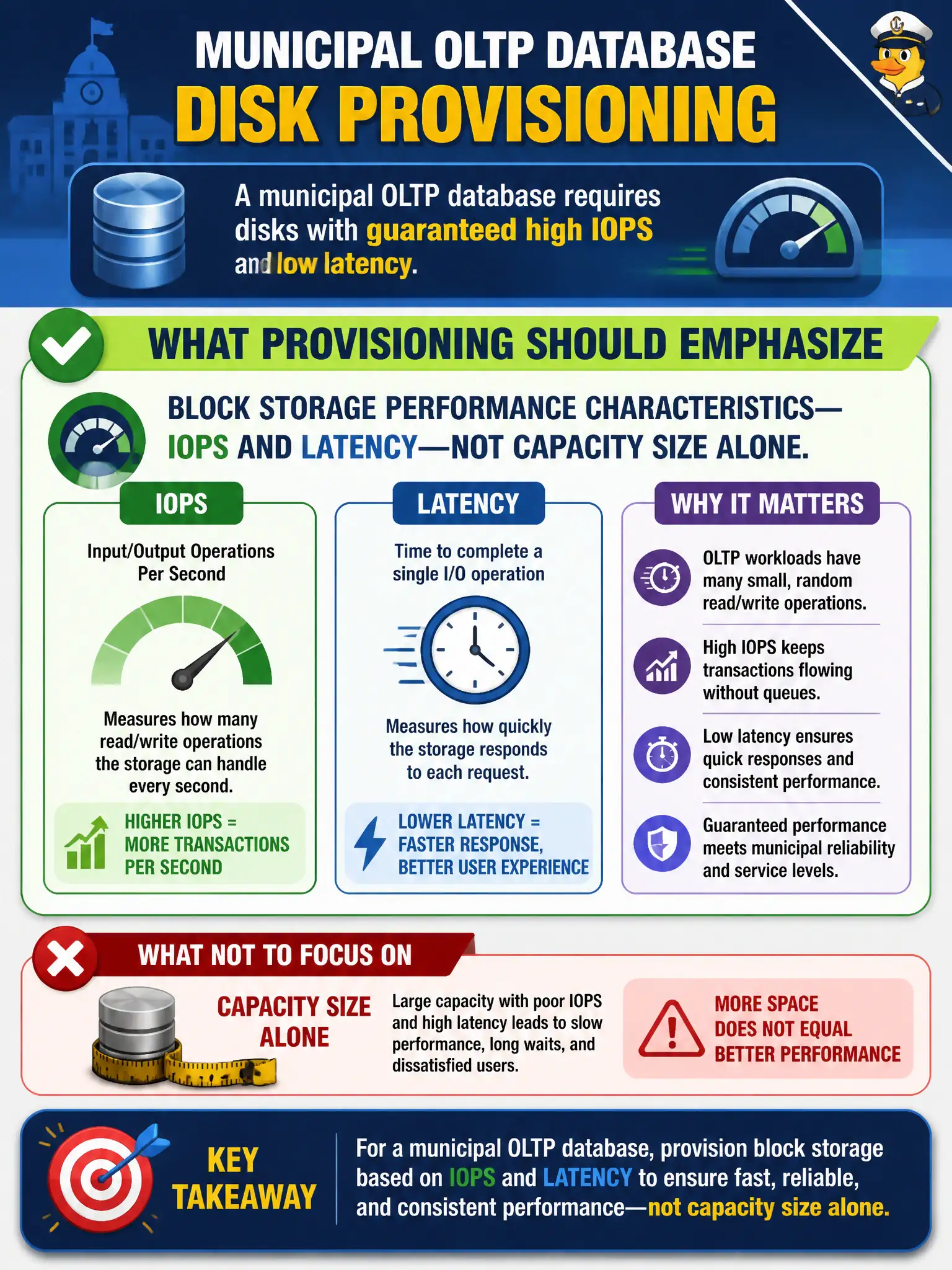
A municipal OLTP database requires disks with guaranteed high IOPS and low latency. What should provisioning emphasize?
Select an answer to reveal the explanation.
Short Explanation
An OLTP database is like a busy teller window—it needs snappy disks, not a deep archive vault. Size the IOPS and latency, not just how many terabytes fit on the label.
Full Explanation
Block storage performance characteristics—IOPS and latency—must be provisioned deliberately for a municipal OLTP database; capacity size alone is insufficient if the disks cannot sustain transactional load. Emphasizing guaranteed high IOPS and low latency is the correct provisioning focus. Archive object tiers optimized only for annual retrieval fail OLTP latency needs. Lowest-cost HDD without performance SLAs fails guaranteed IOPS requirements. CDN edge caches as the primary transactional datastore fail consistency and write semantics for databases. Exam caveat: storage items separate capacity from performance KPIs—especially for databases. Operational check: choose provisioned IOPS or equivalent tiers, benchmark representative civic transactions, watch queue depth and latency dashboards, and rightsize before tax-season peaks. In municipal platform operations, record the chosen control and the rejected alternatives in the change record so future on-call engineers understand the failure modes avoided for citizen services. Re-check the decision after the next provider feature change or compliance update to ensure the same answer still holds for the city's estate. Confirm monitoring, access reviews, and backup coverage still align with the selected approach before closing the civic hypercare period.