
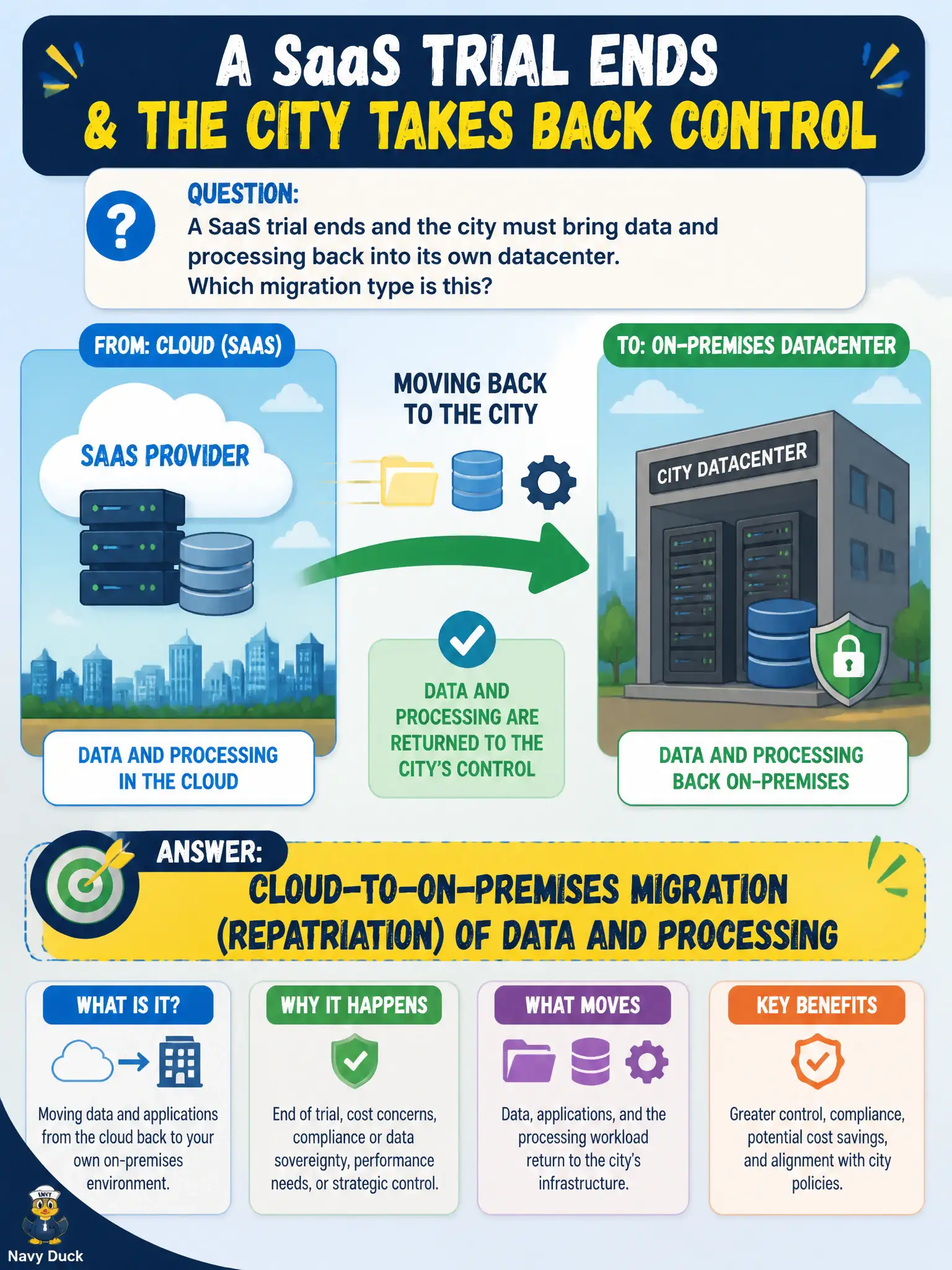
A SaaS trial ends and the city must bring data and processing back into its own datacenter. Which migration type is this?
Select an answer to reveal the explanation.
Short Explanation
Trial over, packing the boxes to bring work home — that is repatriation, cloud back to on-premises. You are leaving the SaaS attic and returning to the city datacenter. That is the opposite of first-time cloud lift or provider-to-provider hops.
Full Explanation
Cloud-to–on-premises migration, often called repatriation, returns workloads or data from a cloud or SaaS environment into customer-owned facilities. When a SaaS trial ends and the city must bring data and processing back into its own datacenter, that directional move is repatriation rather than a first-time cloud landing. On-premises-to-cloud lift of a basement app into IaaS fails because the motion is outbound from SaaS toward city facilities, not into cloud. Cloud-to-cloud move that stays entirely within public providers fails because the target is the municipal datacenter. Rehost within the same SaaS tenant without leaving the vendor platform fails because the city is exiting the SaaS environment. Exam caveat: migration direction items hinge on source and destination ownership—SaaS/cloud back to on-premises is repatriation even when business language says bring it home. Operational check: export in usable formats before the trial expires, validate integrity checksums, restore into approved civic systems, revoke SaaS tokens, and update records-retention maps so legal hold still works offline. In municipal platform operations, record the chosen control and the rejected alternatives in the change record so future on-call engineers understand the failure modes avoided for citizen services. Re-check the decision after the next provider feature change or compliance update to ensure the same answer still holds for the city's estate.