
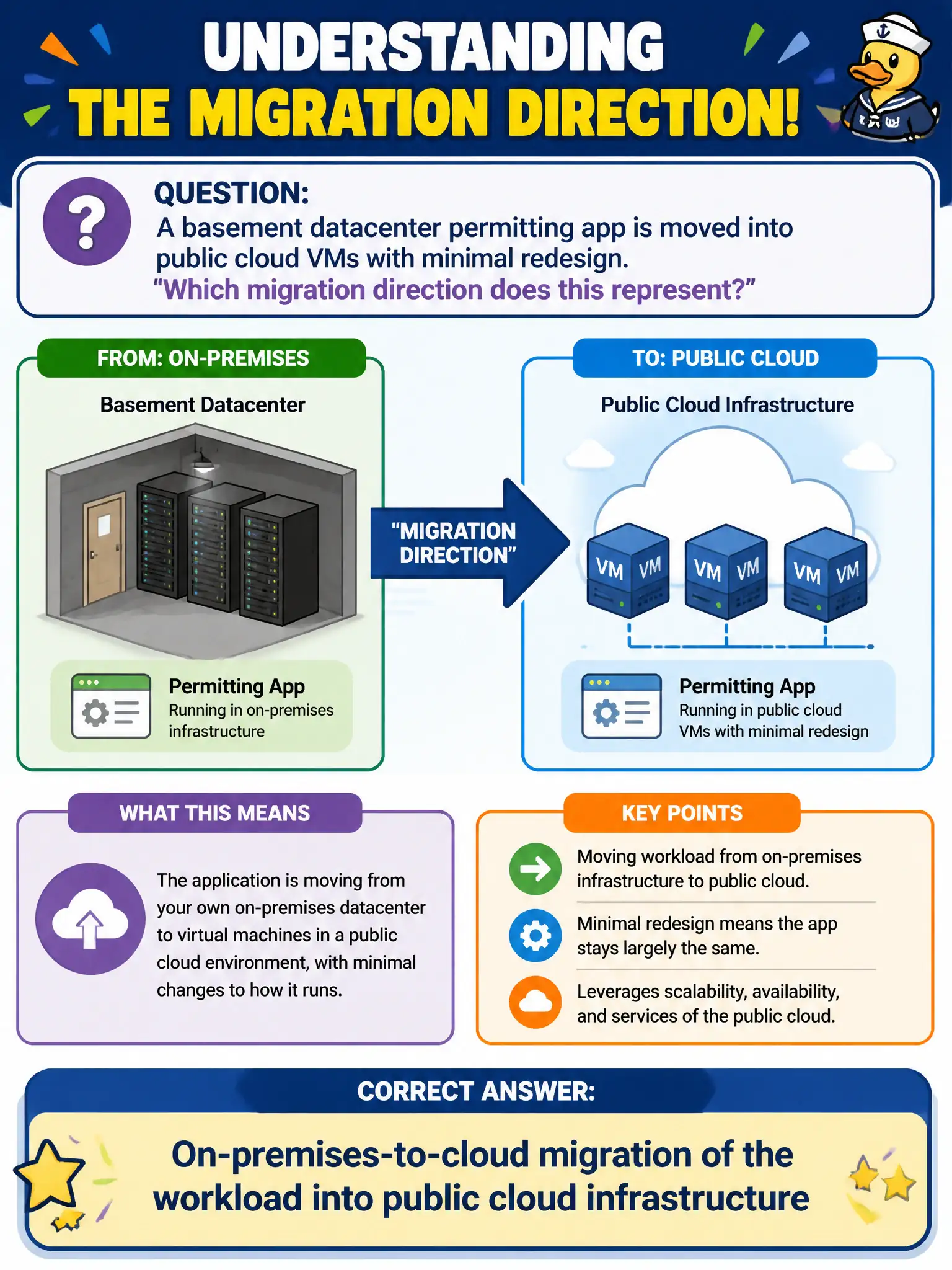
A basement datacenter permitting app is moved into public cloud VMs with minimal redesign. Which migration direction does this represent?
Select an answer to reveal the explanation.
Short Explanation
The app lived in the basement; now it lives in cloud VMs — that is on-premises-to-cloud, plain and simple. You are not hopping provider-to-provider or dragging SaaS back downstairs. Minimal redesign still counts as a migration into the cloud.
Full Explanation
On-premises-to-cloud migration relocates workloads from local datacenters into cloud infrastructure or services. Moving a basement permitting application into public cloud VMs with minimal redesign is that directional pattern, commonly executed as rehost when speed to exit aging hardware matters for municipal operations. Cloud-to-cloud migration between two hyperscalers fails because the source is on-premises, not another cloud provider. Cloud-to–on-premises repatriation fails because the workload is leaving the basement rather than returning to it. Retiring the application without relocating it fails because the app is moved, not decommissioned. Exam caveat: migration questions separate direction (on-prem→cloud, cloud→on-prem, cloud→cloud) from strategy (rehost, replatform, re-architect); answer the dimension the stem asks. Operational check: inventory dependencies, choose landing VPC and identity integration, validate backup and connectivity cutover, and confirm citizen-facing permit SLAs after the first production wave. Keep a rollback path to on-premises snapshots until the municipal hypercare period ends and residual risk is accepted. Confirm licensing, agent coverage, and monitoring on the new cloud VMs so civic operations does not inherit a silent observability gap after basement hardware is powered down.