
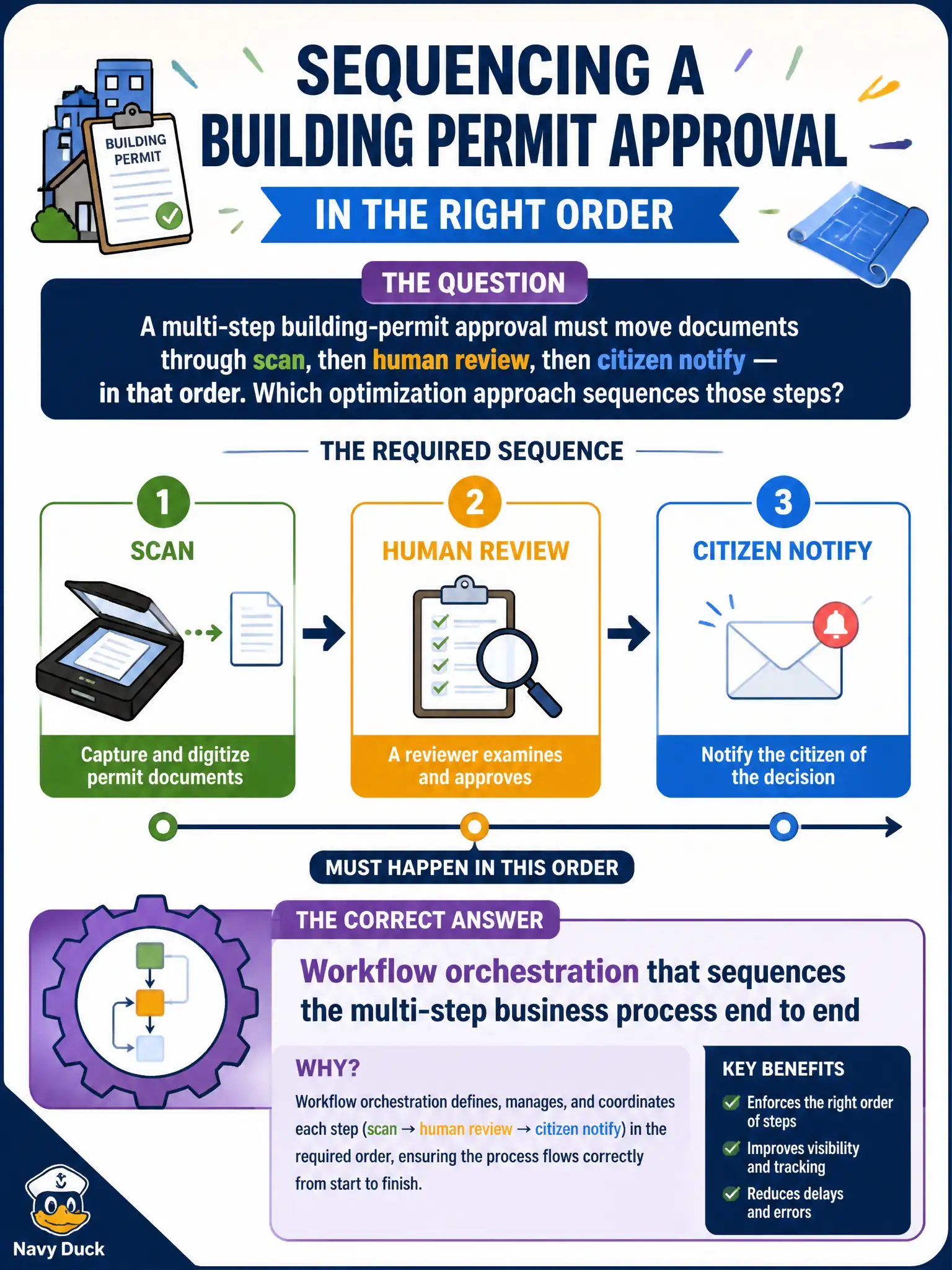
A multi-step building-permit approval must move documents through scan, then human review, then citizen notify — in that order. Which optimization approach sequences those steps?
Select an answer to reveal the explanation.
Short Explanation
Permits are a relay race: scan hands the baton to review, then review hands it to notify. Workflow orchestration is the race director that keeps those stages in order. More CPU alone does not invent that sequence.
Full Explanation
Workflow orchestration sequences a multi-step business process so each stage runs in a defined order—often with branching, human tasks, timers, and compensations—across services and people. A building-permit approval that must move documents through scan, then human review, then citizen notify requires workflow orchestration to enforce that order end to end rather than hoping microservices are called correctly by accident. Randomly invoking microservices without defined stage order can skip reviews or notify citizens prematurely, creating compliance and customer-service failures. Increasing only the VM CPU count without modeling process stages may speed a single step but does not sequence the business process. Disabling audit logging so approvals complete silently undermines accountability and still does not provide ordered orchestration. Exam caveat: distinguish container/workload orchestration (placement and healing) from business workflow orchestration (process stages)—Cloud+ stems may use “orchestration” in either sense; read carefully for business order versus cluster scheduling. Operational check: model permit stages with explicit transitions and role checks, persist workflow state durably, emit audit events for each stage, test failure and retry at the human review step, and verify citizens are notified only after required approvals complete.