
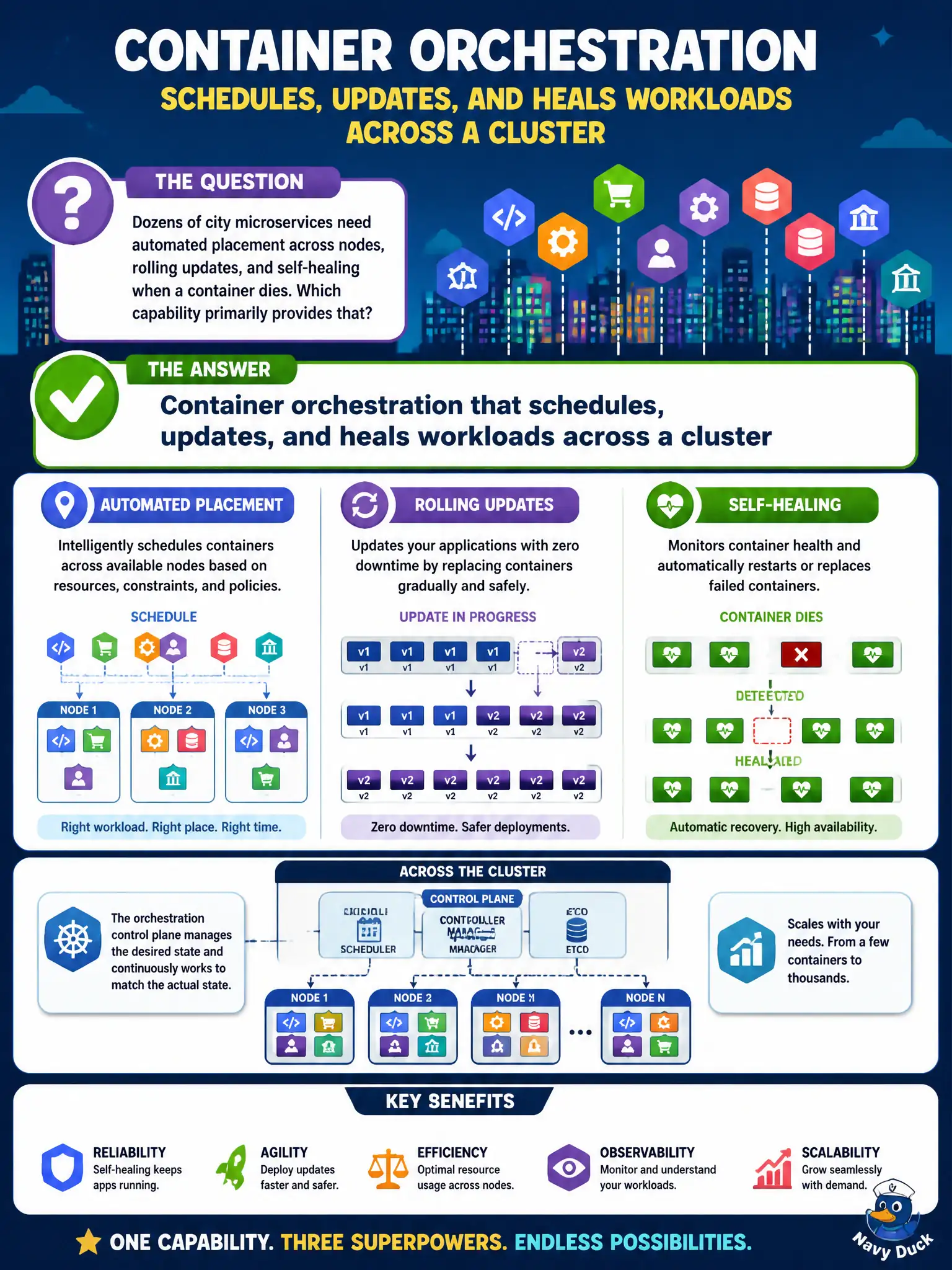
Dozens of city microservices need automated placement across nodes, rolling updates, and self-healing when a container dies. Which capability primarily provides that?
Select an answer to reveal the explanation.
Short Explanation
When you have a flock of microservices, you need a traffic-cop system that parks them on healthy nodes, rolls out updates, and restarts what crashes. That is container orchestration. Spreadsheets and hand restarts do not scale past a handful of boxes.
Full Explanation
Container orchestration schedules workloads across cluster nodes, performs rolling updates, and restarts or replaces containers that fail health checks so operators are not the primary healing mechanism. Dozens of city microservices that need automated placement, rolling updates, and self-healing therefore primarily require an orchestration platform rather than ad-hoc host logins. Manual RDP into each host to restart processes by hand every morning does not scale, is error-prone, and is not automated healing. A spreadsheet listing desired pod counts without an active control plane records intent but cannot enforce desired state when nodes or containers fail. Consumer desktop antivirus software installed only on citizen laptops does not schedule or heal municipal microservice containers in the city’s cluster. Exam caveat: orchestration is the control plane for containerized estates—distinct from merely building a container image or running one container on a laptop without scheduling. Operational check: onboard microservices as deployments with resource requests and probes, enable rolling update strategies, test node failure and pod reschedule during a drill, restrict cluster RBAC to least privilege, and monitor pending pods, restart counts, and error budgets for citizen-facing services.