
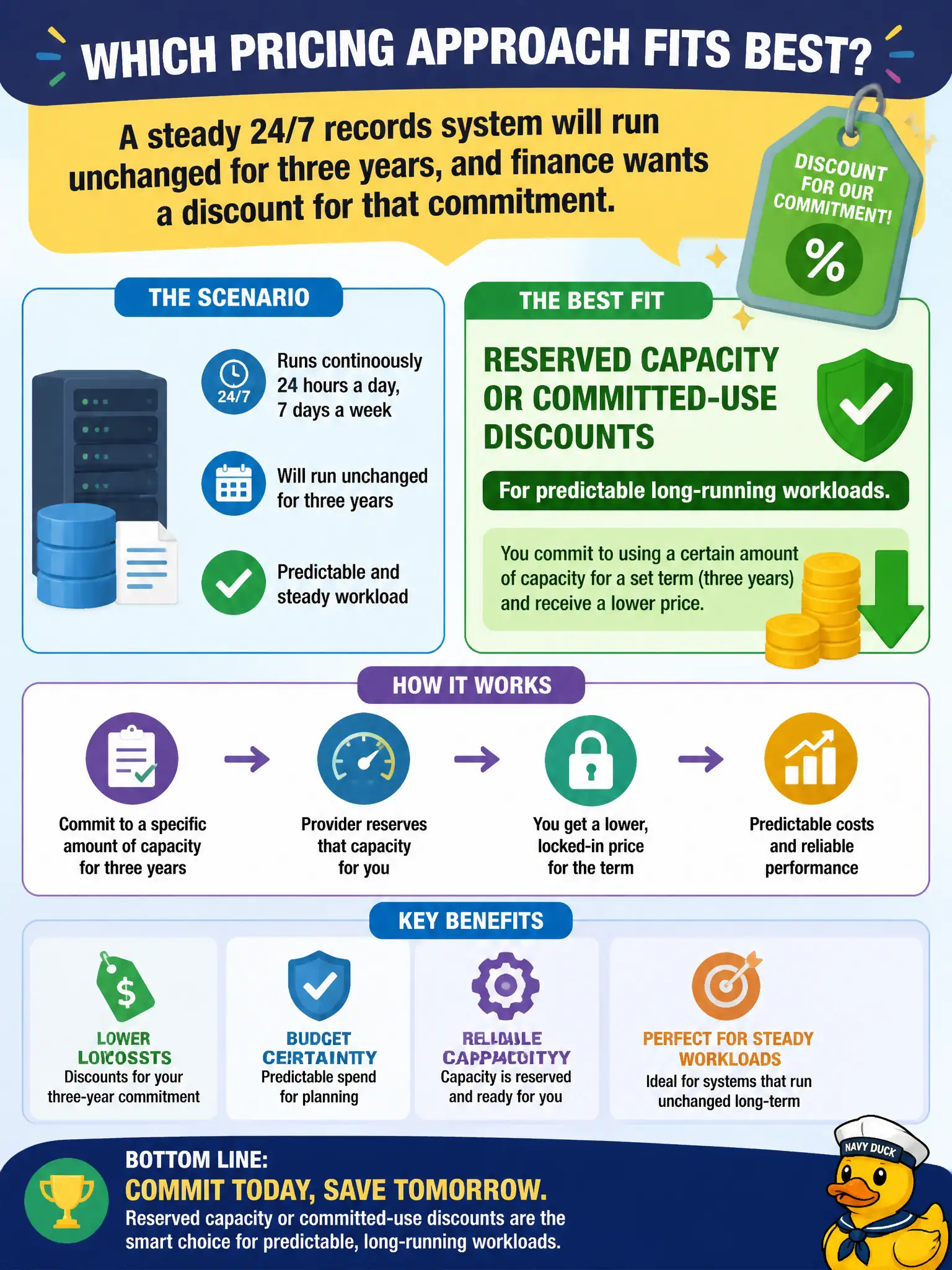
A steady 24/7 records system will run unchanged for three years, and finance wants a discount for that commitment. Which pricing approach fits best?
Select an answer to reveal the explanation.
Short Explanation
If the lights stay on for three years straight, reserve the seats and pocket the discount—like buying a transit pass instead of daily tickets. Spot is for work that can vanish. Steady records belong on committed pricing.
Full Explanation
Reserved capacity or committed-use discounts exchange a term commitment—commonly one or three years—for lower unit rates on predictable, steady-state compute. A records system that will run unchanged twenty-four hours a day for three years is the textbook municipal candidate for reserved or committed pricing rather than remaining on pure on-demand rates. Using only spot instances is inappropriate when interruption would break an always-on records system that citizens and clerks rely on continuously. Paying on-demand rates forever while refusing any term commitment forgoes the discounts finance is explicitly seeking. Deleting the VMs nightly and hoping cold starts finish before business hours introduces unnecessary risk, data inconsistency risk, and contradicts a steady 24/7 availability requirement. Exam caveat: reservations optimize cost for steady baselines; leave burst headroom on on-demand or autoscaling for spikes rather than over-reserving every peak hour or seasonal surge. Operational check: baseline the records system’s continuous vCPU and memory footprint for a representative month, purchase matching reserved or committed capacity in the correct region, tag resources to the commitment for chargeback, review utilization monthly, and avoid covering interruptible lab workloads with long-term reservations.