
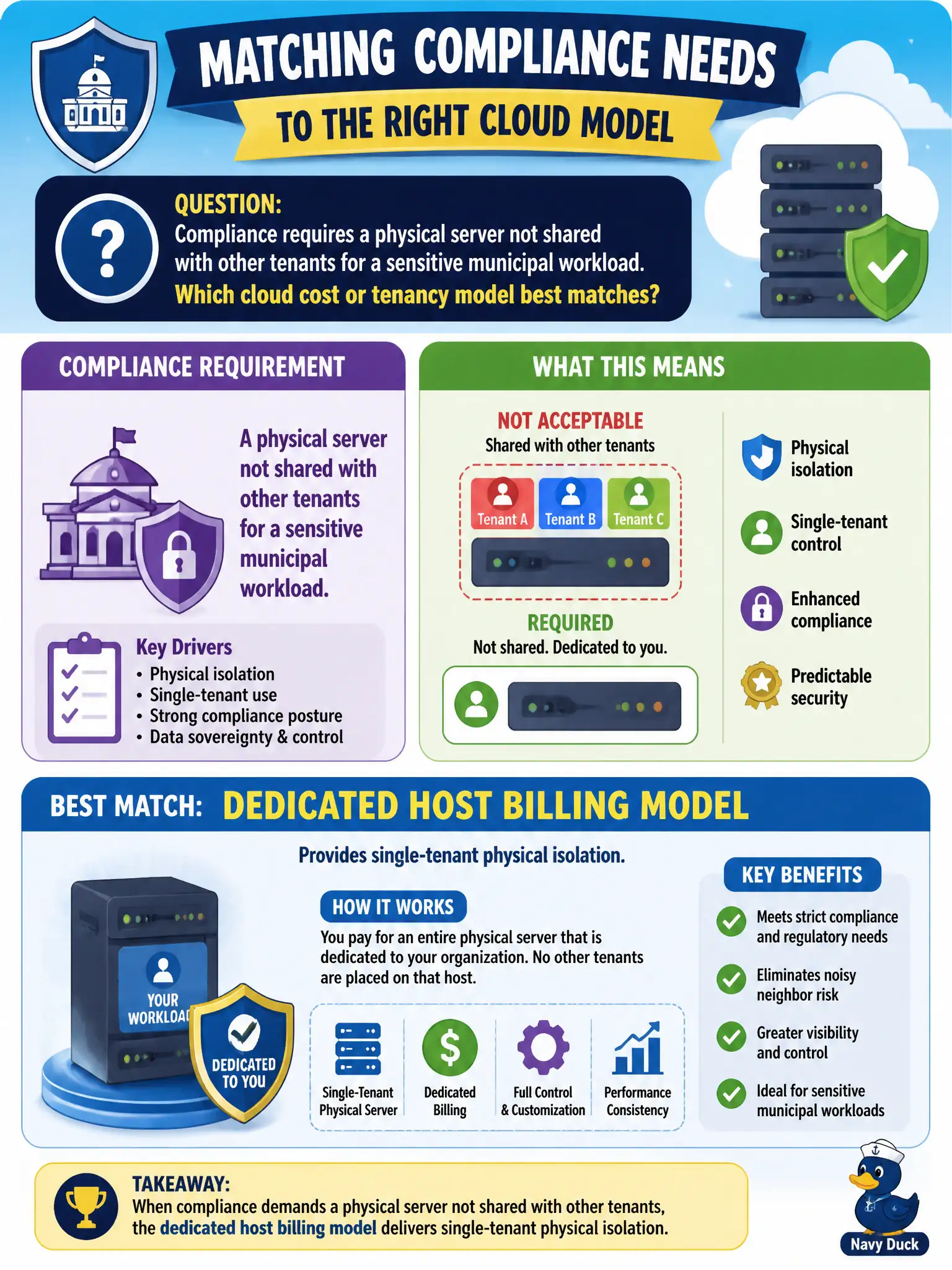
Compliance requires a physical server not shared with other tenants for a sensitive municipal workload. Which cloud cost or tenancy model best matches?
Select an answer to reveal the explanation.
Short Explanation
Dedicated hosts are private offices instead of open cubicles—you pay for the whole physical box so no other tenant sits next door. Compliance teams love that isolation story. Spot and busy shared hosts will not satisfy that requirement.
Full Explanation
Dedicated host billing provides single-tenant physical isolation so a sensitive municipal workload need not share the underlying server with unrelated customer tenants. Compliance language that requires a physical server not shared with other tenants maps directly to dedicated hosts or equivalent dedicated tenancy offerings. Interruptible spot capacity may be reclaimed without notice and is typically multi-tenant, failing both isolation and stability needs for sensitive systems. A multi-tenant burstable shared host explicitly accepts noisy-neighbor risk and shared tenancy. Pure serverless functions abstract away server mapping and do not give the city an isolatable physical server to show auditors. Exam caveat: dedicated hosts address tenancy, sometimes licensing, and compliance placement controls; they usually cost more than shared multi-tenant on-demand capacity and still require the city to patch guest OS and apps on IaaS. Operational check: select dedicated hosts in the approved region and AZ, place the sensitive workload there, verify tenancy settings in the provider console and CMDB, align capacity and patching with the host lifecycle, and retain screenshots or API evidence for compliance reviews.