
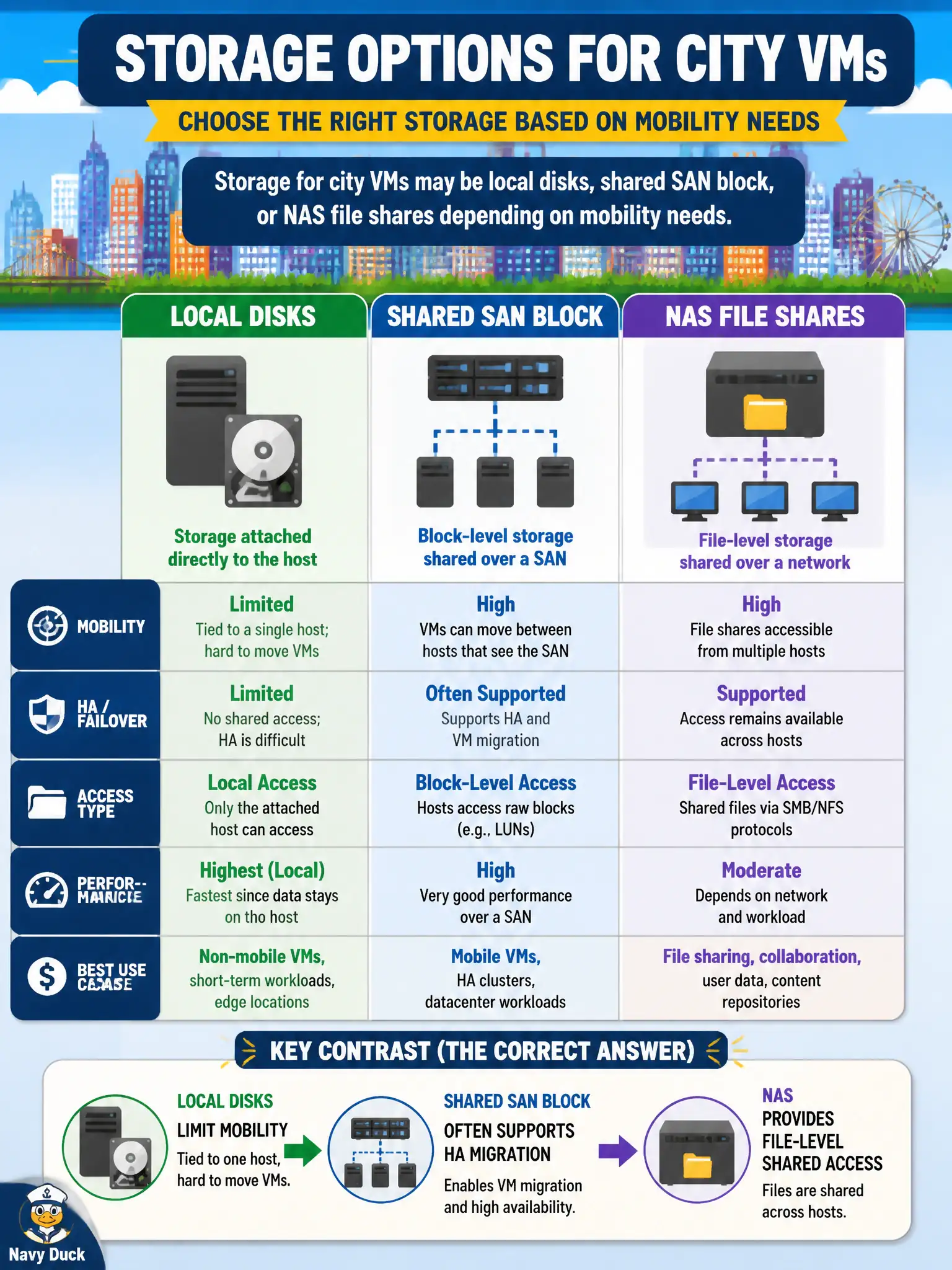
Storage for city VMs may be local disks, shared SAN block, or NAS file shares depending on mobility needs. Which statement correctly contrasts these options?
Select an answer to reveal the explanation.
Short Explanation
Local disks are suitcase storage stuck to one host; SAN block is a shared vault that helps VMs move; NAS is the hallway file cabinet everyone mounts. Pick based on whether the VM needs to pack up and relocate. Mobility needs drive the choice.
Full Explanation
Local disks attached only to one hypervisor limit virtual machine mobility because another host cannot see those disks without replication. Shared SAN block storage is commonly used so clustered hosts can access the same VM disks and support HA migration or failover. NAS provides file-level shared access suitable for file workloads and some shared data, with different locking and performance characteristics than block SAN. Claiming local disks always enable live migration better than any shared SAN reverses typical mobility constraints. Saying NAS can only boot hypervisors and never present data to guests is false. Treating SAN, NAS, and local disks as identical for mobility except bezel color ignores fundamental access and clustering differences. Exam caveat: pick storage backing based on whether VMs must fail over or live-migrate—shared block is the usual HA enabler in classic virtualization questions. Operational check: place HA-critical city VMs on shared or replicated storage, leave truly disposable test VMs on local disk if acceptable, document which datastores support vMotion/live migration equivalents, and test host maintenance with storage still visible to the destination host.