
A forensic lab VM needs direct access to a specialty PCIe card that cannot be fully virtualized. Which technique assigns that device to the guest?
Select an answer to reveal the explanation.
Short Explanation
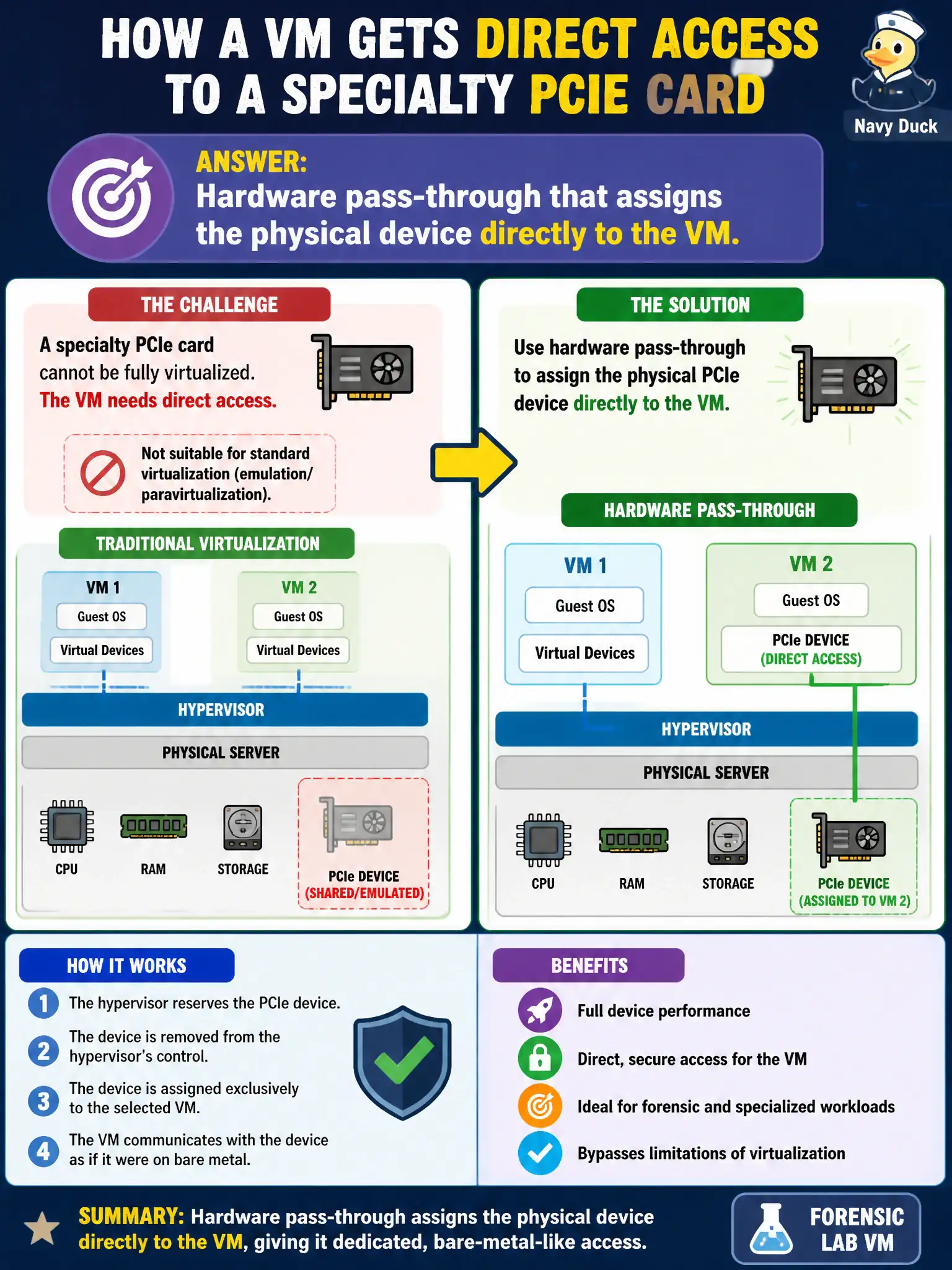
Pass-through hands the real PCIe card to the guest—no fake middle layer when the lab gear will not virtualize cleanly. Think of it as lending the physical tool, not a picture of the tool. Use it when emulation is not enough.
Full Explanation
Hardware pass-through—also called device assignment or PCI pass-through—maps a physical device directly into a guest so the VM can use specialty hardware that is not fully virtualized by the hypervisor. A forensic lab VM that needs a specialty PCIe card therefore uses pass-through rather than relying on a purely emulated or unsupported virtual device that would break evidence acquisition workflows. Nested object storage tiering that supposedly maps PCIe base-address registers into cold archive buckets is not a real device-assignment technique and confuses storage classes with hardware virtualization. File-share quotas that expose a card as a CIFS path under a fake /pci tree confuse network file sharing with device pass-through. Reserved instance billing is a pricing construct and does not automatically virtualize or assign PCIe endpoints to guests. Exam caveat: pass-through typically disables or complicates live migration for that VM because the physical device is tied to one host—plan host affinity, maintenance windows, and HA expectations accordingly for lab operations. Operational check: enable IOMMU/VT-d on the host BIOS and hypervisor, assign only the required PCIe device to the forensic VM, verify the guest driver enumerates the card, restrict administrative access to chain-of-custody standards, and document that the workload is host-affine because of pass-through.