
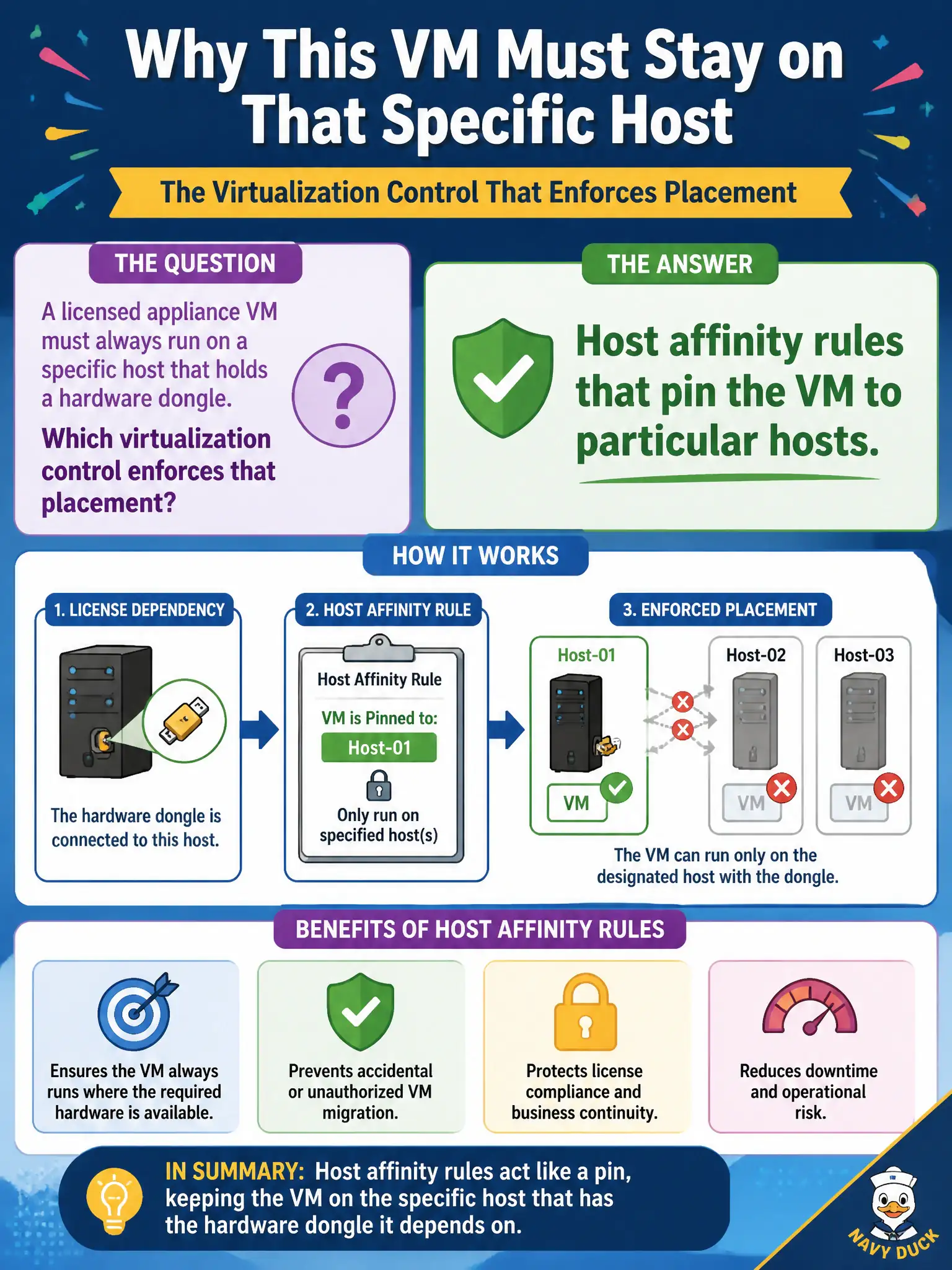
A licensed appliance VM must always run on a specific host that holds a hardware dongle. Which virtualization control enforces that placement?
Select an answer to reveal the explanation.
Short Explanation
Host affinity is a reserved parking spot for that dongle-bound appliance—only the host with the gadget gets the VM. Spreading it everywhere would strand the license. Pin it where the hardware lives.
Full Explanation
Host affinity rules constrain virtual machine placement so a VM runs on a particular host or host group—commonly required when a licensed appliance depends on a hardware dongle, local GPU, or other host-scoped resource. Pinning the licensed appliance VM to the host that holds the dongle is exactly what affinity enforces in municipal virtualization platforms. Horizontal autoscaling that spreads the appliance across every availability zone equally fights the single-dongle constraint and can schedule the VM away from the required hardware. Spot interruption policies that move the VM whenever spare capacity appears can evacuate it from the dongle host without warning. Anycast DNS that randomly resolves to the least-loaded hypervisor influences client routing, not hypervisor placement of a specific appliance VM. Exam caveat: affinity improves placement control but reduces scheduling flexibility and concentrates risk on one host—document that exception for auditors and capacity planners. Operational check: create an affinity (or must-run) rule to the dongle host, verify DRS/automatic migration will not move the VM away, monitor that host’s health closely, maintain a spare dongle or host plan if licensing allows, and record the placement exception in virtualization standards.