
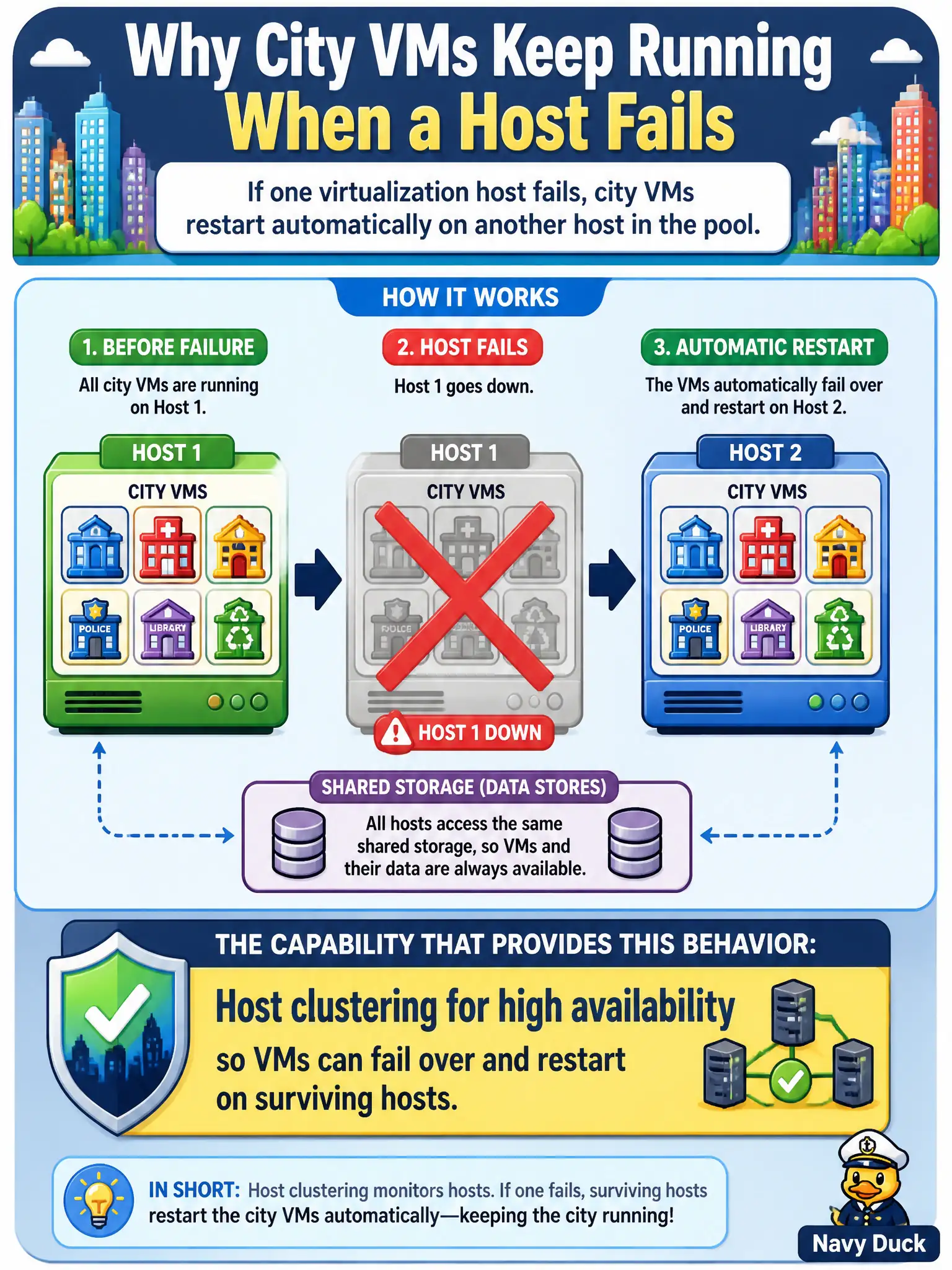
If one virtualization host fails, city VMs should restart automatically on another host in the pool. Which capability provides that behavior?
Select an answer to reveal the explanation.
Short Explanation
HA clustering is the buddy system for hypervisors—when one host drops, another picks up the VMs. Manual after-hours copies are not automatic failover. Design the pool so citizens do not wait on a pager.
Full Explanation
Host clustering for high availability allows virtual machines to restart automatically on surviving hosts when a hypervisor fails, provided shared or replicated storage and healthy cluster membership are configured. City VMs that must recover without waiting for a technician to rebuild a lone host therefore need HA clustering rather than purely manual recovery. Manual cold migration that requires an operator to copy disks after business hours is not automatic failover and extends citizen-facing downtime. Disabling shared storage so each VM can exist on only one local disk forever prevents automated restart on another host. Snapshot deletion policies that remove disks when a heartbeat is missed destroy recovery options instead of providing HA. Exam caveat: HA failover depends on cluster health, fencing or isolation, and accessible VM disks—installing a second hypervisor without shared/replicated storage does not create true automatic restart. Operational check: join hosts to the HA cluster, place VM disks on shared or replicated storage, test intentional host failure in a maintenance window, verify VMs restart on a survivor within the target RTO, and document N-1 capacity headroom so remaining hosts can absorb the load.