
Finance asks why hot object storage for open-data GIS tiles costs more per GB than archive storage holding the same total size of infrequently retrieved maps. What best explains the price difference?
Select an answer to reveal the explanation.
Short Explanation
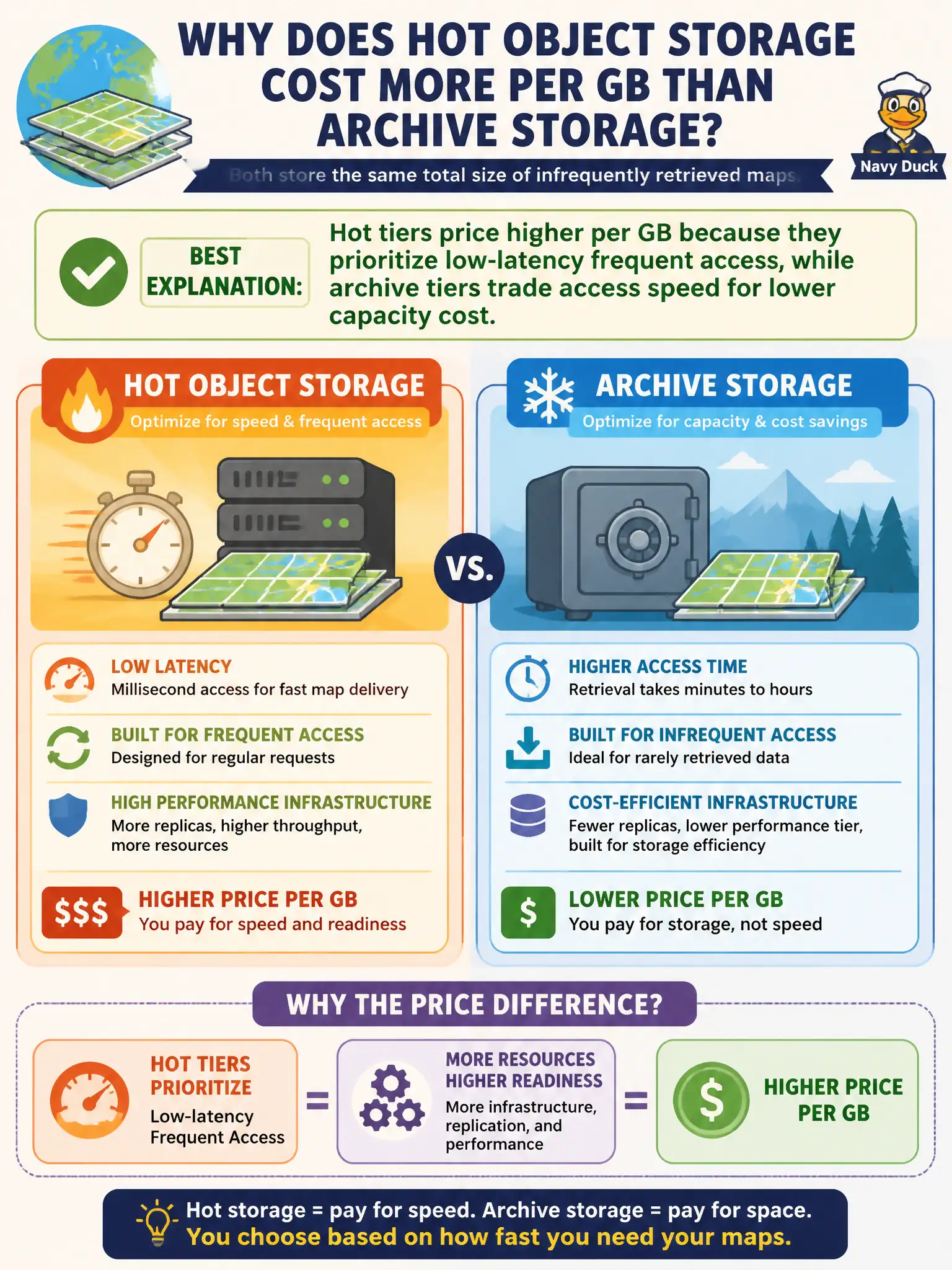
Paying more for hot storage is like keeping milk in the fridge instead of the deep freeze—you pay for grab-and-go convenience. Archive is the warehouse aisle: cheaper per box, slower to fetch. Capacity alone does not set the bill; access performance does.
Full Explanation
Hot object storage prices higher per gigabyte because it is engineered for frequent, low-latency access, whereas archive tiers deliberately trade retrieval speed—and sometimes add restore delay or fees—for much lower capacity cost. Finance comparing open-data GIS tiles on a hot tier with the same total size of infrequently retrieved maps on archive should expect that access-performance difference to drive the unit price gap. Encryption does not uniquely explain the premium: both hot and archive municipal buckets are commonly encrypted, so encryption alone is not why hot costs more per GB. Hot and archive tiers do not bill identically per GB with only egress creating the difference; capacity unit rates themselves typically diverge by class. Claiming hot object storage must run on dedicated physical hosts while archive is “purely virtual” misstates how providers multitenant object platforms and is not the pricing rationale. Exam caveat: Cloud+ cost questions often hinge on access frequency versus retrieval latency—hot versus cool versus archive—not on whether encryption exists. Operational check: classify GIS objects by access pattern, move rarely retrieved maps to archive with tested restore procedures, keep popular open-data tiles on hot or CDN-backed tiers, and review invoices by storage class rather than only by total terabytes.