
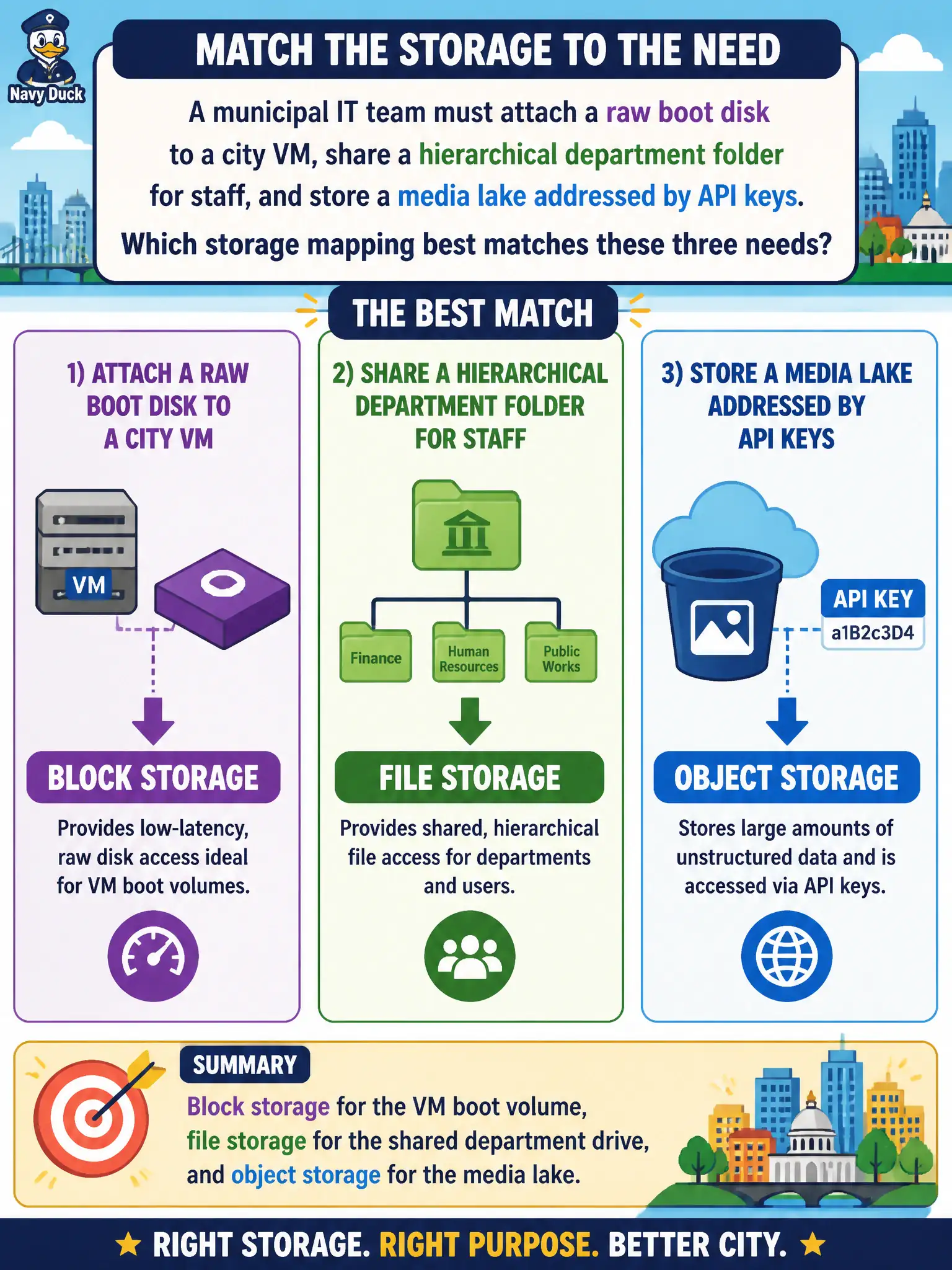
A municipal IT team must attach a raw boot disk to a city VM, share a hierarchical department folder for staff, and store a media lake addressed by API keys. Which storage mapping best matches these three needs?
Select an answer to reveal the explanation.
Short Explanation
Think of storage like tools in a workshop: a boot disk wants a raw block wedge bolted to the VM, a shared folder wants a familiar tree of files, and a media lake wants objects you grab by key. Match the access pattern to the storage type and life gets a lot quieter. Mixing them up usually means pain at boot, share, or API time.
Full Explanation
Cloud storage types map to different access patterns: block storage presents raw volumes ideal for virtual machine boot disks and databases; file storage presents hierarchical shares for departmental collaboration; object storage addresses unstructured objects by key through APIs for media lakes and backups. A municipal team that needs a raw boot disk, a hierarchical department folder, and an API-addressed media lake therefore combines block, file, and object respectively. Using file storage as a boot volume, block as the department share, and a relational database for the media lake mismatches each workload—boot images need block devices, department folders need file semantics, and large unstructured media lakes favor object APIs rather than relational tables. Object for boot, block for shares, and file for the media lake similarly scrambles the mappings. Archive tape for boot, object for interactive department shares, and block for a media lake likewise fails mobility, collaboration, and API access expectations. Exam caveat: Cloud+ expects you to pair storage class with interface semantics (block/file/object), not with a single “cheapest” medium for every city need. Operational check: attach the VM boot volume as managed block storage with snapshots, present the department share via a managed file service with identity-aware permissions, place the media lake in object storage with lifecycle and encryption, and document which applications use which interface.